Strategy Vault: Turn Semi-Bluff Raise in Limit Hold'em with Jonathan Tamayo

Digging deep into the PokerNews strategy archives can lead to a buried treasure, so we'll be unearthing a few gems for your viewing pleasure. In this edition of the Strategy Vault series, we're resurfacing a piece from Jonathan Tamayo.
First published in December 2009, this piece is originally from our "Elite Strategy" series, which featured the wisdom of some of poker’s top players providing viewers with a look at what goes on inside the heads of the game’s elite when they are looking to build their stacks. In this edition, Tamayo discusses a tactic that can be used in limit hold'em: the semi-bluff raise on the turn.
The Player: Jonathan Tamayo
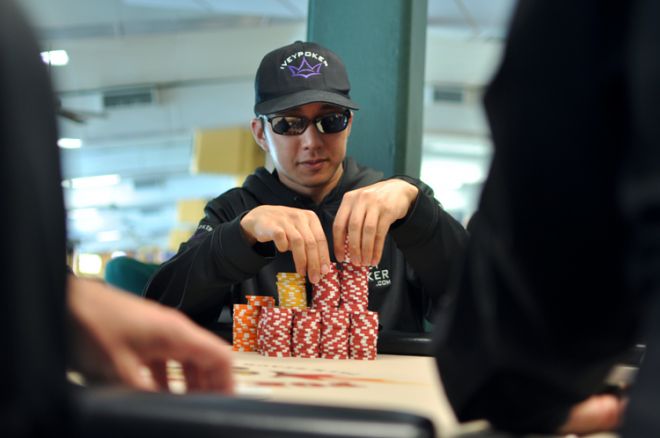
At 27, Tamayo is one of the game’s top young players. Having collected over $1 million in live tournament earnings, he is one of the more respected young players of the game.
He first made a name for himself when he final tabled the $1,500 Mixed Hold'em event at the 2008 World Series of Poker, eventually finishing in second place to Frank Gary for $140,093. That year, Tamayo cashed four times at the 2008 WSOP, and the following year he netted the largest score of his career when he placed 21st in the WSOP Main Event for $352,832. Since that deep run in the most prestigious poker event in the world, Tamayo has racked up the results, including another WSOP final table in the 2011 $1,500 H.O.R.S.E.
Most recently, Tamayo emerged victorious in the WSOP Circuit Palm Beach Kennel Club Main Event for $206,020. He defeated Clint Tolbert heads up for the largest outright win of his career and pushed his live lifetime tournament earnings into seven-figures.
The Game: Limit Hold'em
The Turn Semi-Bluff Raise
The "turn semi-bluff raise" is one of the most underused moves in limit hold’em despite being a very profitable play. As a rule of thumb, I'd recommend using this play if you are heads up, in position and you have at least ten outs going to the river.
Frequently, after you raise preflop and have the big blind defend, you will encounter a situation in which the blind will check-raise after you make a standard continuation bet on the flop. More often than not, many players call with draws and mediocre hands so they can see one more street. Most of the time after the turn, your opponent will bet at the pot to try to get you to fold, continuing with their aggression stemming from the flop check-raise. Often in this situation, players automatically call to see the river unless their hand has improved, in which case, they will raise to try to get value.
Instead of going with the more straightforward play, some of the better limit hold'em players in the world take the opportunity on the turn to raise a drawing hand to keep their opponents guessing. Unleashing the semibluff strategy on the turn in several hands during play makes it difficult for opponents to put you on any one particular hand, and it is especially effective against players of lesser skill.
If you are playing straightforward against better players, they tend to figure out what you are doing and will fold their second-best hand once they pick up on your tendencies. By using the turn semibluff occasionally, you throw off your opponents while inducing weaker players to pay you off when you do improve or when you already have a huge made hand.
Here is an example of how this play could be used:
Suppose you are in a six-handed $30/$60 limit hold’em game, and you are dealt the A♣K♣ in the cutoff seat. You raise, and the big blind defends with a call. The flop comes down J♣6♠8♦, and the blind checks to you. You bet and get raised by your opponent. You call to see that the turn is the Q♣ giving you two over cards and the royal flush draw, and your opponent bets. This is a great time to raise because, in your opponent’s mind, you could easily have a queen, over pair or a set already.
This tactic also makes it very difficult for better players to operate with more marginal hands at this point if they now know you have the capability to raise the turn with both made hands and also drawing hands. If the opponent is holding a hand like Jx9x suited, he or she faces a tough decision at this point on the turn and frequently calls down to the river, which costs two or more bets most of the time, or the person folds and possibly gives up the best hand. If your opponent is semi-bluffing with a draw as well, you have the best hand and will often get a free showdown on the river.
What makes this play profitable is that if you are called, any 10 is good, along with most of your flush cards. Frequently, hitting an ace or a king will be good as well.
Suppose your opponent has the 8♠7♦ for middle pair. You now have 18 outs against that player, which gives you about a 41% chance of winning the hand if he or she calls — you can check these odds and play with some other hand calculations using the PokerNews Odds Calculator. You may also get another chance to bet if you do hit one of your outs and the river is called as well. Thanks to the amount of money already being in the pot, your opponent does not have to fold the turn often for you to show a profit.
If your heads-up opponent doesn't fall for this trick and calls you down, showing these hands to others at the table will more than likely pay dividends for you when you actually do raise the turn with a big made hand, so keeping this play in your arsenal can provide great benefits.
This article was originally published on Dec. 24, 2009.
To stay on top of the poker world, follow us on Twitter and like us on Facebook.