How to Play Texas Holdem Poker: Hold em Rules & Hands

If you want to learn how to play Texas hold'em games, then you need to start from the basic rules and hands. That's exactly what you'll find on this beginner's guide to the game.
Texas holdem is a simple poker game, but it can be daunting to get to grips with.
But don't let that put you off. By the time you are down with this beginner's guide to Texas hold'em poker, you will know:
- What is Texas hold'em poker
- Texas hold'em rules
- Texas hold'em hands
- How to play a Texas hold'em poker game online for free or real money
Here we go over the poker rules for Texas Hold'em.
What Is Texas Hold'em Poker?
Texas Hold'em is the most popular of all poker variations.
All of the marquee tournaments around the world (including those played at the World Series of Poker, the World Poker Tour, the and the European Poker Tour) feature the no-limit variation of this game.
Texas hold'em is so popular that is the only poker game many players will ever learn.
It takes a moment to learn, but a lifetime to master.
Discovering how to play Texas hold'em poker is not difficult and the simplicity of its rules, gameplay, and hand-ranking all contribute to the popularity of the game.
However, don't let the simplicity of the game mislead you.
The number of possible situations and combinations is so vast that Texas hold'em can be an extremely complex game when you play at the highest levels.
If you are approaching the game of Texas hold'em for the first time, starting from the basic rules of the game is key. Not only these are the easiest ones to learn, but they are also essential to understand the gameplay and, later on, the game's basic strategy.
Texas Hold'em Poker Rules
So how do you play Texas hold'em?
The goal of a Texas hold'em game is to use your hole cards in combination with the community cards to make the best possible five-card poker hand.
Hold'em is not unlike other poker games like five-card draw.
However, the way players construct their hands in Texas hold'em is a little different than in draw poker.
It's always possible a player can "bluff" and get others to fold better hands.
- In a game of Texas hold'em, each player is dealt two cards face down (the 'hole cards')
- Over several betting rounds, five more cards are (eventually) dealt face up in the middle of the table
- These face-up cards are called the 'community cards.' Each player is free to use the community cards in combination with their hole cards to build a five-card poker hand.
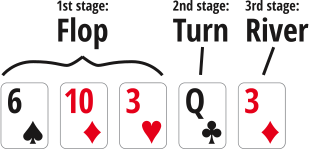
While we will see each betting round and different phase that forms a full hand of a Texas hold'em game, you should know that the five community cards are dealt in three stages:
- The Flop: the first three community cards.
- The Turn: the fourth community card.
- The River:The fifth and final community card.
Your mission is to construct your five-card poker hands using the best available five cards out of the seven total cards (your two hole cards and the five community cards).
You can do that by using both your hole cards in combination with three community cards, one hole card in combination with four community cards, or no hole cards.
If the cards on the table lead to a better combination, you can also play all five community cards and forget about yours.
In a game of Texas hold'em you can do whatever works to make the best five-card hand.
If the betting causes all but one player to fold, the lone remaining player wins the pot without having to show any cards.
For that reason, players don't always have to hold the best hand to win the pot. It's always possible a player can 'bluff' and get others to fold better hands.
READ ALSO: Common Poker Tells: How to Read People in Poker
If two or more players make it all of the way to the showdown after the last community card is dealt and all betting is complete, the only way to win the pot is to have the highest-ranking five-card poker hand.
Now that you know the basics of Texas hold'em and you start to begin gaining an understanding of how the game works, it's time to get into some specifics.
These include how to deal Texas hold'em and how the betting works.
Basic Rules Key Takeaways:
- A game of Texas hold'em feature several betting rounds
- Players get two private and up to five community cards
- Unless all players abandon the game before the showdown, you need the highest poker hand to win
Understand the Texas Holdem Poker Rules with the 1-page handout and join the other players and get involved in the game for your chance to win.
Before you start learning the rules, here's everything you need to host your own poker game!
| Poker Product | Necessity | Our Choice On Amazon |
|---|---|---|
| Poker Chip Set | Must Have A♦ | Buy Now |
| 2 x Proper Playing Cards | Must Have A♠ | Buy Now |
| Poker Table Felt | Must Have A♣ | Buy Now |
| Pro Poker Table | Nice to have K♥ | Buy Now |
| Funny Sunglasses | Just for Fun Q♦ | Buy Now |
| Poker Whiskey Glasses | Just for Fun Q♠ | Buy Now |
| I don't fold T-shirt | Just for Fun Q♣ | Buy Now |
| Poker Rap Star Chain | For Ballers J♥ | Buy Now |
How to Play Texas Holdem Poker
Let's have a look at all the different key aspects of a Texas hold'em game, including the different positions at the table and the betting rounds featured in the game.
The Button
The play moves clockwise around the table, starting with action to the left of the dealer button.
The 'button' is a round disc that sits in front of a player and is rotated one seat to the left every hand.
When playing in casinos and poker rooms, the player with the dealer button doesn't deal the cards (the poker room hires someone to do that).
When you play poker home games with friends the player with the button usually deals the hands.
The button determines which player at the table is the acting dealer.
The first two players sitting to the immediate left of the button are required to post a 'small blind' and a 'big blind' to initiate the betting.
From there, the action occurs on multiple streets:
- Preflop
- Flop
- Turn
- River
Each one of these moments (or 'streets' in the game's lingo) is explained further below.
The button determines which player at the table is the acting dealer.
In Texas hold'em, the player on button, or last active player closest to the button receives the last action on all post-flop streets of play.
While the dealer button dictates which players have to post the small and big blinds, it also determines where the dealing of the cards begins.
The player to the immediate left of the dealer button in the small blind receives the first card and then the dealer pitches cards around the table in a clockwise motion from player to player until each has received two starting cards.
READ ALSO: Poker Positions Explained: the Importance of Position in Poker
The Blinds
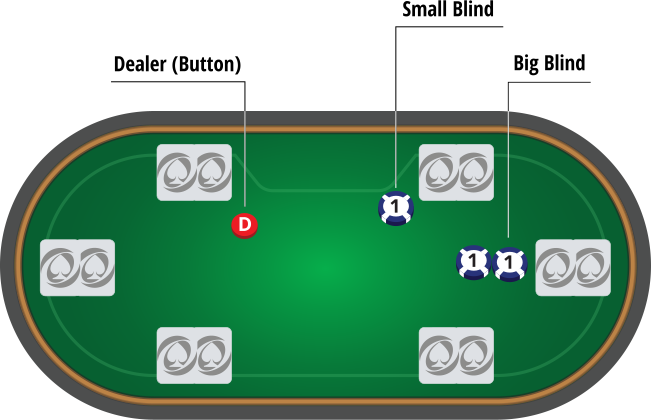
Before every new hand begins, two players at the table are obligated to post small and big blinds.
The blinds are forced bets that begin the wagering.
Without these blinds, the game would be very boring because no one would be required to put any money into the pot and players could just wait around until they are dealt pocket aces (AA) and only play then.
The blinds ensure there will be some level of 'action' on every hand.
In tournaments, the blinds are raised at regular intervals. In cash games, the blinds always stay the same.
In tournaments, the blinds are raised at regular intervals.
- As the number of players keeps decreasing and the stacks of the remaining players keep getting bigger, it is a necessity that the blinds keep increasing throughout a tournament.
- In cash games, the blinds always stay the same.
The player directly to the left of the button posts the small blind, and the player to his or her direct left posts the big blind.
The small blind is generally half the amount of the big blind, although this stipulation varies from room to room and can also be dependent on the game being played.
In a "$1/$2" Texas hold'em game, the small blind is $1 and the big blind is $2.
First Betting Round: Preflop
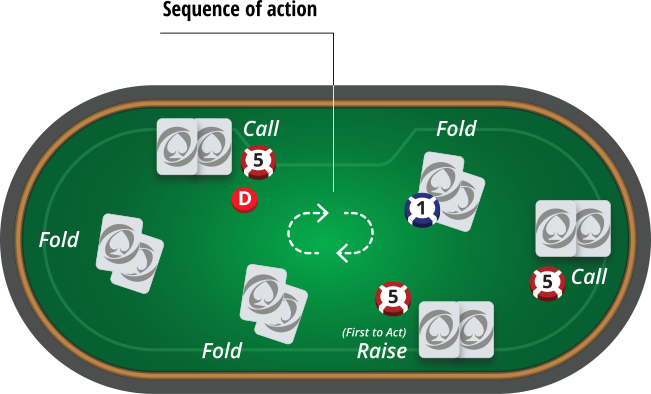
The first round of betting takes place right after each player has been dealt two hole cards.
The first player to act is the player to the left of the big blind.
This position referred to as 'under the gun' because the player has to act first. The first player has three options:
- Call: match the amount of the big blind
- Raise: increase the bet within the specific limits of the game
- Fold: throw the hand away
If the player chooses to fold, he or she is out of the game and no longer eligible to win the current hand.
Players can bet anywhere from the amount of the big blind (the minimum bet allowed) up to the total amount in the current pot.
The amount a player can raise to depends on the game that is being played.
In a game of no-limit Texas hold'em, the minimum opening raise must be at least twice the big blind, and the maximum raise can be all of the chips a player has in his or her stack (an "all-in" bet).
There are other betting variations in hold'em poker.
In fixed-limit hold'em (or just "limit hold'em), a raise is always exactly twice the big blind.
In pot-limit hold'em (played much less often than the other variations), players can bet anywhere from the amount of the big blind (the minimum bet allowed) up to the total amount in the current pot.
After the first player ('under the gun') acts, the play proceeds in a clockwise fashion around the table with each player also having the same three options — to call, to raise, or fold.
Once the last bet is called and the action is 'closed,' the preflop round is over and play moves on to the "flop."
Second Betting Round: The Flop
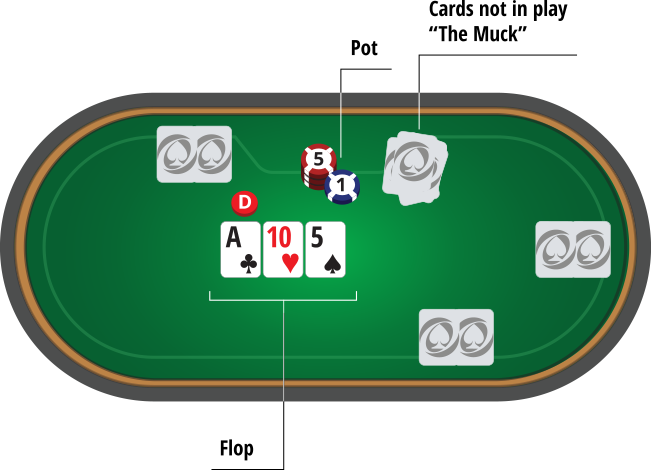
After the first preflop betting round has been completed, the first three community cards are dealt and a second betting round follows involving only the players who have not folded already.
A check simply means to pass the action to the next player in the hand.
In this betting round (and subsequent ones), the action starts with the first active player to the left of the button.
Along with the options to bet, call, fold, or raise, a player now has the option to 'check' if no betting action has occurred beforehand.
A check simply means to pass the action to the next player in the hand.
Again betting continues until the last bet or raise has been called (which closes the action).
It also can happen that every player simply chooses not to be and checks around the table, which also ends the betting round.
Third Betting Round: The Turn
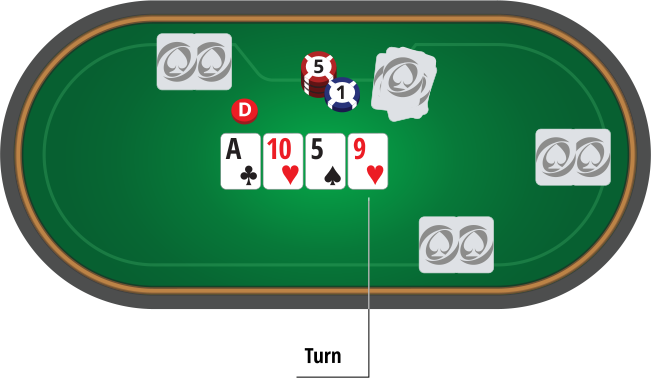
Call – match the amount of the big blind
The fourth community card, called the turn, is dealt face-up following all betting action on the flop.
Once this has been completed, another round of betting occurs, similar to that on the previous street of play.
Again players have the option to check, bet, call, fold, or raise.
Final Betting Round: The River
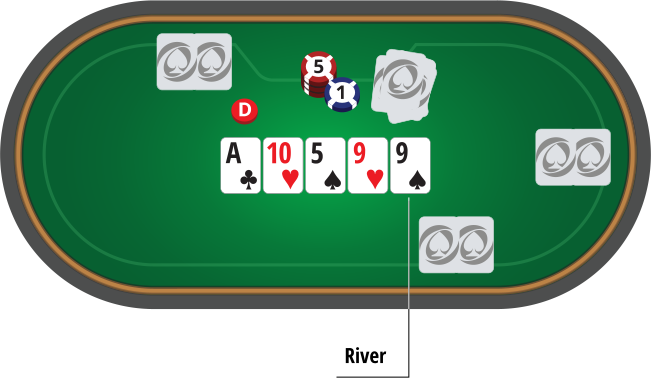
Fold – throw the hand away
The fifth community card, called the river, is dealt face-up following all betting action on the turn.
Once this has been completed, another round of betting occurs, similar to what took play on the previous street of play.
Once more the remaining players have the option to options to check, bet, call, fold, or raise.
After all betting action has been completed, the remaining players in the hand with hole cards now expose their holdings to determine a winner. This is called the showdown.
The Showdown
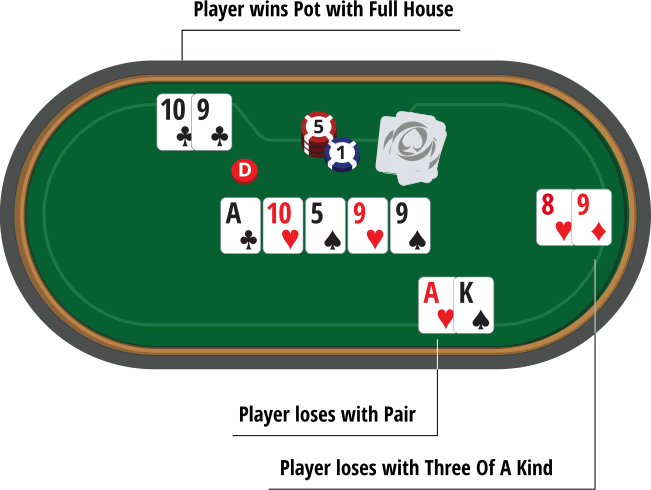
Players construct their hands by choosing the five best cards from the seven available
The remaining players show their hole cards, and with the assistance of the dealer, a winning hand is determined.
The player with the best combination of five cards wins the pot according to the official poker hand rankings.
The Hand Rankings in Texas Hold'em Poker
These hand rankings aren't specifically part of Texas hold'em rules, but apply to many different poker games.
- Royal Flush — five cards of the same suit, ranked ace through ten; e.g., A♥K♥Q♥J♥10♥
- Straight Flush — five cards of the same suit and consecutively ranked; e.g., 9♣8♣7♣6♣5♣
- Four of a Kind — four cards of the same rank; e.g., Q♣Q♥Q♦Q♠4♦
- Full House — three cards of the same rank and two more cards of the same rank; e.g., J♣J♥J♠8♦8♥
- Flush — any five cards of the same suit; e.g., A♠J♠8♠5♠2♠
- Straight — any five cards consecutively ranked; e.g., Q♣J♦10♥9♠8♦
- Three of a Kind — three cards of the same rank; e.g., 8♣8♠8♦K♣4♥
- Two Pair — two cards of the same rank and two more cards of the same rank; e.g., A♠A♣J♦J♣7♠
- One Pair — two cards of the same rank; e.g., 10♥10♣9♥4♦2♦
- High Card — five unmatched cards; e.g., A♣J♦10♠5♣2♥ would be called "ace-high"
An intro to Texas Holdem, strategy, rules and styles of play, all combined for you to understand Texas Holdem with this ultimate guide.
Players construct their hands by choosing the five best cards from the seven available (their two hole cards and the five community cards).
If the board is showing 9♣5♠K♦3♠A♥, a player with the two hole cards A♦9♠ would have two pair (aces and nines) and would lose to a player who has 9♦9♥ for three of a kind (three nines).
Learning hold'em poker begins with understanding how hands are dealt and the order of play as described above.
Of course, learning Texas hold'em rules is just the beginning, as the next step is to learn strategy which involves understanding what constitutes good starting hand selection, the odds and probabilities associated with the game, the significance of position and getting to act last during those post-flop betting rounds, and many other aspects of the game. This is where the PokerNews Poker Odds Calculator can help you.
Want to Find Out the Odds?
By using the PokerNews Texas Hold’em Poker Odds Calculator you can calculate your chances on a given hand, in any situation!
Try it now
How to Play Texas Hold'em Poker Games Online For Free or Real Money
Now that you know how Texas Hold'em works, it's time to put the theory into practice and play your first games.
The best way to start playing Texas Hold'em is to start from these free online poker games and then move up to the real money action only when you feel comfortable enough to do so.
All the 'must-have poker rooms' below offer free games to practice online.
If you are completely new to the game, you should go for play money options, first. These risk-free games with fake money are an excellent way to familiarise with the different moments of play and the betting rounds.
The play money games are a great way to learn more about the hand rankings and begin to read the board fast enough to take all the right decisions at the right time.
After that, you should more to the poker freerolls. These are free poker tournaments with actual prizes on tap that range from free money to free entries into more expensive real money poker games.
How to Play Texas Hold'em Poker FAQs
What is Texas Hold'em Poker?
Texas Hold'em is the most popular poker game variant, where players are dealt two private cards (hole cards), and five community cards are placed face-up in the center of the table. The aim of the game is to make the best possible five-card hand, according to the poker hand rankings, using a combination of your hole cards and the community cards.
How do I win at Texas Hold'em?
To win a hand of Texas Hold'em, you need to have the best five-card poker hand. The possible hand rankings, from highest to lowest, are Royal Flush, Straight Flush, Four of a Kind, Full House, Flush, Straight, Three of a Kind, Two Pair, One Pair and High Card.
What happens if there's a tie in Texas Hold'em?
If multiple players have the same hand ranking, the pot is split equally among the tying players.
What is the dealer button, small blind, and big blind?
In the game of Texas Hold'em, players take turns being the dealer. A dealer button is used and rotates clockwise after each hand. The player to the left of the dealer is the small blind, and the player two seats to the left is the big blind. The 'Blinds' are forced bets to start the action and build the pot.
How are cards dealt in Texas Hold'em?
The Dealer in Texas Hold'em will give each player two private hole cards, and then five community cards are placed face-up in the center of the table. The community cards are dealt in stages: the flop (three cards), the turn (one card), and the river (one card).
What is the order of play in Texas Hold'em?
The order of play rotates clockwise. It starts with the player to the left of the dealer and moves around the table. The player to the left of the dealer posts the small blind, and the next player posts the big blind to start the action.
How many players can play Texas Hold'em?
Texas Hold'em can be played with as few as two players or as many as ten (in the online casino world some variations of Texas Holdem can be played solo against the dealer). However, it's commonly played with 2 to 9 players at a table.
What is a betting round in Texas Hold'em poker?
Texas Hold'em has several betting rounds. After the hole cards are dealt, there is a round of betting. Then, the flop is revealed, followed by another betting round. The turn and river cards are revealed with a betting round after each. Players can check, bet, fold, call, or raise during these rounds.
What are the hand rankings in Texas Hold'em poker?
The strength of your hand is determined by its rank among all possible hands and the community cards. It's essential to understand hand rankings and how they apply to your specific hand in the context of the community cards. The possible hand rankings, from highest to lowest, are Royal Flush, Straight Flush, Four of a Kind, Full House, Flush, Straight, Three of a Kind, Two Pair, One Pair and High Card.
Can players use all, some, or none of their hole cards to form their hand?
Players can use any combination of their two hole cards and the five community cards to make the best hand. It's possible to use both hole cards, only one, or none at all, depending on what gives the best hand.
When should I fold my hand?
There are no hard and fast rules for when you should fold your hand, as it can depend on a number of factors, such as table position, the strength or style of your opponent, and which round of betting you are in. However, knowing when to fold is crucial for preserving your chips and making profitable decisions, so we recommend heading over to the poker strategy section right here on PokerNews to read more.
How do I calculate pot odds and implied odds in Texas Hold'em poker?
Pot odds involves comparing the current size of the pot to the cost of your next bet. Implied odds consider the potential future bets in addition to the current pot size. Understanding these odds can help you make informed decisions.
Is bluffing important in Texas Hold'em?
Bluffing is a strategic element of the game. When used wisely, it can help you win pots with weaker hands. However, it's crucial to be selective and consider your opponents and the table dynamics.
Can you show your cards to other players during the game?
In most poker games, including Texas Hold'em, you can choose to show your hand at the end of the hand if you wish. However, you are not required to reveal your hand if you win a pot.
What are the basic strategies for Texas Hold'em?
Basic strategies include starting hand selection, position awareness, and understanding betting and odds. Learning when to be aggressive, when to fold, and how to read your opponents are also essential skills.
What are the different variations of Texas Hold'em?
There are variations of Texas Hold'em, including No-Limit Texas Hold'em, Limit Texas Hold'em, and Pot-Limit Texas Hold'em. Each has slightly different rules regarding betting.
Where can I play Texas Hold'em poker online?
There are many online poker sites or mobile poker apps where you can play Texas Hold'em. Some popular options include PokerStars, 888poker, partypoker, and many others.
Can I play Texas Hold'em poker online for real money or just for fun?
Many online poker sites offer both real money and play money (for fun) games. You can choose the type of games that suit your preferences and skill level. However, whether you can play for real money will depend on the gambling laws in your location.
Are there different types of online poker games available?
Yes, online poker platforms often offer a variety of poker games beyond Texas Hold'em, including Omaha, Seven Card Stud, and more.
Is online poker fair, or can it be rigged?
Regulated and reputable online poker sites use Random Number Generators (RNGs) to ensure fair and random card distribution. These sites are regularly audited to maintain fairness and integrity.
Are there age restrictions for playing online poker?
Yes, you typically need to be at least 18 years old (or the legal gambling age in your jurisdiction) to play poker online for real money. Please check your eligibility to play before signing up snd placing a bet.
Can I play online poker in the United States?
Online poker regulations vary by state in the United States. Some states have legalized and regulated online poker, while others have not. It's important to check the specific laws in your state to see if online poker is legal and available. If real money gaming is not available, then you might like to look at one of these sites that offer free online poker games. We offer a handy guide to the online poker regulations in the USA.