
 button in Safari
Martingale Strategy for Roulette: How It Works & Risks


Ever wondered if there's a 'guaranteed' way to beat the roulette wheel?
One method that often comes up is the Martingale strategy for roulette, a classic strategy that's been used by casino players all over the world.
The attraction of the Martingale Strategy is that it offers the promise of recovering all your losses with one win. But does it actually work?
In this article, we’ll break down how the Martingale roulette system works, the pros and cons, and how it can be applied in a real roulette game.
What Is the Martingale Strategy?
The Martingale strategy dates back to 18th-century France and was originally applied to coin-toss games. Over time, it evolved into a roulette betting strategy, mainly used on even-money bets like:
- Red or Black
- Odd or Even
- 1–18 or 19–36
The core idea is deceptively simple:
Double your bet after every loss.
Why? It's because the 'theory' is, that over time, you are bound to win. When you do, your win covers all your previous losses plus a profit equal to your original bet.
It's worth pausing here for a second to state that although this sounds plausible due to probability, there is no guarantee of a win coming after a series of losses, even if it seems likely.
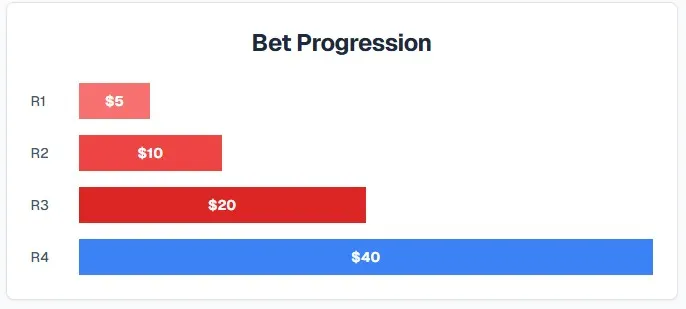
This is the theory, when applied to hypothetical bets:
- Bet 1: $5 – You lose
- Bet 2: $10 – You lose
- Bet 3: $20 – You lose
- Bet 4: $40 – You win
In this scenario, you would be up $5 (or £5, €5 etc) overall, taking into account your loses and eventual win.

How to Use the Martingale System in Roulette
Using the Martingale system is fairly simple, but it still requires discipline and bankroll management.
Here's a step-by-step guide to how it works in practice:
- Choose an even-money bet on the roulette table (for example, betting on red).
- Place your base bet (for practical purposes, let's assume a bet of $5/€5).
- If you win, keep your profit and stick with your base bet.
- If you lose, double your previous bet.
- Repeat until you win, then reset to your base bet.

Set a maximum budget for your session, and know the table limits before you play. Never chase losses beyond your comfort zone, and expect losing streaks that could stretch to 6 consecutive losses or more.
Does the Martingale Strategy Work?
Let’s use our original scenario to simulate how this plays out in a typical roulette session. We'll start with our opening bet of $5/€5.
This table shows the sequence of bets, the outcomes, and your total loss and profit
| Bet Number | Bet Amount | Outcome | Total Loss | Net Profit |
|---|---|---|---|---|
| 1 | $5 | Lose | $5 | -$5 |
| 2 | $10 | Lose | $15 | -$15 |
| 3 | $20 | Lose | $35 | -$35 |
| 4 | $40 | Win | - | +$5 |

So, in simple terms: yes, the system can work, provided you win before you run out of bankroll or hit the table limit.
The problem with this strategy presents itself when you start to see multiple losses in a row. Using the same opening bet of $5/€5, a sequence of 8 losses in a row would mean a total amount of $1,275 wagered with no return! Ok, that is an extreme example, but it illustrates the point about running out of bankroll while you wait for a win.
If you can’t afford the next bet or the table limit stops you, you’re stuck with a massive loss.
Pros and Cons of the Martingale System
Let’s break it down:
Pros:
✅ Easy to understand and apply.
✅ Recover losses with one win.
✅ Short-term success feels achievable.
Cons:
❌ Your bankroll can run out faster.
❌ Table limits stop progression.
❌ Doesn’t change house edge.
❌ Doesn’t work in the long run.
It's also correct to consider responsible gambling guidelines when applying a strategy like Martingale. This means setting limits before you play, and making sure you understand that the Martingale Strategy is not a guaranteed system for roulette.
If you're unsure, consider using demo mode when playing roulette at an online casino, and starting off with low-stakes games. You can also play free roulette to test out your strategy.



 Never chase losses
Always set limits
Take regular breaks
Never chase losses
Always set limits
Take regular breaks
Alternatives to the Martingale Strategy
If Martingale feels a bit too high-stakes, there are some alternative roulette strategies to explore. Here's how they compare to Martingale:
| Strategy | Risk Level | Bet Progression | Suitable For | Goal |
|---|---|---|---|---|
| Martingale | High | Double bets after loss | High-risk takers | Recover loss + base bet |
| D’Alembert | Medium | Increase by 1 after loss, decrease by 1 after win | Balanced risk takers | Slow recovery |
| Fibonacci | Medium-High | Follows the Fibonacci sequence (1,1,2,3,5…) | Math lovers, cautious bettors | Gradual loss recovery |
| Labouchere | Medium | Add bet sizes from a pre-set sequence | Strategic, experienced players | Customized profit target |
Each strategy has its quirks, strengths, and weaknesses. The best roulette strategy? It's the one that fits your risk appetite, session goals, and temperament.
Is there an Opposite Martingale Strategy?
Yes, there is an 'opposite' strategy, known as the 'Reverse Martingale Strategy' or Paroli.
The Paroli system flips the traditional Martingale Strategy, meaning you double your bet after wins instead of losses. This version seeks to ride winning streaks rather than recover from losing ones. It’s less risky and often favored by more conservative players.
Martingale Strategy for Roulette FAQs
Is the Martingale strategy legal in roulette?
Yes, the Martingale strategy is completely legal. Casinos allow all forms of betting progression, as long as you play within the house rules and table limits.
Can you win consistently using the Martingale roulette system?
In the short term, yes, you might string together small wins. But over the long term, odds and table limits catch up. It's not a sustainable method for consistent profit, and like all strategies, does not guarantee success.
What’s the biggest risk of using the Martingale system?
The biggest risk is running into a long losing streak, where you either hit the table limit or run out of bankroll. This can lead to significant losses very quickly.
Are there safer alternatives to the Martingale strategy?
Yes. Systems like the D’Alembert, Fibonacci, and Paroli strategies involve slower progression and lower risk, making them safer for longer sessions.
Does the Martingale strategy work in online roulette?
Technically, it works the same way as in land-based casinos. But since online games often have lower table limits, you may hit those caps faster than in a physical casino.
Should beginners use the Martingale system?
Beginners can try it to understand betting progressions, but they should start with very small bets and always gamble responsibly.
Does Martingale increase your chances of winning at roulette?
No, it doesn’t change the house edge or increase your actual odds. It’s a money management system, not a probability booster.