What Are Prediction Markets? Beginner’s Guide to Trading Real-World Events

If you’re a poker player, you probably already understand odds, strategy, and making +EV decisions. Well, prediction markets use the same skills.
But instead of betting on a hand, you’re trading on real-world events like elections, economic trends, pop culture or sports outcomes. And in the past year, interest in prediction markets has exploded.
With regulatory shifts, high-profile forecasts going viral, and, perhaps most significantly, the entry of major sports betting operators into the space, what was once a niche hobby has started to go mainstream, with traditional platforms like Kalshi and Polymarket now competing with sportsbook-backed products like the recently-launched FanDuel Predicts.
In this guide, we'll explain....
- What Prediction Markets are
- How Prediction Markets work
- Which are the Best Prediction Markets
- The legal situation with Prediction Markets
And much more besides....
What is a Prediction Market?
Let's start with the basics: What is a Prediction Market? Quite simply, think of a prediction market like a stock exchange, but instead of trading company shares, participants can buy and sell contracts based on the likelihood of real-world events happening.
The price of each contract reflects the market's collective belief in the probability of an outcome. As new information emerges, prices fluctuate in response to changes in supply and demand, and when the event resolves, the winning contracts pay out, while the losing contracts become worthless.
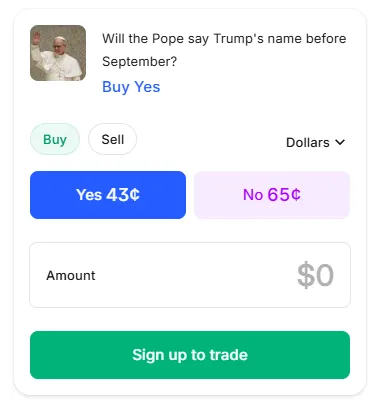
For example, if a market exists for “Will Bitcoin hit $150K by the end of 2026?”, traders can buy shares that reflect their belief in the outcome. If the market price for "Yes" is 70 cents, that means the crowd believes there's a 70% chance of it happening.
If Bitcoin reaches $150K, those who bought "Yes" shares get $1 per share, while "No" shares expire as worthless.
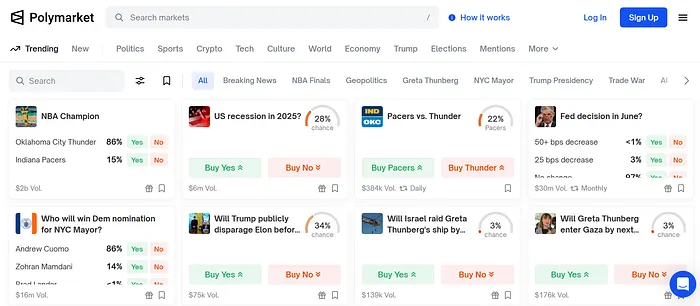
An example of a Prediction Market
How Do Prediction Markets Work?
Now that you understand what a Prediction Market is, let's look at how they work.
Once you have chosen your preferred platform, such as Kalshi, Polymarket, or FanDuel Predicts, using prediction markets is actually quite simple.
Here, we’ll guide you through each step:
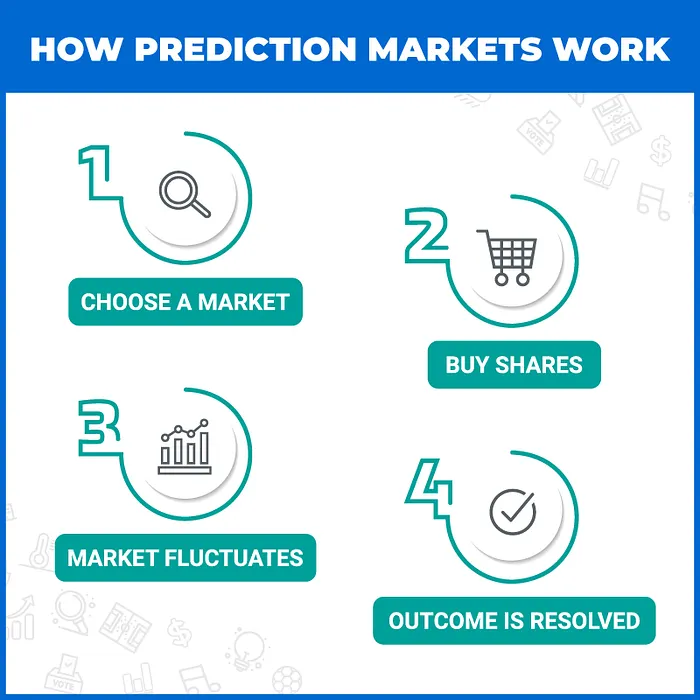
Step 1: Choosing a Market

Prediction markets cover a wide range of topics, including, but not limited to, political elections, economic trends, sports outcomes, and cryptocurrency movements. Other categories include Pop Culture and now even ‘Elon Tweets’.
| Market Type | Explanation | Example |
|---|---|---|
| Political elections | Markets that speculate on the outcome of political events or votes. | e.g. Will Donald Trump win the 2024 U.S. Presidential election? |
| Economic trends | Markets that speculate on the outcome of political events or votes. | e.g. Will the Fed raise interest rates next quarter? |
| Sports outcomes | Markets predicting the results of sports games or tournaments. | e.g. Will the Lakers win the NBA Championship? |
| Cryptocurrency movements | Markets forecasting price changes or milestones in digital assets. | e.g. Will Ethereum reach $5,000 by year-end? |
Step 2: Buying and Selling Shares
Once a prediction market is live, traders can buy and sell shares in the outcome they believe is most likely. Each share is priced between $0 and $1, reflecting the probability of that event occurring.
If new information emerges, prices will fluctuate in response to supply and demand. Traders can try to buy low and sell high before the event concludes, or hold their shares until the final result determines payouts.
Step 3: Settlement and Payouts
Once the event concludes, the prediction market is settled, and payouts are distributed. If the predicted outcome occurs, winning shares pay out at $1 each, while losing shares become worthless.
The platform typically takes a small commission or trading fee from either the trade itself or the winning side, which is how it generates revenue and sustains the market infrastructure.
The Best Prediction Market Sites
Prediction markets have grown in popularity and there a number of different platforms out there for customers to choose from, each with their own pros and cons.
When choosing the best prediction market sites, consider factors such as fees, market variety, liquidity, and overall user experience. Some platforms specialise in crypto-based markets, while others focus on politics or sports, and each offers its own approach to trading and forecasting.
Below are some of the best prediction market platforms, with an explanation of what makes them unique.
Kalshi
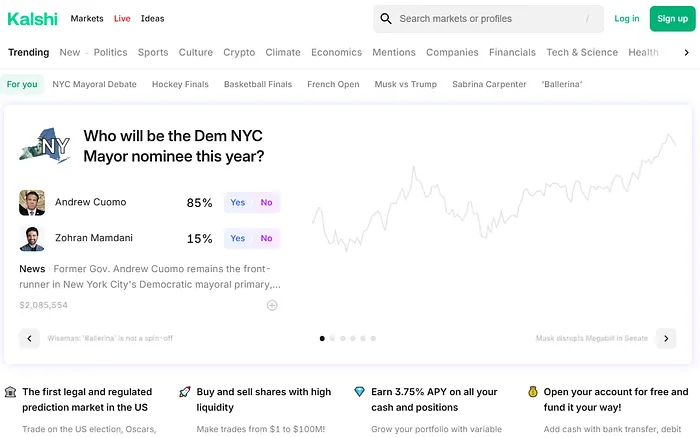
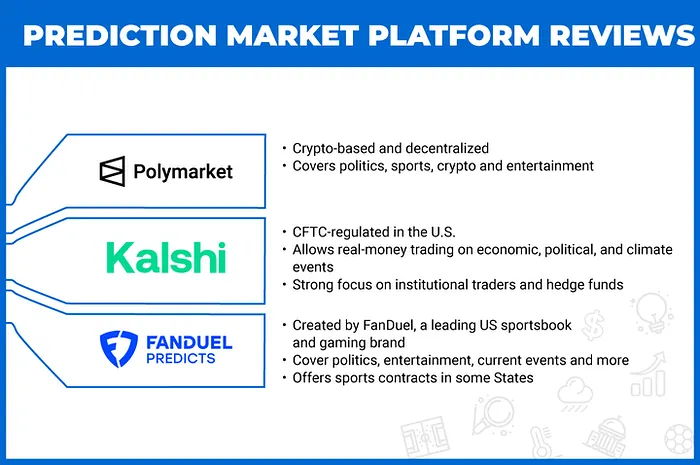
Kalshi is a Commodity Futures Trading Commission (CFTC) regulated prediction market based in the United States, offering legally compliant, real-money trading on economic, political, and climate-related events. Designed with a strong focus on institutional traders and hedge funds, Kalshi provides a professional-grade platform where users can hedge against real-world risks or speculate on key financial and geopolitical developments.
Key Features
✅ CFTC-regulated in the U.S.
✅ Allows real-money trading on economic, political, sports and climate events.
✅ Strong focus on institutional traders and hedge funds.
Polymarket
Polymarket is a crypto-based, decentralized prediction market that allows users to trade on a variety of topics, including politics, sports, cryptocurrency, and entertainment. It operates on the Polygon blockchain and utilizes the USDC stablecoin for trading, offering a seamless and borderless experience for users seeking to engage in real-money forecasting.
Key Features
✅ Crypto-based and decentralized.
✅ Covers politics, sports, crypto, and entertainment.
✅ Uses USDC stablecoin for trading.
FanDuel Predicts
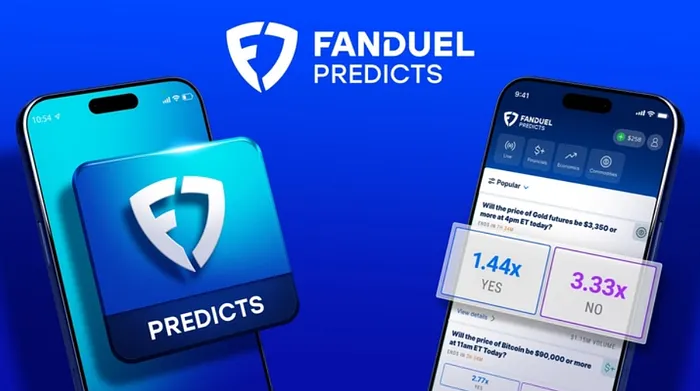
FanDuel Predicts is the recently-launched prediction market platform from one of America’s biggest names in sports betting. Designed to let users trade on the outcome of real-world events, including politics, pop culture, and more, the platform blends FanDuel’s signature user experience with a simplified yes/no trading interface. Its arrival marks a major shift, signalling mainstream interest from established gaming brands in the prediction market space.
Key Features
✅ Created by FanDuel, a leading US sportsbook and gaming brand
✅ Covers politics, entertainment, current events and more
✅ Offer Sports contracts (in some States)
What topics do Prediction Markets cover?
Prediction markets aren’t limited to elections or economics. They span a wide range of real-world topics that attract forecasters, bettors, and data nerds alike. Depending on the platform, you’ll find markets that cover everything from global politics to celebrity news.
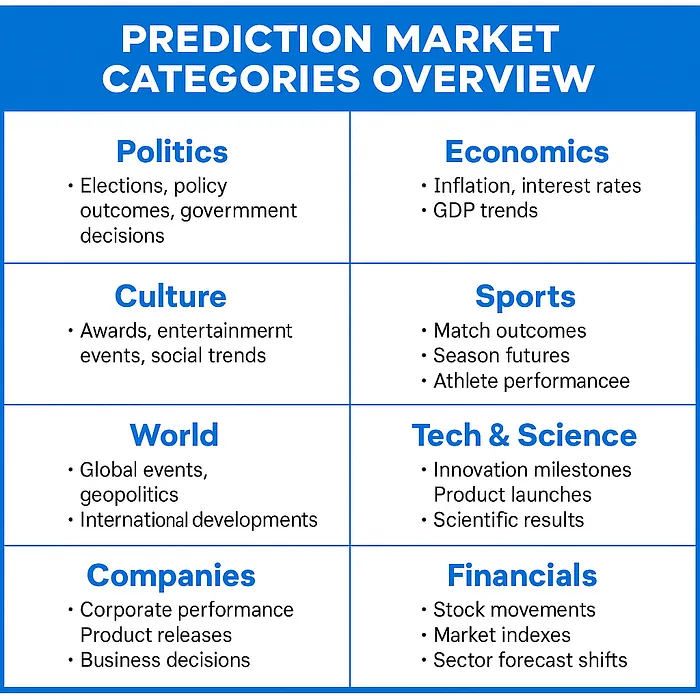
Indeed, prediction markets allow users to take a position on just about anything. Here's a breakdown of the most common categories.
Politics
Political trading is one of the most popular categories, covering U.S. elections, legislative outcomes, congressional balance of power, Supreme Court decisions, and regulatory actions. These markets enable users to forecast how voters, lawmakers, and courts will act in real-time, which is ideal for those closely following news cycles, polls, and political dynamics.
Economics, Companies and Financials
Economics focuses on key macroeconomic indicators like inflation, job growth, interest rates, and GDP releases. Traders can speculate on whether the Fed will raise rates or how inflation numbers will print, which is great for those following central bank decisions and economic data calendars.
Corporate events such as CEO changes, earnings surprises, product launches, or major acquisitions provide a niche for stock watchers and business analysts who follow big tech and Fortune 500 firms closely.
Financials tracks major financial benchmarks, such as S&P 500 movements, bond yields, interest rate hikes, and consumer confidence. These markets are ideal for portfolio managers, retail investors, or anyone who trades off economic sentiment and fiscal trends.
World, Culture and Climate
World markets enable users to trade on geopolitical shifts and outcomes that extend beyond the U.S. bubble, covering things like foreign elections, military actions, diplomacy, and global policy.
Culture markets such as celebrity appearances, award shows, and viral moments are becoming increasingly popular. From Oscar winners to Taylor Swift sightings, these contracts offer fun, fast-moving action that often mirrors social media buzz and entertainment headlines.
Climate markets, including average temperature readings, hurricane counts, and other weather-driven data, appeal to environmental analysts and policy watchers, particularly as climate risk becomes increasingly relevant to finance, insurance, and legislation.
Crypto
Markets centered on crypto adoption, price milestones, and blockchain events, such as whether Bitcoin will hit a specific level or if a new protocol will launch. Ideal for traders already active in DeFi, Web3, or digital assets.
Sports
Covers outcomes across major leagues and tournaments, including the NFL, NBA, tennis, golf, and more.
Sports bettors and fans alike can make data-driven predictions on titles, match results, or athlete performance without using a traditional sportsbook, albeit noting that sports contracts are under some regulatory pressure and are available only in certain locations.
Tech & Science
Includes innovation-focused markets like space missions, AI milestones, scientific discoveries, and product launches.
Mentions
Covers whether a person, brand, or issue will be referenced in high-profile settings, such as debates, State of the Union addresses, earnings calls, or major interviews.
Can You Make Money on Prediction Markets?
Absolutely, it's possible to make money on prediction markets But like poker, it's not just about luck. Some traders attempt to profit from prediction markets by identifying value, managing risk, and sometimes spotting opportunities others miss.
Strategies can include arbitraging price differences, exploiting market inefficiencies, hedging real-world exposure, or tracking high-performing traders, and/or studying news, polling, and historical trends (including traders even conducting their own independent research) in order to estimate probabilities more accurately than the general market.
Ultimately, there are multiple strategies that traders can use to gain an edge.
That said, trader should consider that every trade carries risk. Whilst traders can make a profit, it’s just as possible to lose money if a read is off or the market moves against them.
Arbitrage Opportunities
Arbitrage in prediction markets involves taking advantage of price discrepancies between different platforms. Since markets like Kalsh and Polymarket are created independently, the same event may have different probabilities assigned on each platform.
By buying “Yes” on one platform where the price is lower and “No” on another where the price is higher, traders can secure a profit regardless of the outcome. However, arbitrage opportunities are rare and require quick action, as markets adjust rapidly.
Identifying Market Inefficiencies
Prediction markets are driven by crowdsourced probabilities, but they are not always efficient. Sometimes, public bias, misinformation, or overreactions can create mispriced opportunities.
By analyzing historical trends, expert opinions, and statistical data, you can find undervalued shares that have a higher probability of winning than the market suggests. This is similar to value betting in sports betting, where the goal is to bet against the public when the odds are skewed.
Hedging Positions
Hedging with prediction markets allows traders to balance their risk exposure in other areas. For example, if you own stocks that might decline due to an upcoming economic policy decision, you could place a bet on “Will the Fed raise interest rates?” in a prediction market. If the Fed does raise rates and your stocks drop, your prediction market win can help offset the loss.
This strategy is commonly used by investors, businesses, and policymakers to mitigate financial risk.
Follow Successful Traders
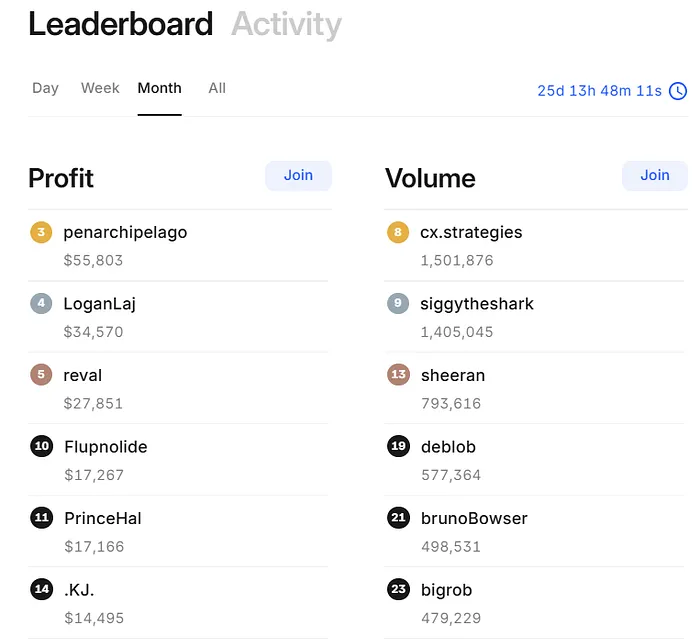
Some traders follow other consistently successful traders. Many platforms provide leaderboards or public trade histories, allowing you to identify users with a strong track record of making accurate predictions.
By analyzing their positions and reasoning, you can gain insights into market trends, adjust your own trades accordingly, and increase your chances of making profitable decisions. However, it's important to do your own research and not rely solely on others, as even top traders can be wrong!
How Are Prediction Market Winnings Taxed?
The taxation of prediction market winnings depends heavily on your country of residence and the platform you use.
In the United States, profits made on regulated platforms like Kalshi are generally treated as capital gains or other income, similar to stock or crypto trading. Traders may be required to report their winnings via a tax return, and platforms may issue 1099 forms if a trader meet certain thresholds.
For users trading on crypto-based platforms like Polymarket, gains may be classified as taxable crypto transactions, and they'll need to track both their initial cost basis and sale price in USD terms.
Traders should always keep clear records of their trades and seek independent tax advice applicable to their individual circumstances to ensure compliance with local tax laws, especially when using decentralized or offshore platforms.
Are Prediction Markets Legal?
The legality of prediction markets depends heavily on where you live and which platform you're using. In the United States, the legal status of prediction markets is complex and still evolving.
Regulated Platforms (Legal in the U.S.)
Some platforms operate with approval from government regulators. For example, Kalshi is regulated by the Commodity Futures Trading Commission (CFTC), allowing U.S. residents, as of the date of writing, to legally trade contracts on economic, political, and policy-based events.
However, while prediction markets themselves can operate legally under federal oversight, the inclusion of sports-related event contracts sits in a more uncertain regulatory area.
The CFTC has not explicitly approved sports outcome contracts in the same way it has approved economic or policy-based markets, and their status continues to be debated.
As a result, sports contracts have drawn increased scrutiny from state regulators and lawmakers, particularly in states with existing sports betting frameworks. This has created ongoing regulatory pressure in the U.S., with availability and market scope often changing based on state interpretation and enforcement.
Platforms like Polymarket, which use blockchain technology and cryptocurrencies (e.g., USDC), are considered decentralized and operate in a more regulatory gray area. Polymarket US users were restricted from using the platform due to an enforcement action by the CFTC, but their site currently states that "Polymarket's U.S. app is now being rolled out to those on the waitlist".
Globally, crypto-based platforms are generally accessible, but legal status varies by jurisdiction.
In many countries, real-money prediction markets are treated similarly to gambling and are either heavily regulated or outright banned. Others, like the UK and parts of the EU, may allow prediction-style betting under existing gambling laws, but not as dedicated exchanges like Kalshi or Polymarket.
Always read a platform’s terms of service and check current regulations in your country before trading.
Prediction Markets FAQs
What is a prediction market?
A prediction market is a type of exchange where participants buy and sell contracts based on the probability of an event occurring. Prices fluctuate based on market demand, and when the event concludes, winning contracts pay out while losing ones expire worthless.
How do prediction markets determine probabilities?
Prediction markets rely on crowdsourced trading activity to establish probabilities. If a contract is trading at $0.70, it suggests that the market believes there is a 70% chance of that outcome happening. As new information becomes available, prices adjust in real time.
Can you make money in prediction markets?
Yes, it is possible to make money on prediction markets, but it comes with risk—much like trading stocks, playing poker, or betting on sports. Success usually depends on making informed decisions and using smart strategies, so it’s important that traders stay responsible and only risk what they can afford to lose.
How are prediction markets different from traditional sportsbooks?
Unlike sportsbooks, where odds are set by bookmakers, prediction markets operate as trader-driven exchanges. Prices are determined by supply and demand, and participants can buy or sell shares at any time, rather than locking in fixed odds before placing a bet.
Are prediction markets legal in the U.S.?
It depends on the platform. Kalshi is CFTC-regulated, making it legal for U.S. users. It is your responsibility to check local laws and verify that you are legally allowed to use a given platform before participating. Read our full affiliate & risk disclosure.
What types of events can you trade on prediction markets?
Prediction markets cover a wide range of topics, including: Politics (elections, policy changes, Supreme Court rulings), Finance (interest rate hikes, stock performance, crypto prices), Sports (major tournaments, MVP winners, game outcomes), Technology & Science (AI advancements, space missions, scientific breakthroughs).
What happens if I change my mind after buying a contract?
Unlike traditional betting, prediction markets allow you to sell your shares before an event concludes. If new information shifts probabilities, you can lock in a profit or minimize losses by exiting your position early.
What’s the difference between centralized and decentralized prediction markets?
Centralized markets (e.g., Kalshi, PredictIt) operate under regulatory oversight, with real-money trading and compliance with financial laws, while Decentralized markets (e.g., Polymarket) use blockchain technology and crypto-based trading, making them borderless but subject to regulatory uncertainty.
How do I get started with prediction markets?
To start trading, simply choose a platform such as Kalshi or Polymarket based on your location, preference and deposit funds (USD, USDC, or crypto depending on the platform). Then browse available markets, analyze the odds, and buy or sell shares based on your research, with the outcome determined by your analysis.
Are Prediction Markets accurate?
Prediction markets can be accurate, but they aren’t always. Their reliability is affected by how clearly the contract is defined, how much liquidity the market has, how many informed participants are involved, and many other factors.
Are there risks in using prediction markets?
Yes, prediction markets carry both financial and operational risks that users should be aware of. The most obvious is the risk of losing money, just like poker or sports betting. If your predictions are wrong, you can lose your full stake. However, there are also platform-specific risks that depend on where and how you're trading. As with any speculative activity, it’s crucial to only risk what you can afford to lose, trade responsibly, and understand both the market mechanics and legal status of the platform you're using. Read our full affiliate & risk disclosure.
What does the future look like for prediction markets?
Prediction markets are expected to grow as technology improves and platforms offer more diverse markets. With better tools and broader access, prediction markets will likely become more mainstream and useful for real-time forecasting.
How will regulation impact the growth of prediction markets?
Clearer and more consistent regulations will help the industry expand. While rules currently vary across regions, ongoing clarification from regulators should make it easier for platforms to operate and innovate.