button in Safari
Ace
An Ace card is the most versatile and valuable card in several casino games, most prominently blackjack. Its unique characteristic is that it can often count as either 1 or 11, depending on which value benefits the player most.
In blackjack specifically, its flexibility means an Ace is central to many of blackjack’s best starting hands, including a natural blackjack (an Ace and a ten-point card), which typically pays 3:2.
In gameplay, having an Ace gives you what’s called a “soft” hand - a hand in which an Ace counts as 11" but can shift to 1 if needed. For example, Ace-7 can be 8 or 18, which gives players more options and a lower risk of busting. Mastering how to play hands involving Aces is a key part of becoming a skilled blackjack player.
What is an Ace in Different Casino Games?
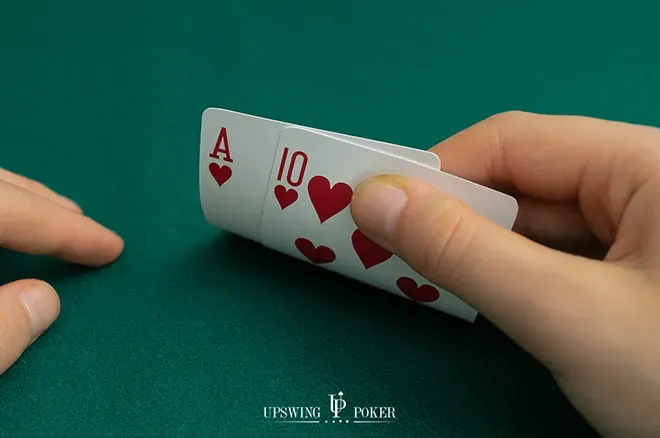
While Aces play a vital role in a range of casino games, they can work in different ways and have varying values or uses. The table below shows several popular casino games, whether an Ace is included in the game and what its role is.
| Game | Aces Included | Role of Aces |
|---|---|---|
| Blackjack | ✅ | The most valuable card with a value of either 11 or 1. |
| Roulette | ❌ | N/A |
| Baccarat | ✅ | Worth one point. |
| Casino Hold'em | ✅ | The highest-valued card that can also be used as the lowest card in a five-high straight (A-2-3-4-5) |
| Three Card Brag | ✅ | The highest-valued card that can also be used as the lowest card in a three-high straight (A-2-3) |
| Video Poker | ✅ | The highest-value card that can form high pairs, high or low straights, flushes and other winning combinations. |
| Craps | ❌ | N/A |
What is an Ace in Blackjack?
The Ace in blackjack is the best single card to hold. It has a value of either 11 or 1 depending on the total value of the player's hand. It is also one of the cards required to be able to make blackjack. Without an Ace, a player cannot have blackjack.
They also change how hands are calculated and how blackjack strategy is applied. Holding an Ace is often tied to some of the most profitable scenarios for the player.
- Dual Value: Can be worth 1 or 11
- Soft Hand: Any hand containing an Ace counted as 11 (e.g., Ace-6 = soft 17)
- Hard Hand: If the Ace must be counted as 1 (e.g., Ace-6 + King = hard 17)
- Blackjack: Ace + 10-point card pays 3:2 in most games
- Impact on House Edge: When played optimally, Aces help keep the house edge as low as 0.5%
How to Bet an Ace in Blackjack
You don’t bet on an Ace directly, but the presence of an Ace in your hand often influences strategic decisions such as:
- Doubling down: Soft hands involving Aces (like Ace-5 or Ace-6) are great double-down candidates against certain dealer cards.
- Splitting: When you’re dealt a pair of Aces, always split them. Most rules allow only one extra card per split Ace, but this still improves your chances.
There are side bets like "Royal Match" or "Perfect Pairs" where Aces may factor in, but they are outside the scope of regular betting strategy.
How Does an Ace Work in Blackjack?

At the beginning of each round, cards are dealt. If you receive an Ace and a ten-point card (10, Jack, Queen, or King), that’s a natural blackjack and wins immediately - unless the dealer also has a blackjack, in which case it's a standoff.
If you receive an Ace and a smaller card (like Ace-4), you have a soft 15. You can hit without busting because if you draw a high card like a 10, the Ace will switch from 11 to 1. This flexibility is what makes soft hands with Aces so advantageous.
Examples of an Ace in Action
Example 1: Natural Blackjack
- Your hand: A♥ + K♥
- Dealer’s upcard: 7♠
- Result: You’re paid 3:2 on your bet. A $100 wager pays $150.
Example 2: Soft Hand Strategy
- Your hand: A♣ + 6♥ (soft 17)
- Dealer shows a 3♦
- Strategy: Hit or double down, depending on table rules
- Draw a 5♦ → now you have A♠ + 5♦ + 5♦ = soft 22, but Ace switches to 1 → total = 12
Example 3: Splitting Aces
- You’re dealt two A♥A♠
- You split and place a second bet
- You receive a 9♥ on the first and a K♠ on the second → 20 and 21
- Result: Strong hands on both, with high potential to win
Tips for Playing Hands with Aces
Just because you get dealt an Ace in blackjack, it doesn't mean you're automatically going to win the hand. In fact, if you don't apply optimal strategy, you could see yourself losing with an Ace more often than you think. Equally, if your hand doesn't include an Ace it doesn't necessarily mean it's weak or that you won't win.
But when you are dealt one, it's crucial to make the most of it. So here are five quick tips on how best to play an Ace in blackjack.
- Always split Aces: Even if you can only get one card per Ace, it gives you a better chance at a strong hand.
- Understand soft hands: Soft 17 or soft 18 may seem strong but often need to be hit or doubled depending on the dealer’s card.
- Watch the dealer’s upcard: The strength of your Ace hand can shift based on what the dealer is showing.
- Don't overvalue a soft 18: It's easy to think Ace-7 is safe, but against a 9, 10, or Ace, it’s often better to hit.
- Practice makes perfect: Use free blackjack games to get comfortable adjusting Ace values mid-hand.
FREE Blackjack Cheat Sheet
Want to know your next move in a blackjack hand? Rather than guessing, why not download our free blackjack cheat sheet. All the information is in one useful sheet, which you can download for free and print off to help you improve your game.
PokerNews Free Blackjack Calculator
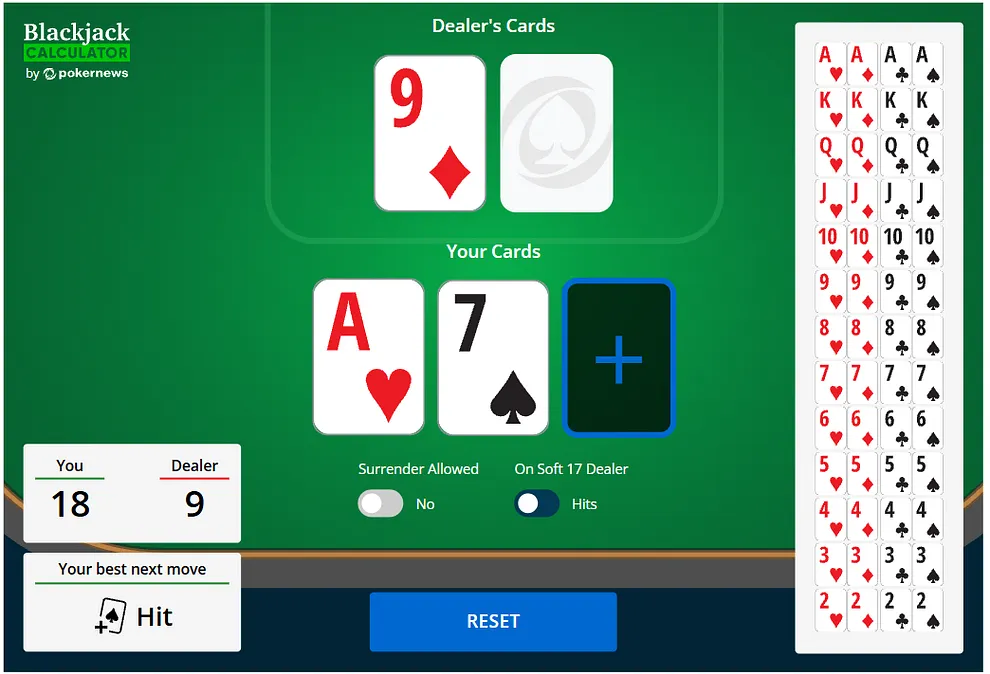
Want to perfect your strategy and learn exactly when you should stick, hit or split with an Ace? Try the FREE PokerNews Blackjack Calculator. It's very easy to use and will calculate your best play at the click of a button. Simply enter your cards, the dealer's face card and we do the rest.
Looking for more casino guides and content?
- Find the Best Real Money Slots
- Read our Latest Casino Reviews
- The Best Online Casinos to Play Right Now
- Try Out Some FREE Online Games - Slots, Poker and Casino Games
- The Latest & Best Casino Bonuses
Ace - Blackjack - FAQs
What is a soft hand in blackjack?
A soft hand contains an Ace that counts as 11. For example, Ace-5 is a soft 16.
When should I hit a hand with an Ace?
It depends on the total and the dealer’s upcard. For example, soft 17 should be hit against dealer 9, 10, or Ace.
Should I always split Aces?
Yes. Splitting Aces gives you a chance to build two strong hands instead of playing one mediocre one.
Does a blackjack with an Ace always win?
Yes, unless the dealer also has a blackjack, in which case it’s a standoff (push) and your bet is returned.
Can I double down on a hand with an Ace?
Yes. Soft totals like Ace-6 or Ace-7 are good candidates for doubling down against weak dealer upcards (like 3 through 6).