
 button in Safari
D'Alembert Strategy for Roulette: How It Works & Is It Effective?


When it comes to roulette strategy, there's a good chance you'll have heard of the D'Alembert system, as it's one of the most popular ways to play roulette out there.
Created by a French mathematician in the 1800s (you can guess his name), it has gained popularity as one of the lower-risk roulette strategies, which, if executed correctly, shouldn't significantly impact your bankroll.
In this article, we'll be taking a closer look at the D'Alembert roulette strategy, breaking it down so you can understand it and offering an understanding of whether it's an effective way to make money playing roulette.
What Is the D'Alembert Strategy?
The D'Alembert strategy is a negative progression betting system commonly used in even-money casino games, such as roulette and blackjack. Named after 18th-century French mathematician Jean le Rond d'Alembert, the system is based on the idea that over a large sample size, wins and losses will eventually balance out over time.
The crux of D'Alembert is that you increase your bet by one unit after a loss and decrease it by one unit after a win. The aim is to gradually recover losses without the steep risk curve of systems like the Martingale, which doubles the bet after each loss.

The maths behind it assumes a roughly even distribution of outcomes (this is the basis of the logic behind the strategy). For example, if you're betting $10 and lose, your next bet would be $20. If that wins, you'd drop back down to $10. This slow, steady adjustment makes it far less volatile than more aggressive progression systems.
Unlike the Martingale strategy, which can lead to massive bet sizes after just a few wagers, or the Fibonacci, which has a more complex numerical sequence, the D’Alembert system is simple to follow and generally speaking is safer for longer sessions, though like all betting systems, please be aware that it doesn't alter the house edge.
How to Use the D'Alembert Strategy in Roulette
Using the D’Alembert system in roulette is straightforward, especially on even-money bets like red/black or odd/even. You begin by choosing a base unit, which becomes your starting bet amount.
After each losing spin, you increase your bet by one unit. After each winning spin, you decrease it by one unit. The idea is that wins will eventually balance out losses, and the gradual changes in bet size help manage risk.
For example:
- Start with a $10 bet on red
- If you lose, bet $20 on the next spin
- If that wins, reduce your bet to $10
- Keep repeating the pattern, adjusting one unit at a time
| Spin | Result | Bet Amount | Outcome | Next Bet |
|---|---|---|---|---|
| 1 | Loss | $10 | –$10 | $20 |
| 2 | Loss | $20 | –$20 | $30 |
| 3 | Win | $30 | +$30 | $20 |
| 4 | Win | $20 | +$20 | $10 |
| 5 | Loss | $10 | –$10 | $20 |
| 6 | Win | $20 | +$20 | $10 |
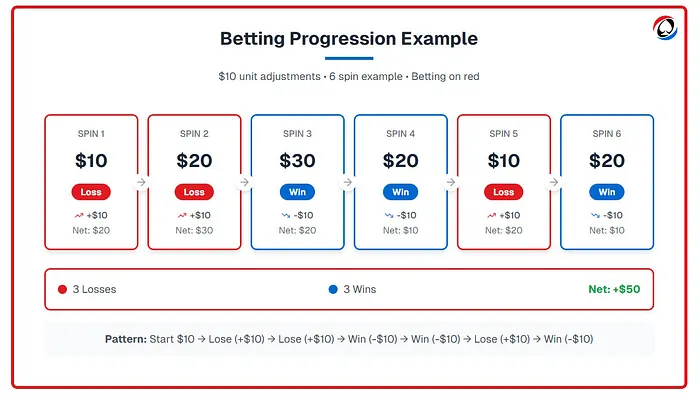
This system is popular among players who prefer a slower, more controlled betting strategy compared to more aggressive systems like the Martingale. It's essential to track your bets carefully and set clear win/loss limits before you start.
Pros and Cons of the D'Alembert Roulette Strategy
Like all betting systems, the D’Alembert strategy comes with both strengths and weaknesses. Here’s a breakdown of the main pros and cons to consider before using it at the roulette table:
Pros
- Simplifies bankroll management – Because bet adjustments are small and predictable, it’s easier to track your balance over time.
- Less risky than Martingale – You’re not doubling your bet after every loss, so the risk of hitting table limits or wiping out your bankroll is lower.
- Good for even-money bets – Works best with red/black, odd/even, or high/low wagers where the outcomes are nearly 50/50.
- Doesn't require a big bankroll – Unlike more aggressive systems, D’Alembert can be used with relatively modest starting funds.
Cons
- Does not overcome house edge – Like all betting systems, it doesn’t change the odds of the game or reduce the casino's long-term advantage.
- Can still lead to losses – Long losing streaks can still erode your bankroll, especially if you don’t set clear limits.
- Recovery is slow – It may take many bets to get back to even, especially after multiple losses in a row.
Comparing the D'Alembert to Other Roulette Strategies
The D'Alembert system is one of several popular roulette betting strategies, each with its own level of risk, complexity, and pace. Here's how it stacks up against other common approaches like Martingale and Fibonacci.
| Strategy | Type | Risk Level | Progression Style | Ease of Use | Best For |
|---|---|---|---|---|---|
| D'Alembert | Negative progression | Medium | +1 after loss, -1 after win | Easy | Steady play, small bankrolls |
| Martingale | Negative progression | High | Double after loss, reset after win | Easy | Short sessions, big bankrolls |
| Fibonacci | Negative progression | Medium-High | Follows Fibonacci sequence | Moderate | Players who want structure without doubling |
| Flat Betting | No progression | Low | Same bet each time | Very Easy | Beginners, low-risk players |
| Labouchere | Negative progression | High | Cancels numbers in a sequence | Complex | Experienced players, big bankrolls |
Does the D'Alembert System Work in the Long Run?
The D’Alembert strategy can offer short-term structure and a sense of control, but it’s absolutely not a guaranteed path to consistent winnings. Like all betting systems, it doesn’t change the odds of the game or reduce the house edge.
Roulette is a game of chance, and each spin is independent of the last. While the D’Alembert approach can help manage bet sizes and limit rapid losses, it won’t protect you from extended losing streaks or shift the long-term mathematical advantage away from the casino.
In the end, no system can overcome the random nature of roulette. Players should treat strategies like D’Alembert as tools for pacing and structure rather than a way to beat the game. Always set limits, stick to your budget, and gamble responsibly.



 Never chase losses
Always set limits
Take regular breaks
Never chase losses
Always set limits
Take regular breaks
D'Alembert Roulette Strategy FAQs
Is the D'Alembert system good for beginners?
Yes, the D’Alembert system is simple to understand and easy to use, making it a popular choice for beginners. It offers a structured way to manage bets without the steep risk of more aggressive systems like the Martingale.
Can you win consistently using the D'Alembert strategy?
While the D’Alembert system can help smooth out short-term losses, it doesn’t guarantee consistent wins. Like all roulette strategies, it can’t overcome the house edge in the long run.
What is the safest roulette betting strategy?
Flat betting is generally considered the safest, as you bet the same amount every spin and avoid increasing losses. The D’Alembert system is also seen as relatively safe compared to other negative progression strategies.
Does the D'Alembert strategy work in online roulette?
Yes, the D’Alembert system can be used in both live and online roulette. Just keep in mind that results are still based on random outcomes, and no system guarantees profit.