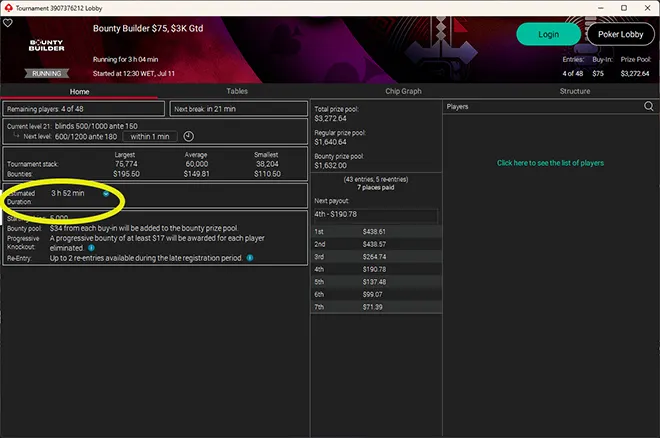
Those who grind multi-table tournaments online at PokerStars will now be able to plan the sessions more accurately after the online poker giant released its new prediction tool during the latest raft of software updates.
Until now, tournament players could only look at similarly-sized completed tournaments to see how long their event would likely take to finish, but this new prediction tool removes most of the guesswork.
PokerStars built a smart model that looks at several factors, including past tournaments, player counts, blind structures, and more, before predicting how long that tournament might last.
Currently, the tool works for all of PokerStars' one-day scheduled tournaments, but Zoom, Phased, Sit & Go, Kick-Offs, Home Games, and Play Money games are not included. Though the prediction is generated at the tournament's creation and doesn't update afterward, it is still accurate and gives a good indication of how long it will take to win a tournament.
If you've headed to the Spin & Go lobby since the last PokerStars software update, you may have noticed that Spin & Go Flash games have vanished. That is only partly true because they have merged with traditional Spin & Go games.
Spin & Go tournaments with lower multipliers will progress faster due to shorter blind levels, while those with higher multipliers have slower blind structures, giving players more time to think when more money is at stake.
The merging of the two games, which also includes Spin & Go Omaha tournaments, will reduce waiting times for games to start, too.
Check Out the New MTT Prediction Tool During the Mystery Bounty Series
The $3 million guaranteed Mystery Bounty Series shuffles up and deals on July 13, running until July 20. Most of the 55 numbered events have the tournament length prediction tool activated in the lobbies.
Expand the table below to see the full 55-event schedule of the PokerStars Mystery Bounty Series
Matthew Pitt hails from Leeds, West Yorkshire, in the United Kingdom, and has worked in the poker industry since 2008, and worked for PokerNews since 2010. In September 2010, he became the editor of PokerNews. Matthew stepped away from live reporting duties in 2015, and now concentrates on his role of Senior Editor for the PokerNews.

 button in Safari