button in Safari
Return to Player
Return to Player (RTP) is a theoretical percentage that indicates how much of all total money wagered on a casino game is paid back to players over a massive volume of rounds.
How Return to Player (RTP) Works
Return to Player (RTP) serves as the mathematical baseline for all regulated casino games. While many players associate the metric strictly with online slots, RTP applies to every real-money game in a casino, including table games such as blackjack and roulette, live dealer titles, and video poker. Because RTP is calculated across millions or billions of simulated game rounds, it represents a long-term average rather than a guaranteed return for any single gaming session.
Checking a game's RTP is simple. In most modern online casino games, opening the game rules or info tab displays the official RTP. For example, a game with a 96% RTP is programmed to retain 4% of total wagers for the house while returning 96% of all wagered funds back to the player pool over time.
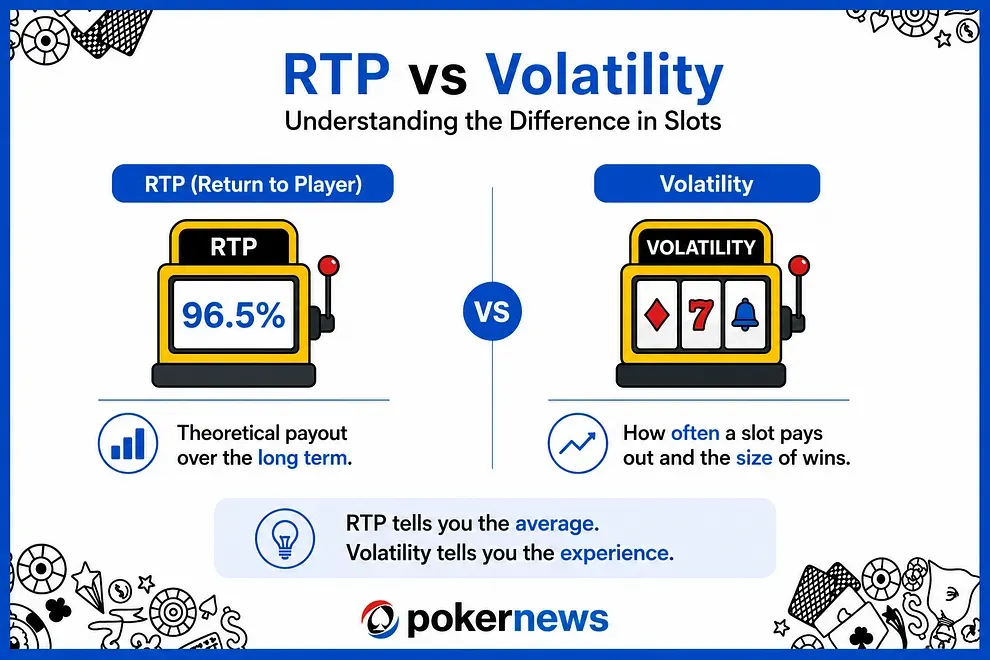
The inverse of RTP is the House Edge. Subtracting a game's RTP from 100% gives you the built-in advantage the casino holds on that title. While it's often mentioned alongside volatility, RTP in slots refers to long-term win rate, while slot volatility dictates how big and how frequent wins will occur.
Example of Return to Player Across Game Types
RTP percentages vary significantly depending on the category of casino game you choose to play. An example comparison across game types includes a 96% slot, a 97.3% European Roulette table, and a 99.5% Blackjack game.
In this example, if $1,000 in total wagers is placed on a 96% online slot, the expected long-term theoretical return to all participating players is $960. On European Roulette (97.3% RTP), that same $1,000 in total stakes mathematically yields $973 in returns over time. Playing basic strategy in Single-Deck Blackjack (99.5% RTP) raises the theoretical payout to $995 per $1,000 wagered.
It is critical to remember that RTP does not account for short-term variance. In a 50-spin session, a player might double their money or lose their balance entirely, but as total spins reach the tens of millions, overall results strictly align with the theoretical RTP of the slot or table game states.
Why Do Casinos and Developers Publish RTP Figures?
One reason game developers and online casinos publish RTP figures is to ensure regulatory compliance and transparency. Regulatory bodies in licensed jurisdictions require software providers to publish tested, audited RTP stats so players know exactly what house edge they face.
Additionally, publishing competitive RTP rates helps operators attract savvy players. Comparing RTP across platforms gives casino enthusiasts clear benchmarks when managing their bankrolls and choosing where to play.
Pros and Cons of Relying on RTP
Using RTP as a benchmark offers valuable statistical insight, but there are both pros and cons to relying on it during gameplay.
| Pros | Cons |
|---|---|
| Provides a transparent measure of a game's house edge | Reflects long-term theoretical averages rather than short-term session results |
| Allows direct comparisons across different game types | Does not indicate payout frequency or volatility |
| Helps players select titles that maximize their bankrolls | Some games feature variable RTP ranges |
How to Check Game RTP Rates
Finding the official RTP of any casino game is simple if you know where to look. Here are five ways you can verify game RTP before playing.
- Read detailed RTP guides on PokerNews to learn about high-return slots and table games.
- Click the information or settings button inside the online slot or table game.
- Check the bottom footer or main menu of licensed online casinos for links to independent audit reports (e.g., eCOGRA or iTech Labs).
- Review software developer websites, such as NetEnt or Microgaming, for official specification sheets.
- Compare multiple casino sites for the same slot title to ensure the operator hasn't configured a lower RTP setting.
Is RTP Audited and Fair?
Published RTP rates are legitimate and heavily tested. Before any game is launched on a licensed online casino, independent testing laboratories run millions of simulated rounds to verify that the game's engine matches the advertised RTP. Regulators continuously monitor these payout stats to maintain game fairness.
Return to Player (RTP) FAQs
What is considered a good RTP for an online slot?
The industry average for online slots is roughly 96.00%. Anything above 96.50% is considered high RTP, while slots below 95.00% are generally considered low.
How does RTP differ from Volatility?
RTP measures how much a game pays back overall in the long run. Volatility (or Variance) measures how that money is distributed, whether through small, frequent payouts or rare, large jackpot wins.
Can online casinos change a game's RTP?
Many modern game developers offer "Flexible RTP Ranges," allowing individual casinos to choose from preset RTP tiers for the same game title. Always check the game info file at your specific casino.
Does playing optimal strategy change a game's RTP?
On skill-influenced table games like Blackjack and Video Poker, using basic strategy raises the effective RTP to its theoretical maximum. Misplays or random betting will lower your actual session RTP. Additionally, some slots offer a higher RPT when purchasing a bonus buy or playing for higher stakes.
Is RTP the same as Hit Frequency?
No. Hit Frequency measures how often a spin or hand results in any winning outcome; it is also expressed as a percentage. A game can have a high Hit Frequency with low payouts, yielding a moderate overall RTP.
Why doesn't my personal win rate match the game's published RTP?
Personal sessions represent a tiny sample size compared to the millions of theoretical spins used to calculate official RTP. Over short periods, random luck and variance massively outweigh the theoretical average.