Prediction Markets World Cup Guide: How to Trade the 2026 World Cup
The 2026 FIFA World Cup is expected to be one of the most heavily traded sporting events in prediction market history. Traders can already buy and sell contracts on everything from the tournament winner to group-stage outcomes and individual player awards.
This guide explains how World Cup prediction markets work, the types of markets available, strategies traders use to evaluate them, and the best platforms for trading the 2026 World Cup.
As someone who has spent years following prediction markets, what excites me most about World Cup prediction markets is how they turn a global sporting event into a real-time universal signal and forecasting exercise anyone around the world can engage with.
Every injury report, lineup announcement, and surprise result can immediately be reflected in market prices, creating an evolving picture of how experts collectively view the tournament.
World Cup prediction markets are event contracts tied to outcomes related to the FIFA World Cup. Instead of placing a traditional wager, traders buy and sell contracts whose value changes as the perceived probability of an outcome changes.
Markets can be created around dozens of questions.
Which country will win the World Cup?
Which teams will advance from their groups?
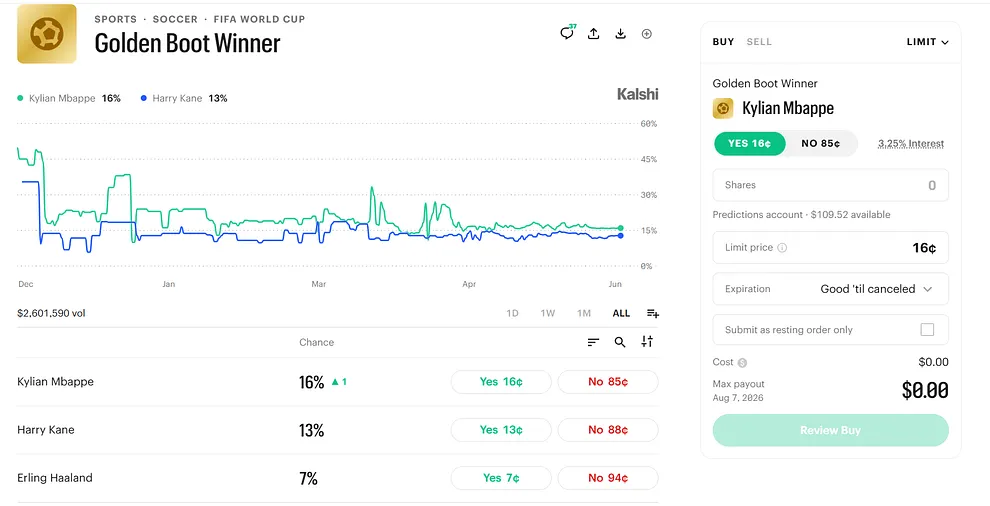
Who will win the Golden Boot?
Will a specific nation reach the semifinals?
Like other prediction markets, prices generally reflect the collective expectations of market participants. A contract trading at 40 cents can be interpreted as the market assigning roughly a 40% chance to that outcome occurring.
The 2026 World Cup is particularly noteworthy because it will be the first FIFA World Cup played during the modern era of regulated U.S. sports event contracts. For many American prediction market traders, it will be their first opportunity to actively trade World Cup markets.
Summary
● World Cup prediction markets allow traders to buy and sell contracts tied to tournament outcomes.
● Market prices generally reflect implied probabilities.
● The 2026 World Cup is the first tournament of the regulated U.S. sports event contract era.
Example of a World Cup Prediction Market
One of the most popular World Cup markets asks a simple question: Which nation will win the tournament?
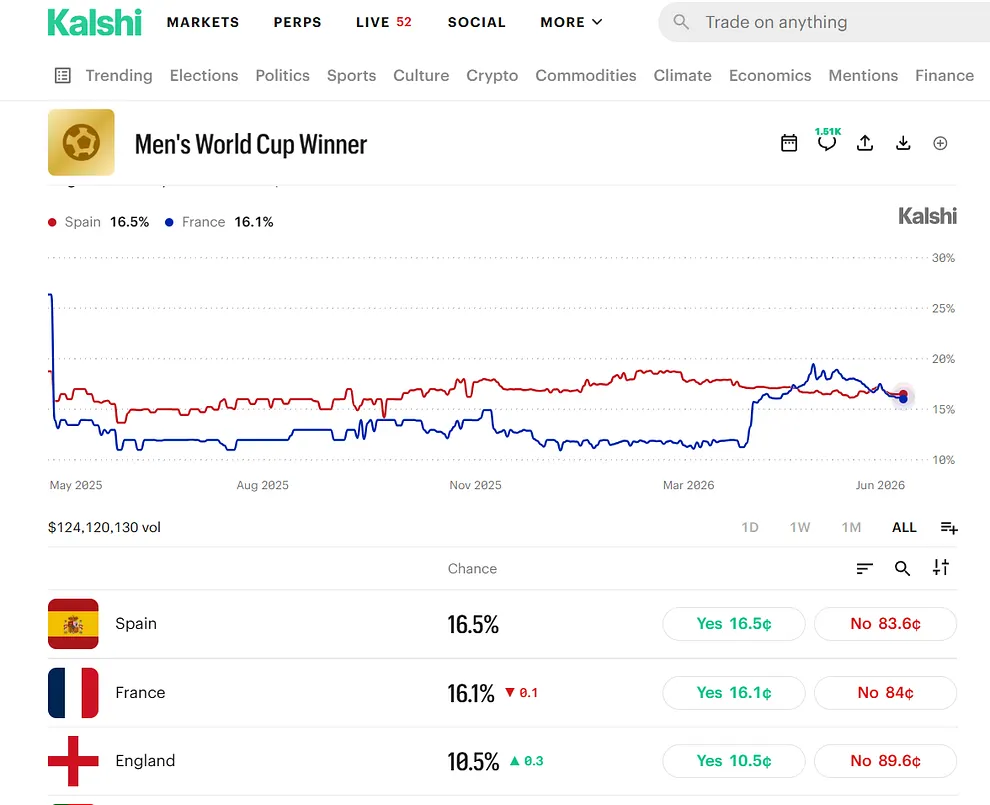
Rather than choosing a winner and waiting for settlement, traders can buy and sell positions throughout the life of the market. More than a year before kickoff, the World Cup Winner market has already generated over $124 million in trading volume, demonstrating significant early interest from traders.
So, according to the markets, Spain are the favorites with a 16.5% chance of winning (at the time of writing). If you buy 'Yes' contracts at 16.5 cents, you'll be able to sell these for more as Spain progress through the tournament. This is because every stage they progress through to is one step closer to them winning it, meaning the chances become more likely.
Alternatively, you could hold out if you think Spain will win it - buy the 'Yes' contracts and wait. If Spain win it, your trade is settled as a winner.
This gives you two opportunities to make money:
Outcome is Successful - Spain wins the World Cup and your trade is settled as a winner.
Sell Before Settlement - Sell your contracts before settlement (at a higher price than you bought them for).
World Cup Prediction Markets vs Sports Betting
Prediction markets and sports betting share similarities, but they function differently.
The biggest difference is flexibility. In a prediction market, traders can often exit positions before the tournament concludes. If a team's chances improve, a trader may be able to sell their position for a profit without waiting for the World Cup Final.
As explained in the previous section, this allows participants to trade changing probabilities rather than simply predicting the final outcome.
Aspect
Prediction Markets
Sports Betting
Odds
Market-implied probabilities
Bookmaker-set odds
Positions
Can be bought and sold
Typically held until settlement
Price Discovery
Determined by traders
Determined by sportsbooks
Early Exit
Usually available through trading
Limited cash-out functionality
Focus
Trading probabilities
Predicting outcomes
What Markets Can You Trade for the 2026 World Cup?
The World Cup generates an enormous range of tradable events. Depending on the platform, traders can access everything from outright winners to individual player awards and group-stage outcomes. Below are just a handful of examples of markets.
The outright winner market asks which country will lift the trophy in July 2026.
Current markets suggest traders view the tournament as unusually competitive. Spain and France sit near the top of the board, while several other nations remain realistic contenders. Unlike some previous tournaments, there is currently no runaway favorite.
Group Winners
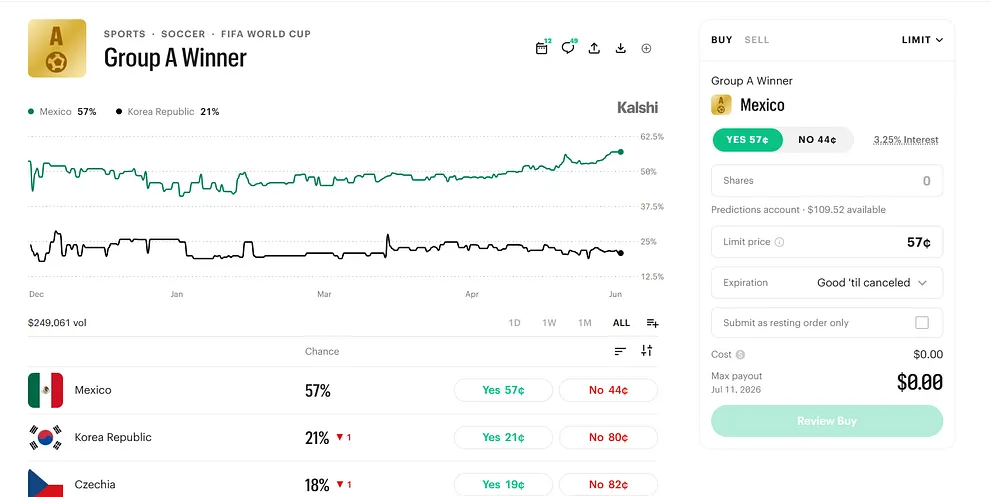
Group Winner markets focus on which team will finish first in a particular group.
These markets often behave differently from outright winner markets because traders only need to evaluate three group-stage matches rather than an entire tournament run.
Golden Boot
Golden Boot markets focus on which player will score the most goals during the World Cup.
Evaluating these markets requires consideration of player quality, expected minutes, team strength, and how far a nation is expected to advance in the tournament.
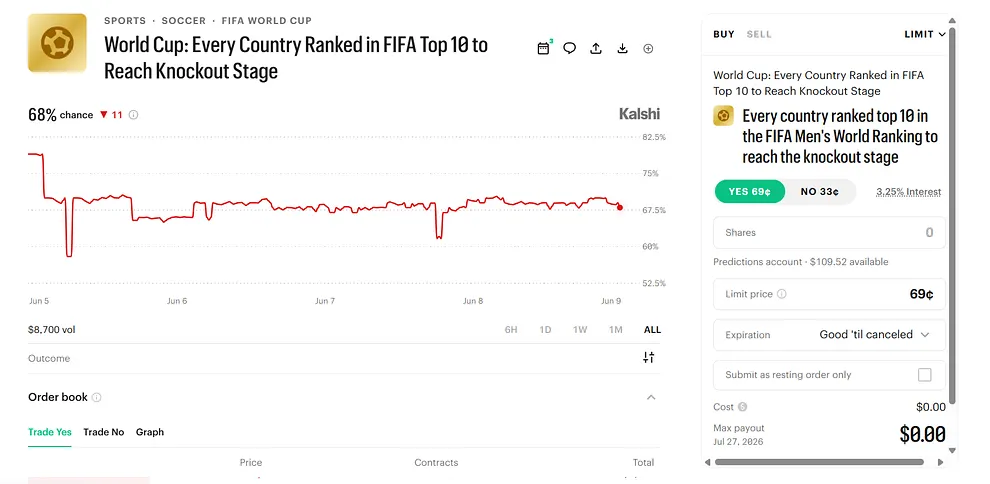
Knockout Stage Markets
Many platforms offer markets on whether teams will reach the Round of 16, quarterfinals, semifinals, or final.
These contracts allow traders to focus on specific stages of the tournament rather than requiring a team to win the World Cup outright.
How to Trade World Cup Prediction Markets
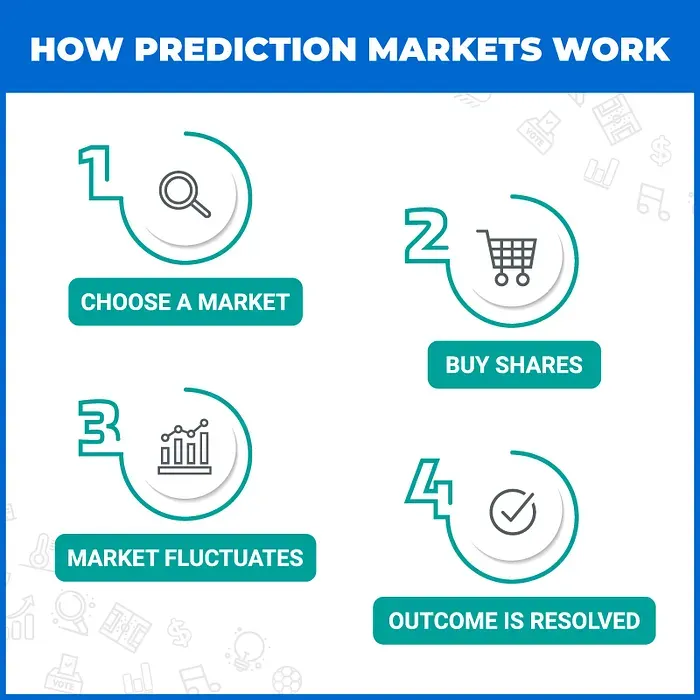
Trading World Cup markets is relatively straightforward. Most platforms allow users to buy and sell contracts based on their assessment of an outcome's probability. Here's how to start trading.
Traders purchase contracts when they believe the market is underestimating the likelihood of an outcome. If market sentiment later shifts in their favor, they can often sell those contracts before settlement.
Understanding Market Prices
Market prices are one of the most important concepts in prediction markets. A contract trading at 65 cents can generally be interpreted as a roughly 65% probability. Understanding how markets translate information into probabilities is essential when evaluating opportunities.
Closing Trades Before Settlement
Unlike many traditional bets, prediction market positions can often be closed before the final outcome occurs. This allows traders to react to injuries, team news, and changing tournament dynamics rather than remaining locked into a position until the World Cup concludes.
Best Prediction Market Strategies for Trading the World Cup
There is no guaranteed strategy for trading World Cup markets. However, experienced traders often focus on several recurring themes when evaluating tournament probabilities.
A key injury, suspension, or unexpected roster decision can significantly alter a nation's chances. Staying informed about team news helps traders incorporate information into their forecasts more effectively.
Managing Liquidity
Not all markets attract the same level of activity.
Larger markets typically have tighter spreads and more participants, while smaller markets may experience greater price volatility. Understanding liquidity can help traders better evaluate market conditions.
Watching for Overreaction
Markets frequently react to major developments, but not every headline changes a team's true probability as much as participants initially believe.
Experienced traders often pay close attention to whether new information is being appropriately priced into the market.
Comparing Multiple Platforms
Different platforms occasionally assign different probabilities to the same outcome.
Comparing markets across platforms can help traders better understand consensus expectations and identify situations where prices diverge.
Understanding Tournament Format
Many casual observers focus exclusively on team strength.
However, tournament structure matters. Two similarly talented teams can have very different championship odds depending on their group draw, potential knockout opponents, and projected path through the bracket.
Best Platforms for World Cup Prediction Markets
Several platforms offer World Cup prediction markets throughout the tournament.
FanDuel Predicts is one of the newer prediction market platforms, but that doesn't mean it's not a great choice for World Cup trading.
The brand itself is well-established in the sports industry, with its sportsbook being a dominant force in the US. On FanDuel Predicts, traders can open positions on several soccer markets for the World Cup. One particular benefit of trading on FanDuel Predicts is that in 2026, it launched combination contracts, allowing users to effectively trade parlays on events like the World Cup.
Summary
● Well-established sportsbook brand
● Operator that has decades of experience in the sports industry
● Ability to trade parlay-type contracts across multiple markets
Get Started Trading the 2026 World Cup on Prediction Markets
Getting started with World Cup prediction markets is relatively simple. Most platforms follow a similar onboarding process that's outlined below.
Find a Prediction Market Platform - Choose a platform that offers World Cup event contracts and supports users in your jurisdiction.
Create an Account - Register with your chosen platform and complete the account creation process.
Verify Your Identity - Many regulated platforms require identity verification before trading can begin.
Explore Available Markets - Browse World Cup markets and familiarize yourself with the different contract types available.
Open Positions and Start Trading - Once funded and verified, you can begin buying and selling contracts based on your assessment of tournament probabilities.
2026 World Cup Prediction Markets FAQs
Can you trade prediction markets for the 2026 World Cup?
Yes. Several prediction market platforms offer contracts tied to World Cup outcomes, including tournament winners, group-stage results, and player awards.
Sports betting vs prediction market trading: which is better for the 2026 World Cup?
They serve different purposes. Sports betting focuses on wagering on outcomes, while prediction markets allow users to actively trade changing probabilities throughout the tournament.
Can you get better odds for the World Cup on prediction markets?
Prediction markets use trader-driven pricing rather than bookmaker-set odds. Depending on market conditions, prices may differ from traditional sportsbooks.
What prediction market platform is best for trading the World Cup?
The answer depends on location, market availability, liquidity, and user preference. Kalshi, Polymarket, and FanDuel Predicts are among the most prominent options.
Is it legal to trade the World Cup on prediction markets?
Legality depends on jurisdiction and platform. Users should review local regulations and platform eligibility requirements before participating.
How can I trade the World Cup?
Create an account on a prediction market platform, complete any required verification steps, explore available World Cup contracts, and buy or sell positions based on your assessment of tournament probabilities.

 button in Safari