button in Safari
Random Number Generator (RNG)
A Random Number Generator is a system used in online casinos to produce unpredictable outcomes for games like slots, roulette, and card games. It ensures that every spin, deal, or result is generated without a predictable pattern.
RNGs are essential in digital gambling because they replicate the unpredictability of real-world casino games. Without RNGs, online games would be fixed or follow patterns, making them unfair and easy to exploit.
How Random Number Generators Work
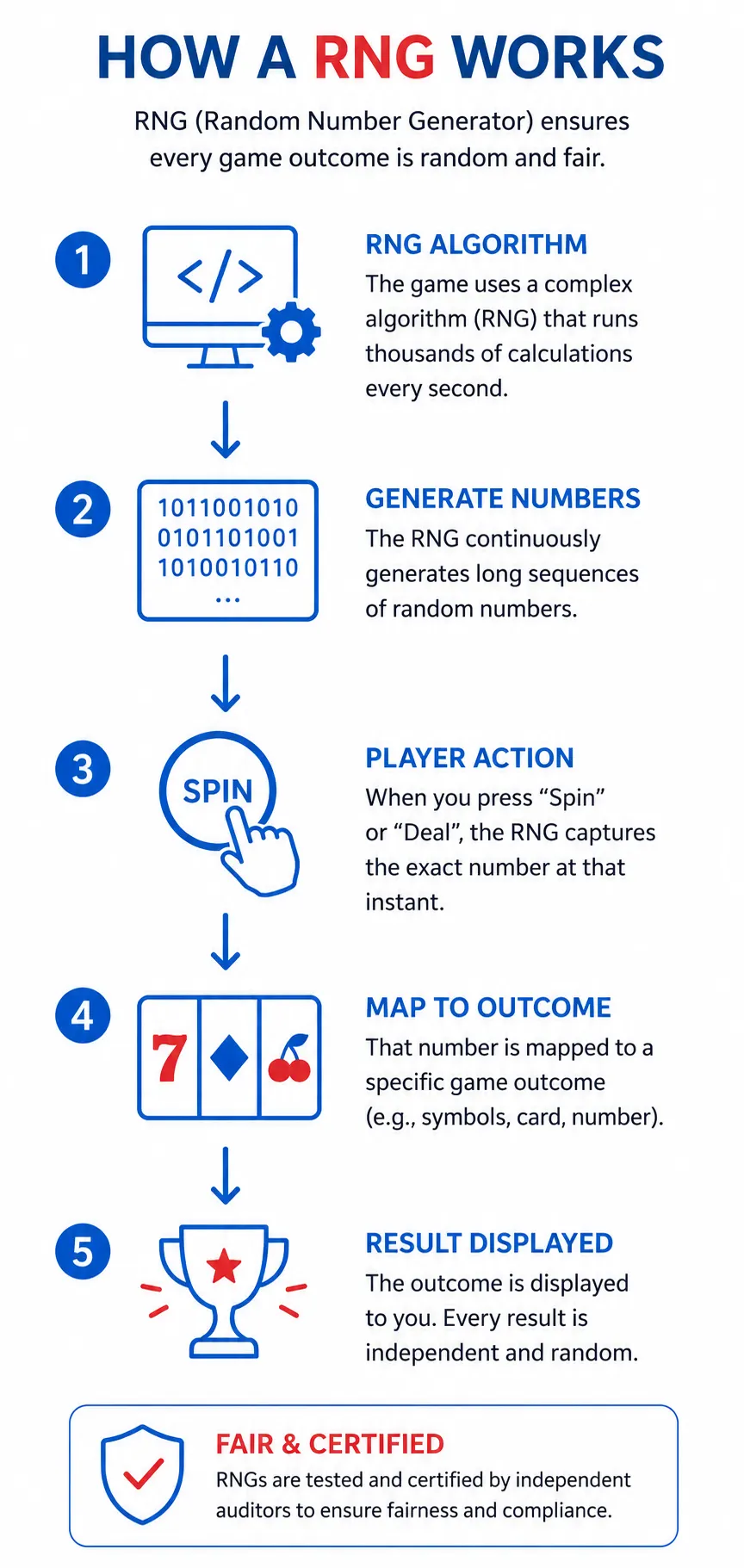
RNGs use complex algorithms (usually called pseudorandom number generators) to produce long sequences of numbers that appear completely random. These systems start with a 'seed' value and rapidly generate thousands of number combinations per second.
In online casinos, the number generated at the exact moment you press 'spin' or 'deal' determines the outcome. This number is mapped to a game result, such as a slot symbol combination or a card draw. RNGs are constantly running in the background, ensuring that every outcome is independent of previous results.
Online casinos use certified RNG systems that are regularly tested by independent auditing bodies to ensure fairness and compliance with gaming regulations.
Types of RNG Used in Casinos
There are two main types of Random Number Generators used in gaming systems.
- Pseudorandom Number Generators (PRNGs): Very fast and most commonly used, but not entirely random. PRNGs are tested regularly, though, to ensure fairness.
- True Random Number Generators (TRNGs): Truly random but less commonly used by casinos due to slower processing times and higher costs.
Pseudorandom Number Generators (PRNGs):
These are the most common in online casinos. PRNGs use mathematical algorithms to generate long sequences of numbers that appear random. They are extremely fast and efficient, making them ideal for real-time games like slots, roulette, and card games like blackjack.
While they are not truly random in a mathematical sense, they are designed to be unpredictable and are regularly tested for fairness.
True Random Number Generators (TRNGs):
TRNGs generate randomness based on physical processes such as atmospheric noise or electronic signal fluctuations. Because they rely on real-world phenomena, they are considered truly random.
However, they are less commonly used in online casinos due to higher cost and slower processing compared to PRNGs.
Fairness and Certification
Online casinos use RNG systems that are regularly tested and certified to ensure fair play.
RNGs are tested by independent auditors to confirm that outcomes are random and unbiased. These testing bodies run thousands or even millions of simulated game rounds to detect any patterns or irregularities.
Common testing agencies include eCOGRA, iTech Labs, and GLI. These organisations are widely recognised in the gaming industry for setting strict fairness and compliance standards.
Casinos must pass regular certification to obtain and maintain their gaming licenses. Without this certification, they cannot legally operate in regulated markets.
Testing ensures no bias toward the player or the house, meaning outcomes remain unpredictable and fair over time.
What’s Really Behind Your Winning Streak?
Learn More about how Random Number Generators have an impact on your spin!
Common Myths About RNGs
There are many misconceptions about how RNGs work in online gambling. Here are some of the most common myths:
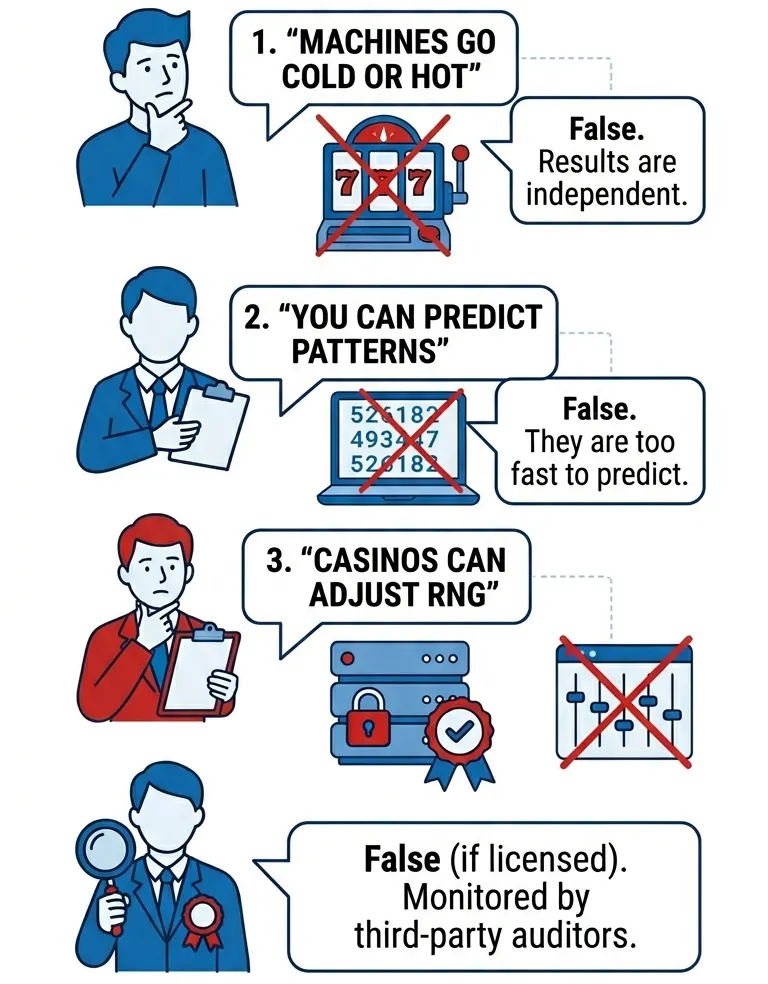
'Machines Go Cold or Hot' ❌
There's no such thing as a slot going cold or hot. Each spin is independent from one another, so even if there has been 10 consecutive wins in a row, it doesn't mean the 11th spin is more or less likely to be a winner.
'You Can Predict Patterns' ❌
Patterns can appear when playing slots, but it will be purely coincidental. Poker players often have "favourite hands" based on memorable wins rather than actual probabilities or these holdings being the best hands. The same psychological bias applies to slots. Even if results seem to follow a pattern, each spin is random and independent, so any trend is nothing more than a coincidence.
'Casinos Can Adjust RNG' ❌
This is another myth. While casinos can alter the return to player (RTP) or a casino game, making it less likely to payout, they cannot affect RNGs. Regulated casinos are held to strict standards, and one of those is that in-game RNGs are regularly tested by third-party auditors.
Are RNGs Really Random?
Yes, RNG outcomes are random in practice and cannot be predicted or influenced by players or casinos during gameplay. Each result is independent, meaning past outcomes have no effect on future ones.
While they are technically 'pseudorandom' in a mathematical sense, they are designed and tested to behave as true randomness in gambling environments.
Random Number Generator - FAQs
Can RNGs be hacked or manipulated?
Licensed online casinos use encrypted, certified RNG systems that are extremely difficult to tamper with. Any reputable operator is regularly audited for fairness.
Do RNGs favor the casino?
The RNG itself is neutral. However, casino games are built with a built-in house edge, which is separate from the randomness of the RNG.
Can players predict RNG results?
No. RNG outputs are designed to be unpredictable and independent, making prediction impossible.
Are RNGs used in all casino games?
Most online casino games like slots, roulette, and virtual card games use RNGs. Live dealer games use real cards and wheels instead.
What is the difference between RNG and true randomness?
RNGs are algorithm-based (pseudorandom), while true randomness comes from physical phenomena. However, for gaming purposes, RNGs are sufficiently random and rigorously tested.