
 button in Safari
Poker Probabilities Explained – Texas Hold’em Odds and Understanding Outs
Poker might seem like it's all about the chips, table dynamics and reading opponents, and while those are all fundamental aspects, probabilities are arguably a more significant part of the game. When poker hands are tied or have similar strength, it's important to know your chances of improving by showdown.
Pot odds, expected value and understanding outs are all part of this. It might seem intimidating for beginners, but getting to grips with the math behind poker hands is vital if you want to be successful.
However, this page is not a lecture about numbers and percentages. Nor is this just a guide on the hand rankings in poker or what hands beats what. Instead, this guide gives simplistic explanations in how to use probabilities to estimate chances, including some nifty tricks and tips that makes things easy for even new players. You don't need to be doing complex calculations mid-hand.
In this guide, you'll learn:
- The Probability of Making Each Poker Hand
- What are 'Outs' in Poker?
- The Rule of 2 and 4
- Pot Odds vs Probability
- Top 4 Common Probability Mistakes
- Best Ways to Practice and Learn Poker Probabilities
What Are Poker Probabilities?
We all know probability relates to the chances of an outcome happening. In the context of poker, it applies to the chances of hitting flush or straight draws, improving your hand or winning at showdown.
So why is it important for poker? If you know the probability of hitting your hand based on odds, you can use that information to accurately determine what you should do in a hand. Only playing the very best starting hands based on the probability of making a strong hand by showdown is a good place to start.
But let's imagine you're facing a big bet but the probability of hitting your outs on future streets is very small, it might not be worth calling. We'll explain this in more detail later on, so don't worry if things aren't adding up just yet.
Probability of Making Each Poker Hand
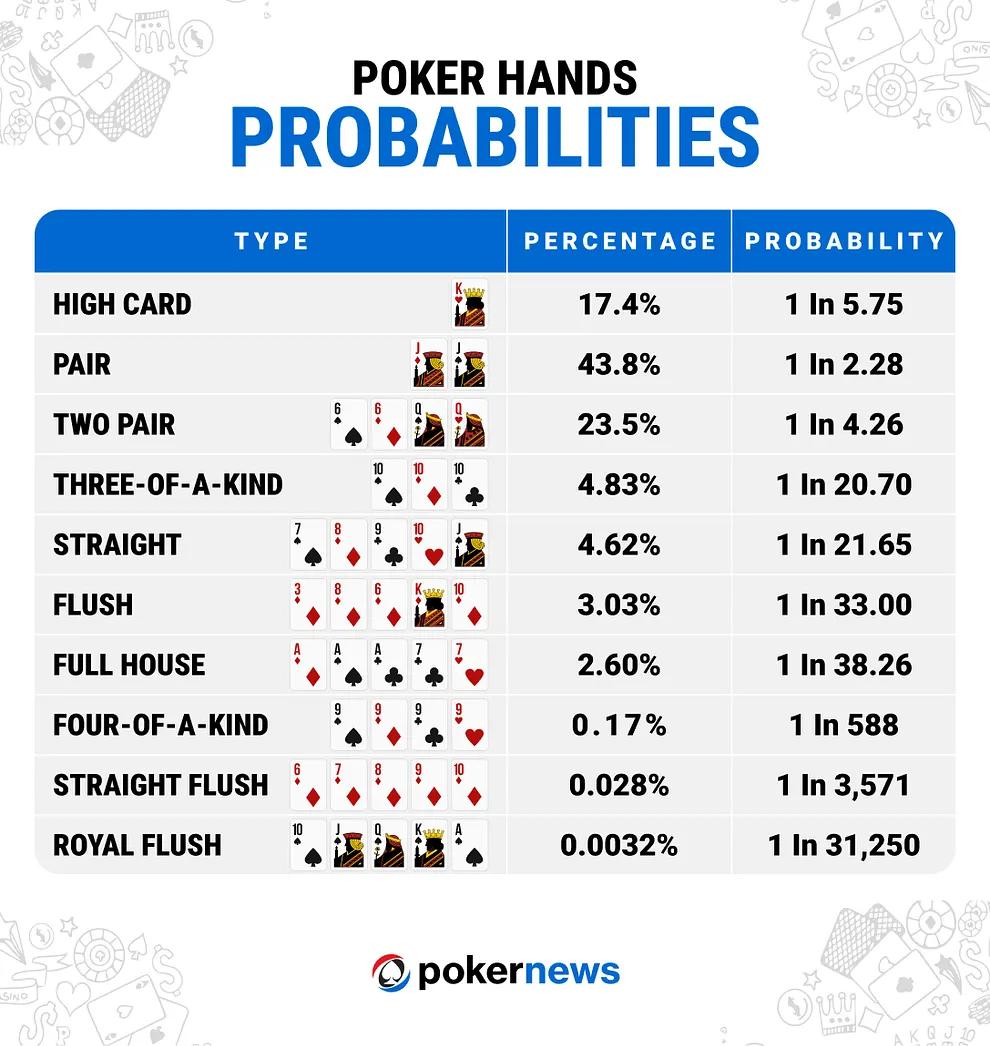
To start with, let's keep things simple and look at the probability of making each hand in poker.
If you've wondered what the chances of making hands like a royal flush or four-of-a-kind, you can find this information below. It's worth noting, that this is the overall probability of making a set hand our of the seven possible cards available (two hole cards + five community cards) in Texas Hold'em.
The Most Important Poker Probabilities to Know
Let's look more into probabilities. This section will go through the most important probabilities you need to know, from preflop hand strength to chances of hitting your draws, and simply explain how to use these to benefit your poker.
Preflop Hand Strength Odds
It makes sense to begin at the start of the hand - the preflop (before the three community cards are drawn) stage. This is the simplest dynamic when it comes to probabilities, as we only have limited information. At this stage of the hand, you know you're own two hole cards and that's it. But that's still information you can work with.
For example, when acting first, you can estimate how likely your hand is to win the pot based on its strength. If others have acted before you, that's more info you can use as the size of their bet and position on the table can indicate the strength of their hand. So it's important to know general preflop hand strength, which is why we've created the graphic below.
It shows the preflop equity (chances of winning the hand based on the information we have preflop) for different hands. Given that you won't know opponents' cards, the probability is based on your hand vs any random other two-card hand.
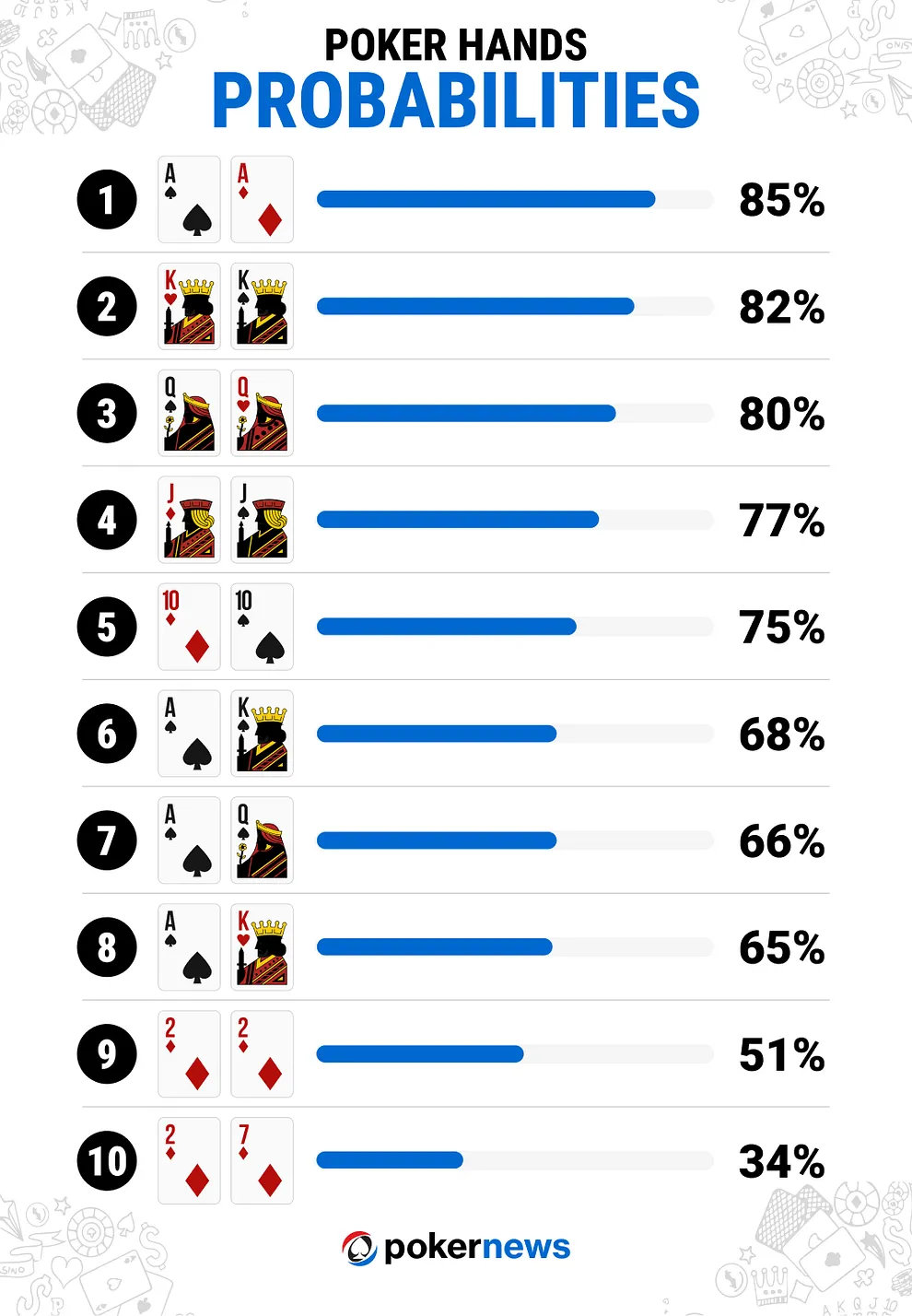
While these probabilities are very general, they give you a good sense of how strong your preflop hand is. Here are some other key points on preflop probability that are useful to know:
Pocket Aces - 80% Preflop Equity
It's true that pocket aces are the best starting hand in poker, and you should be playing these very aggressively preflop to add as many chips as possible into the pot. But you should note that the hand is not an automatic win. Around one in five times you pickup aces, you won't win the hand. So yes, it's frustrating when your aces get cracked by some maniac playing 56 suited, but you can't expect your aces to win every single time.
Aces won't win every time. Statistically, you'll lose with aces 20% of the time but that's not to say you shouldn't still play ultra aggressively with them preflop as you'll always be a strong favorite and want to build the pot as much as you can!
AK vs Small Pair - 50-50% (Coin Flip)
If you haven't heard of a coin flip in poker, you soon will. At the tables, coin flips are very common and generally refer to when one player has a small pocket pair and another has two overcards. The 'classic' coin-flip situation is when one player has AK and another 22. Ace-king seems a lot more attractive, holding the two highest-value cards against the smallest possible pair. However, the preflop odds of each hand winning are even.
AK vs a small pocket pair is almost always going to be a coin flip - with both players having a near-equal chance of winning the hand.
Multi-way Pots Change Equity
We often refer to heads-up (one player versus one other player) play for many probability situations, simply because that's the most common table dynamic that arises. But you should note that the more players that are in the hand, the smaller your equity becomes regardless of how strong your hand is or how weak your opponents' hands are.
Let's take aces as an example. They're strong favorites to win any hand heads up, but imagine you have aces against five other players in the hand. Your equity goes from 80% to likely somewhere around the 50% mark. So be wary that probabilities and odds that you'll win a hand significantly diminish the more players are involved.
PokerNews asked players at the 2025 WSOP what they'd do if they had pocket aces in the first hand of the $10,000 Main Event with every player at the table already all-in preflop. The answers were fascinating!
Flop-to-River Improvement Odds
Calculating your chances of improving from the flop to the river is crucial if you want to make informed, math-based decisions that will be profitable in the long run. Counting your outs is key part of this. With nine outs (such as a standard flush draw) on the flop, you’ll improve by the river about 36% of the time. With eight outs (for example, an open-ended straight draw), your chance drops slightly to around 32%.
A quick shortcut is the Rule of 2 and 4. This is a simple calculation that anyone can do to quickly workout how many outs you have in a hand. Just multiply your outs by four on the flop to estimate your chance of hitting by the river, or by two on the turn to estimate your chance of hitting on the next card. It’s not exact, but it’s close enough for fast in-game decisions.
We'll go into more detail on the Rule of 2 and 4 later on.
Hitting Specific Hands
Understanding how often certain draws and made hands come in can sharpen your decision-making. Here are a few quick examples that show you the probabilities of hitting in some common poker situations.
- Flush draw odds: With nine outs after the flop, you’ll complete your flush by the river about 35% of the time (roughly 1 in 3).
- Open-ended straight draw odds: With eight outs, you’ll make your straight by the river about 32% of the time (just under 1 in 3).
- Set probability: If you start with a pocket pair, you’ll flop three of a kind around 12% of the time - or roughly 1 in 8 flops.
What Are “Outs” in Poker?
If you're not entirely sure what 'outs' are in poker, why they matter or how to count them, this section will help you. Learn everything there is to know about outs in poker in these quick snippets.
Definition of Outs
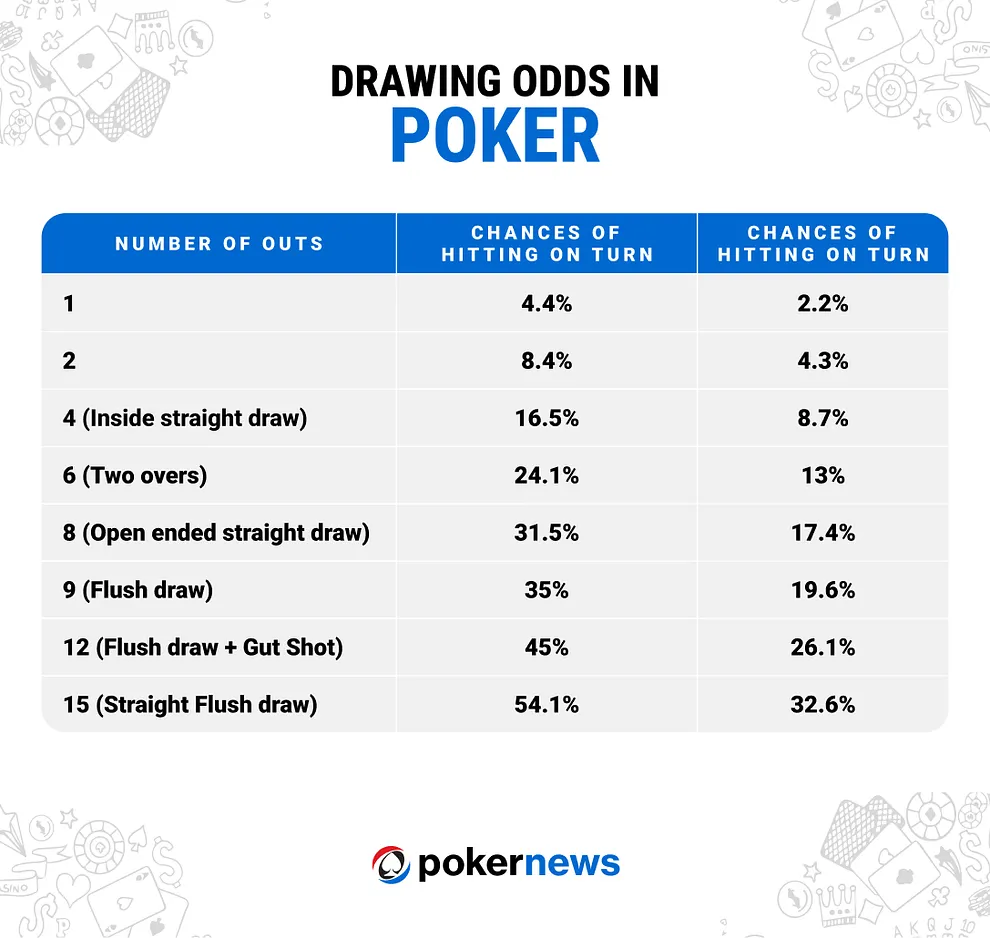
Outs are the cards required for you to improve your hand or hit the hand you're drawing to (E.g. a straight or a flush). See below the number of outs you have for common draws in poker and the chances of hitting them.
Counting Outs Accurately
To calculate your outs, count how many cards remaining in the deck complete your draw. For example, if you hold four hearts after the flop, there are nine remaining hearts in the deck - giving you nine outs to make a flush. It's as simple as that. If you have a four-card straight (E.g. 4-5-6-7), then you have eight outs to hit to complete a full straight: four 3s and four 8s remaining in the deck.
Removing “Dirty Outs”
Not all outs are clean. Some cards may improve your hand but also give an opponent a stronger one. These are called “dirty outs” and should be discounted when estimating your real equity. For instance, if you need a jack to land to make your straight, you have four conventional outs. However, if your opponent has four hearts, this impacts your outs. The jack of hearts will be a 'dirty out' for you, because if it lands you'll make your straight but your opponent will also improve and make a better hand - a flush. Therefore, you shouldn't consider dirty outs into your calculations.
Why Overcounting is a Common Beginner Mistake
Many new players count every possible improvement without considering stronger hands their opponents could hold. This leads to inflated odds and poor decisions. Accurate counting - and removing questionable outs - keeps your math realistic and your bankroll healthier. Don't be too put off if this sounds a complex - it's simpler in reality.
Let's say you have a straight-flush draw, which is a strong position to be in. You can hit a number of outs that will either give you a flush, straight or straight flush and likely win the hand.
However, if you're opponent is usually tight but is now betting large amounts, you have to think what they might have. If they already have a made nut-flush, then your straight and flush outs won't help you win the hand even if you hit them. In this situation, you might think you have 15 outs when in reality, your only true outs are the two remaining cards that will give you a straight flush.
Calculating outs is always going to just be an estimation. There's no definitive way you can know your opponents' cards, but making a calculated guess at the number of outs you might have and acting on that information will improve your game.
The Rule of 2 and 4 - Simple Tip for Calculating Outs
The Rule of 2 and 4 is a quick way to estimate your chance of hitting a draw.
- Multiply your outs by 2 when there is one card to come (on the turn).
- Multiply your outs by 4 when there are two cards to come (from flop to river).
For example, if you have eight outs with two cards to come: 8 × 4 = 32% chance of improving by the river.
This rule gives a rough indication, not an exact figure. It slightly overestimates odds in some situations, but it’s accurate enough for fast, practical decisions that are required at the tables.
Once you estimate your percentage chance of hitting, you can compare it to your pot odds. If the chance of improving your hand is higher than the price you’re being offered (E.g. the bet you must call), then continuing with the hand and calling is mathematically justified. If your chances of hitting your draw are lower than your pot odds, folding is usually correct.
The Rule of 2 and 4 becomes less precise with very large numbers of outs, on the turn (where exact math matters more), or in complex multi-way pots. In those spots, exact calculations provide better guidance - but for most in-game decisions, the shortcut works well.
Pot Odds vs Probability
We've covered probability, but how does that tie in with pot odds? In this section, we'll explain what pot odds are, how to calculate them and how to use them to your advantage.
What are Pot Odds?
Pot odds in poker are effectively the price you're getting to continue in the hand. For instance, if there's $10 already in the pot and your opponent bets $5, you must put in $5 for a chance to win the entire $20 pot. Your pot odds here 3:1.
Comparing Pot Odds to Equity
So you have your pot odds, now what?
Now you bring equity and probability into the frame. Sticking with the example above, let's say you have a flush draw with two cards to come and pot odds of 3:1. Assuming no dirty outs, you'll have nine solid outs to make your flush and win the hand. Using the Rule of 2 and 4, we multiply your nine outs by four to get an approximate hand equity of 36%.
Pot odds of 3:1 mean you need to win 25% of the time to break even (you’re calling 1 to win a total of 4). Therefore, the equity of your hand (36%) is greater than the pot odds you're getting to call of 3:1 (25%), meaning your decision should be call.
Why is this?
Because if you're expected to win the hand (by hitting your flush) 36% of the time, then calling a bet that would be 25% of the total pot means you statistically will win more than you'll lose in the long run.
At the start, using pot odds and equity to inform your decisions at the table is difficult to master. But once you get used to processing hands in this way, it becomes more natural and will benefit your game. Practice is the only way to learn this technique.
Top 4 Common Probability Mistakes Beginners Make
Probability isn't easy at first, and beginners make several common mistakes before they get their head around the numbers. Here are four of the most common probability mistakes that you should avoid making if you want to improve your game.
Overvaluing Draws
Overvaluing and chasing draws is more common among beginners. When you have a four-card flush, you instantly think of the value you can get if that fifth suited-card lands. It's tempting to chase draws in an attempt to hit the big hands, but you should always try to be methodical in your actions. Not taking into account dirty outs is part of this mistake and can mean the actual hand equity is far less than what you perceive it to be.
Ignoring Reverse Implied Odds
Reverse implied odds take into account the amount of money that you could lose on future streets by continuing in the hand. This could be because even after hitting your draw, your opponent still has a stronger hand.
But a greater factor in reverse implied odds that's relevant to beginners is fold equity. A hand itself might not have great equity, but if you bluff all other opponents out of the pot then your weak hand will still win the pot. So if an opponent is betting big in the early streets, this might indicate strength and imply the big bets will continue to the river. As a result, your implied odds get worse as you'll likely have to call a huge river bet that might not be mathematical profitable in the long run, or simply just fold and lose the money you've already committed.
Forgetting Opponent Ranges
Equally, opponents' ranges is an important thing to consider in any hand and forgetting to do so could be costly. You should always be thinking about poker ranges (a set of hands that an opponent might logically hold based on all their prior actions in the hand) anytime you play. Position and preflop betting action can help shape an opponents' range and you can factor this in to help you make better decisions. If you use the math that comes with hand equity and pot odds, and combine it with opponents' possible ranges, you'll get a more accurate representation of implied odds.
We've put together 10 of the most valuable poker range charts. These will help you learn what hands you should and should not be playing preflop at the tables.
Playing for “Hope”
Playing for hope is only a mistake in terms of profitability. This might sound crazy, but if you're just playing poker for the fun and excitement of it, then chasing draws and hoping to hit is fine. However, this is not profitable in the long run. Most players do care about the money they spend to play and potentially win, and having fun is not the only reason to be at the tables. If that's you, resist the temptation to chase draws.
Mistakes are part of the game. Everyone makes them, from complete beginners to seasoned professionals. What separates winning players is their ability to minimize costly mistakes and consistently plug leaks - that constant refinement is what keeps the best players ahead of the competition.
What separates winning players is their ability to minimise costly errors and consistently plug leaks — that constant refinement is what keeps them ahead of the competition.
Best Ways to Practice and Learn Poker Probabilities
If you want to learn more about poker probabilities, practice is great way to go about it. Here are four of the best ways to develop your knowledge of odds in poker.
Poker Odds Calculator
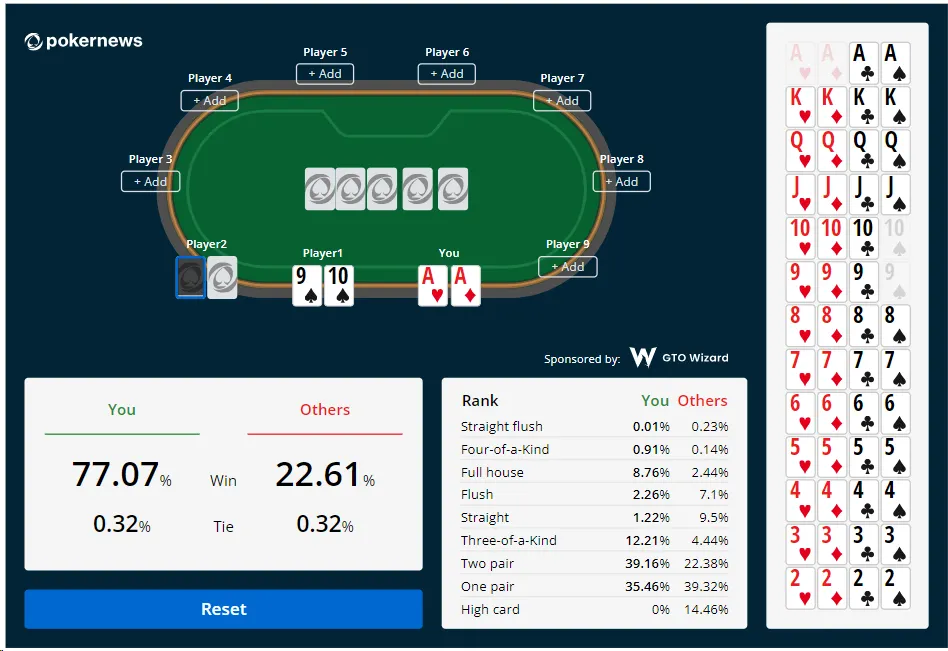
The PokerNews Poker Odds Calculator is the best you'll find online.
With our calculator, you can add in your cards and the cards of up to nine other players, as well as inputting the five community cards. This will give you an accurate calculation of the equity your hand has versus the rest of the table. It's a great way to better get to grips with the odds and study very specific spots that you might have been in at the real tables.
Real Money Online Poker Sites
Another good way to improve your knowledge is by playing the real thing. There are a host of different, safe and secure real money poker sites for you to play. With these, you'll get genuine experience and be able to practice calculating odds, odds and equity in a real environment.
Free Play / Freerolls
Free poker games using play chips and freeroll tournaments are other great places to practice odds and probabilities. There's no financial risk, so you can literally play until you're comfortable enough to try the real-money version. Play-chip games allow beginners to focus on counting outs, calculating pot odds and applying the Rule of 2 and 4 in real time.
Freerolls add a competitive edge because real prizes are on the line, encouraging more realistic decision-making while still costing nothing to enter. Both formats will help you build confidence with probability calculations and understand how equity translates into long-term results - all without wagering a cent!
Poker Trainers
Poker trainers are dedicated tools that are tailored to help beginners learn and better understand the game. One such trainer is GTO Wizard, which is the most comprehensive poker training site in the business. While it might seem advanced for some newbies, GTO Wizard's software is very easy to get to grips with and they have an abundance of help features and guides that will get you accustom to how to use the tools.
Learn More About Poker Hands and Strategy
If you want to move beyond basic probabilities and improve your overall decision-making, explore our deeper strategy guides below.
- Poker Hand Rankings
- Best Starting Hands in Texas Hold’em
- Kicker in Poker
- Tied Poker Hands
- What Beats What in Poker?
- Short Deck Poker Hand Rankings
- Poker
Odds Calculator
- How to Play Texas Hold’em
- Beginner Poker Strategy Guide
Probability in Poker FAQs
What are poker probabilities?
Poker probabilities refer to the likelihood of an outcome occurring, such as completing a draw of wining a hand. Understanding these probabilities helps players make profitable decisions in the long run.
What are the odds of hitting a flush in poker?
Taking into account all seven cards a player can use in Texas Hold'em, you'll make a flush around 3.03% of the time (once every 33 hands). If you have a flush draw on the flop, your chance of completing the flush by the river is generally around 36%, falling to 18% by the turn.
Do you need to calculate pot odds in poker?
It's strongly advised to calculate pot odds during poker hands. While it will never be an exact science, doing so helps you to make more informed decisions at the table.
What are the odds of hitting a royal flush?
Royal flushes in Texas Hold'em are extremely rare, and your odds of hitting one are approximately 0.0032% - once every 31,250 hands.
What are the odds of flopping a royal flush?
The odds of flopping a royal flush in Texas Hold'em poker are approximately 0.000154% - once every 649,740 hands.
Are poker probabilities different in tournaments compared to cash games?
While the math is the same, pot odds and equity works a little differently in poker tournaments due to ICM (Independent Chip Model). ICM basically takes into account how much each chip is worth in a tournament based on the prize money that's left to be won. In latter stages of tournaments, where there's an imminent pay jump, you're on the money bubble or there are one or more very short stacks remaining, pot odds and hand equity become less important. Optimal strategy dictates it's better to fold or play more cautiously in some spots, regardless of probabilities or pot odds implications.