
 button in Safari
Tied Poker Hands - Split Pots & Tie-Breaker Rules Explained

Poker can feel straightforward until two players turn over hands that look exactly the same. Suddenly, hand probabilities, equity and odds mean nothing and it's just a question of determining which hand is the best. But who wins? Does suit matter? And what if the board plays?
This guide explains what happens when hands are tied in poker, when a split pot occurs, and how official tie-breaker rules work in Texas Hold’em. It does not repeat the full hand hierarchy. If you need a refresher on rankings from high card through royal flush, visit our Poker Hand Rankings explainer first.
We’ll also discuss how kickers affect outcomes. If you’re unfamiliar with that concept, see 'What Is a Kicker in Poker?' before diving deeper into this article here.
Think of this page as a rules clarification and decision guide. By the end, you’ll know exactly what happens in poker when hands are tied, when pots are split, and how to confidently determine the winner at showdown.
In this guide, you'll learn:
- What is a Tied Poker Hand?
- What Happens When Poker Hands Tie?
- When do you Split the Pot in Poker?
- Top 3 Most Common Mistakes
- Where to Practice Split-Pot Situations
What is a Tied Poker Hand?
A tied poker hand occurs when two or more players hold the same ranked five-card hand at showdown.
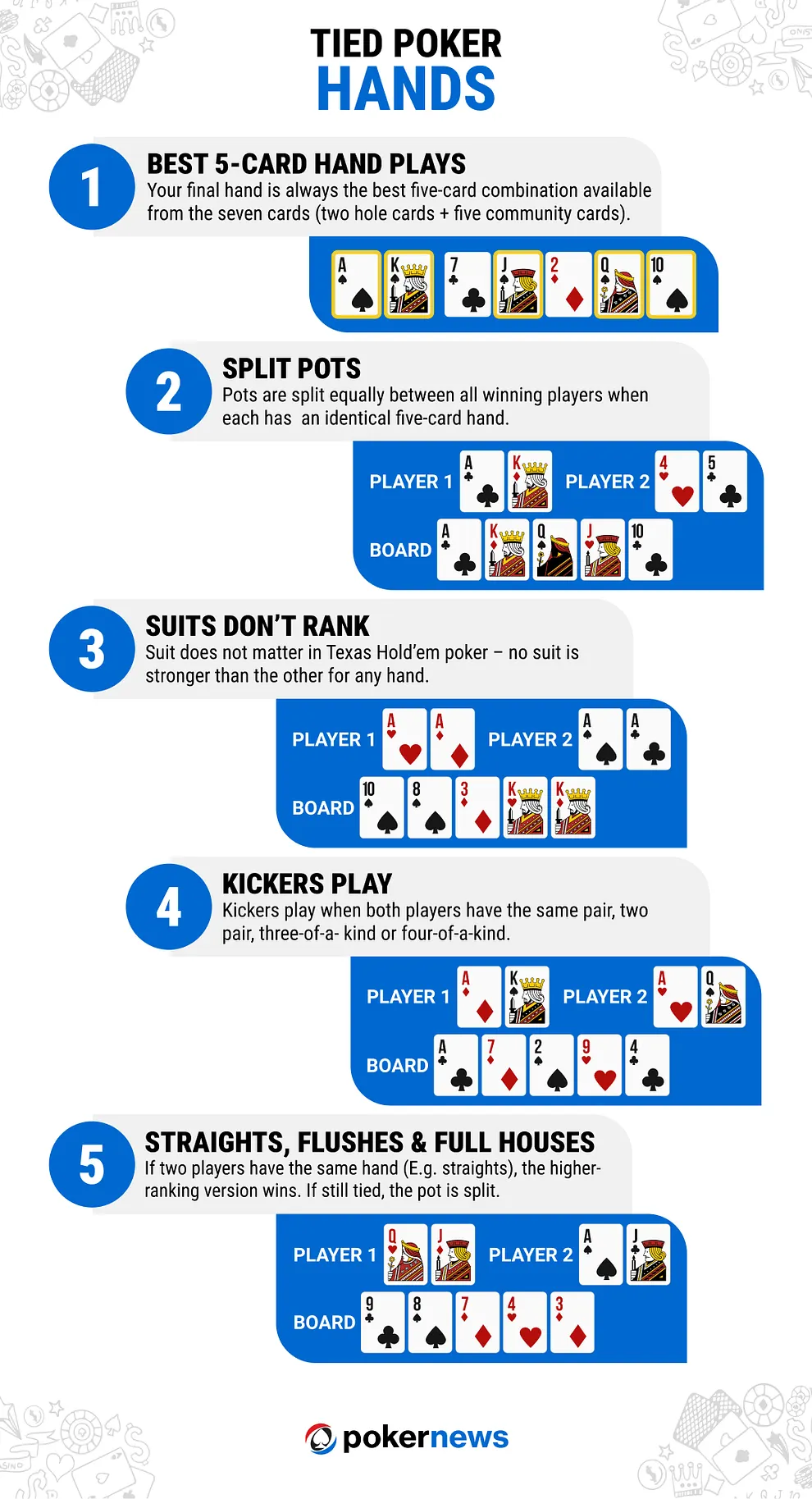
Every player has a two-card starting hand. In Texas Hold’em, the goal is to make the best possible five-card combination using the two hole cards and the five community cards. Only the best five cards count. That rule alone explains many ties.
For example, if the board reads A♠K♦Q♣J♥10♠, every remaining player has a straight to the ace. Their private cards do not matter. The pot is split.
Ties are more common than many beginners might expect because:
- Players often share community cards.
- The board can "play" for everyone.
- Certain textures create identical combinations.
One crucial rule: suits do not break ties in standard poker. A flush in hearts does not beat a flush in spades if both hands are otherwise equal.
If you need a refresher on hand strength order, review the Poker Hand Rankings guide or learn more in How to Play Texas Hold’em.
What Happens When Poker Hands Tie?
When poker hands tie, the pot is split evenly between the tied players. This is known as a split pot.
Each player receives an equal share based on chip denomination. In most cases, the division is exact. But occasionally, the pot cannot be divided perfectly.
What is an Odd Chip?
An odd chip is a leftover chip after the pot is split as evenly as possible. Live poker rooms use house rules to award it. In most card rooms:
- The odd chip goes to the player closest to the dealer button.
- In stud games, it may go to the highest card by suit for administrative purposes only.
Online poker simplifies this entirely. The software automatically splits the pot and assigns any odd chip according to site rules, usually based on position.
Importantly, the pot is only split among players with identical best five-card hands. If one player’s fifth card is higher, even by a single rank, there is no split.
Understanding this is key. Poker does not reward close hands. It rewards the best five-card combination.
How Poker Tie-Breakers Work
Tie-breakers in poker always come back to one principle: compare the best five-card hand for each player.
If the primary hand ranking is identical, compare the highest relevant card. If those are equal, move to the next highest card. Continue until a difference appears or all five cards match.
If all five cards are identical, the pot is split.
WATCH: Example of a Split Pot After a Tied Poker Hand
Comparing Top Pair
If both players hold the same top pair, compare the highest kicker.
Board: A♣7♦4♠2♥J♠
Player 1: A♥K♣
Player 2: A♦Q♦
Both have a pair of aces. Player 1 wins because the king kicker beats the queen.
Comparing Two Pair
With two pair, compare the highest pair first. If equal, compare the second pair. If still tied, compare the fifth card.
Board: 6♠6♦Q♠Q♥K♠
Player 1: A♠Q♦
Player 2: J♠10♠
Both hold queens and sixes The ace kicker wins the pot. If both players also share the same kicker from the board, it’s a split.
Comparing Three-of-a-Kind
When both players have three of a kind, compare the rank of the trips. If those are equal, compare the highest kicker, then the second kicker.
Board: 10♠10♦10♣6♥A♠
Player 1: 8♦2♦
Player 2: K♣J♣
Both have trip tens. Both players have the ace of spades kicker, so it moves to the second kicker. Here, the king of clubs kicker wins. If kickers are identical, the pot is split.
Comparing Straights
Straights are compared by their highest card only.
Board: 7♠8♦9♣10♥J♠
Player 1: K♦3♦
Player 2: K♣4♣
Both have a jack-high straight. It is a tie. Suits do not matter. A straight is defined purely by rank.
Comparing Flushes
Flushes are compared card by card from highest to lowest.
Board: Q♦8♦6♦K♦10♦
Player 1: K♠4♠
Player 2: Q♠10♠
Both have a flush. But because both players' best five flush cards match exactly, it is a split pot. If one player in this case had a diamond higher than a six, they'd win the pot with a higher flush.
Comparing Full Houses
For full houses, compare the three-of-a-kind portion first. If equal, compare the pair.
Board: A♦A♠A♣7♣7♥
Every player remaining has aces full of sevens. The pot is split. If one player improves to a higher full house using hole cards, that player wins outright.
QUIZ: Can You Spot a Tied Poker Hand?
Think you've got the tie-breaker rules figured out? Put them into practice with our Poker Hand Rankings Quiz. Compare Hero's hand with the Opponent's and decide who wins, or whether the pot should be split.
When Do You Split the Pot in Poker?
Split pots occur when players’ best five-card hands are completely identical.

Identical Five-Card Hands
This often happens when the board itself makes the strongest hand.
Board: 5♣6♦7♠8♥9♣
Every player has a straight. Unless someone holds a ten for a higher straight, the pot is split. Hole cards are irrelevant if they do not improve the five-card combination.
Same Pair, Same Kickers
Sometimes the board supplies both the pair and the highest kickers.
Board: A♣A♦K♠Q♥J♣
Player 1: 4♠3♦
Player 2: 9♣2♣
Both players’ best five-card hand is A-A-K-Q-J. The board plays. The pot is split.
Full House on the Board
Board: 8♣8♦8♠K♥K♣
Every player has eights full of kings. Unless someone holds a king for kings full of eights, everyone ties.
Flush on the Board
Board: K♠10♠7♠4♠2♠
All players have a king-high flush. If no one holds a higher spade than the board’s king, the pot is split. If someone holds the A♠, that player wins with an ace-high flush.
This is one of the most misread situations in live poker.
It might seem like there's a lot to consider when taking into account split pots in poker. In reality, it's simple. Look at the best possible five-card combination - if all five are on the board and it can't be improved on (E.g. a broadway straight without flush possibilities), the pot is split.
Does Suit Ever Break a Tie in Poker?
No, suits do not rank in standard Texas Hold'em Poker.
A flush in hearts does not beat a flush in clubs. A king of spades does not outrank a king of diamonds. Suits are equal in Texas Hold’em and most mainstream variants.
Rare exceptions exist in:
- Some home games.
- Certain non-standard variants.
- Administrative procedures for awarding odd chips.
But in regulated casino and online poker, suits never determine the winner of a tied hand.
Top 3 Most Common Mistakes - Tied Hands in Poker
Even experienced players occasionally misread tie situations. Here are the most common errors.
- Misreading the Board
- Ignoring the Fifth Card
- Assuming your Kicker Always Plays
Misreading the Board
Players often focus on their hole cards and miss that the board already makes the best hand.
If the board shows a straight or full house, ask yourself whether your hole cards actually improve it. If not, you may be chopping.
WATCH: Chady El Ojeil Makes a Costly Mistake - Misreading his Full House
Ignoring the Fifth Card
Many players compare pairs but forget the final kicker.
Two players with pair of kings are not tied if one holds an ace kicker and the other holds a queen. Always compare all five cards.
Assuming Your Kicker Always Plays
Your kicker only matters if it is part of your best five-card hand.
If the board provides higher kickers than yours, your card does not count. This frequently leads to confusion and incorrect celebrations at showdown.
Learn More About Poker Hands
If you want to master more than just tie situations, explore our full poker rules and strategy guides below.
- Poker Hand Rankings
- Short Deck Hand Rankings
- Probability in Poker
- What Beats What in Poker?
- What is a Kicker in Poker?
- Best Starting Hands
- How to Play Texas Hold'em
- Poker Strategy Basics for Beginners
- Poker Odds Guide
Tied Poker Hands FAQs
What happens if two players have the same poker hand?
If two players have identical five-card hands, the pot is split evenly between them. Any leftover odd chip is awarded according to house rules, usually to the player closest to the dealer button.
Who wins in poker if both players have a pair?
The higher pair wins. If both players have the same pair, compare kickers from highest to lowest. If all five cards match, the pot is split.
Does a higher kicker in poker always win?
A higher kicker wins only if it is part of the best five-card hand. If the board provides better kickers than your hole cards, your kicker does not play.
What happens if the board makes the best hand in poker?
If the five community cards form the best possible hand for everyone, the pot is split unless a player can improve using hole cards.
Can two players have the same full house in poker?
Yes. If the board shows a full house and no player improves it with hole cards, both players share the same five-card hand and split the pot.
Does suit matter in poker when hands are tied?
No. Suits do not rank in standard poker. They never break ties in Texas Hold’em.
What is an odd chip in poker?
An odd chip is a leftover chip that cannot be evenly divided during a split pot. It is awarded based on house rules, often to the player nearest the dealer button.