button in Safari
Slot Payout Percentage
A slot payout percentage is the theoretical percentage of wagered money that a slot is programmed to return to players as winnings over a long period of time. It is commonly expressed as the metric 'Return to Player' (RTP).
What is a Slot Payout Percentage?
A slot payout percentage shows how much of a player's total wagering amount they can expect to get back as winnings.
For example, a slot with a 96% payout percentage will theoretically return $96 for every $100 wagered. The remaining $4 represents the theoretical house edge, which live and online casinos take in order to generate revenue.
However, this does not guarantee that every player who wagers $100 will get $96 back. Some might, but others will win more and some will win less. Payout percentages are calculated across a very large number of spins, and individual playing sessions can produce significantly different results.
Slot payout percentage is closely related to Return to Player (RTP), with both terms essentially referring to the same thing.
How Does Slot Payout Percentage Work?

Every online slot uses a random number generator that generates random outcomes for every spin. Although this technology creates randomness, the slot's RTP (payout percentage) is factored into it.
This means the payout percentage represents the theoretical return generated by those outcomes over the long term.
Here's a simple example of how slot payout percentage works:
- Check the Payout Percentage: Check a slot's information or rules (these are usually easily accessible) to see the theoretical payout percentage - E.g. 96%.
- Make a Spin: You make a $1 wager and the slot reels begin to spin.
- Random Outcome is Generated: Symbols randomly land on the reels and either form a winning or losing combination.
- Winnings Paid Out: If a winning combination lands, the spin pays out according to the game's paytable.
- Results Accumulate: As more and more spins are made over time, the total accumulated winnings should theoretically more closely match the slot's RTP.
The payout percentage applies to the game overall rather than an individual player's session.
Slot Payout Percentage Example
Imagine an online slot has a payout percentage of 96%.
If a player wagers $10,000 on 10,000 ($1) spins over a long period of time, they can expect to win back $9,600. The remaining $400 will be kept by the casino, and represents the house edge.
| Total Spins | Stake Per Spin | Total Wager | Payout Percentage | Theoretical Return | House Edge |
|---|---|---|---|---|---|
| 10,000 | $1 | $10,000 | 96% | $9,600 | 4% |
This is only a theoretical example. The actual amount returned over any specific period can be higher or lower because individual slot outcomes are random.
Is Slot Payout Percentage the Same as RTP?
Slot payout percentage and RTP are generally used to describe the same concept: the theoretical amount a player can expect to win over a long period of time. One main difference, though, is that most casino games have an RTP but slot payout percentage obviously only relates to slots. However, if we just use the term 'payout percentage,' that can relate to wider casino games as well. Both metrics are displayed as a percentage.
- Slot Payout Percentage: 96.5%
- Same Slot's RTP: 96.5%
| Slot Payout Percentage | RTP |
|---|---|
| Expressed as a percentage | Expressed as a percentage |
| Represents theoretical player returns | Represents theoretical player returns |
| Calculated over long-term gameplay | Calculated over long-term gameplay |
| Does not guarantee individual returns | Does not guarantee individual returns |
Payout Percentage vs. House Edge - What's the Difference?
Payout percentage represents the theoretical amount returned to players, while the house edge represents the theoretical amount retained by the casino. Both are displayed as a percentage and are inversely related.
This means the two percentages combine to equal 100%.
For example:
96% payout percentage + 4% house edge = 100%
This means any slot game with a higher payout percentage generally has a lower theoretical house edge.
| Payout Percentage | House Edge |
|---|---|
| 98% | 2% |
| 96% | 4% |
| 94% | 6% |
| 90% | 10% |
What is a Good Slot Payout Percentage?
Players may consider several factors when choosing a game, but if slot payout percentage is the most important metric, anything higher than 96% tends to qualify as a high RTP slot.
While gameplay, volatility and bonus features are all important considerations, comparing payout percentages can show which games theoretically return the most over the long term. For example, a 97% slot has a higher theoretical return than a 94% slot, so regardless of any other factors, players will theoretically lose less playing the 97% slot.
Payout percentage should not be considered in isolation. Slot volatility, features, jackpots, gameplay and betting limits can also differ significantly between games.
Where Can You Find a Slot's Payout Percentage?
Online slots often display their RTP or payout percentage within the game's information, help or paytable section. In fact, most regulated online casinos are legally obligated to display a game's RTP to players.
Exactly where to find it depends on the game and software provider, but players can generally:
- Open the slot game.
- Select the information, help or menu button.
- Open the rules or paytable.
- Look for the RTP information.
Can't find a slot's RTP? We have hundreds of up-to-date online slot reviews, which give you RTP information, volatility and our opinions of games.
It's crucial to check the specific version being played because casinos often offer different payout percentages for the same slot.
Does Slot Volatility Affect Payout Percentage?
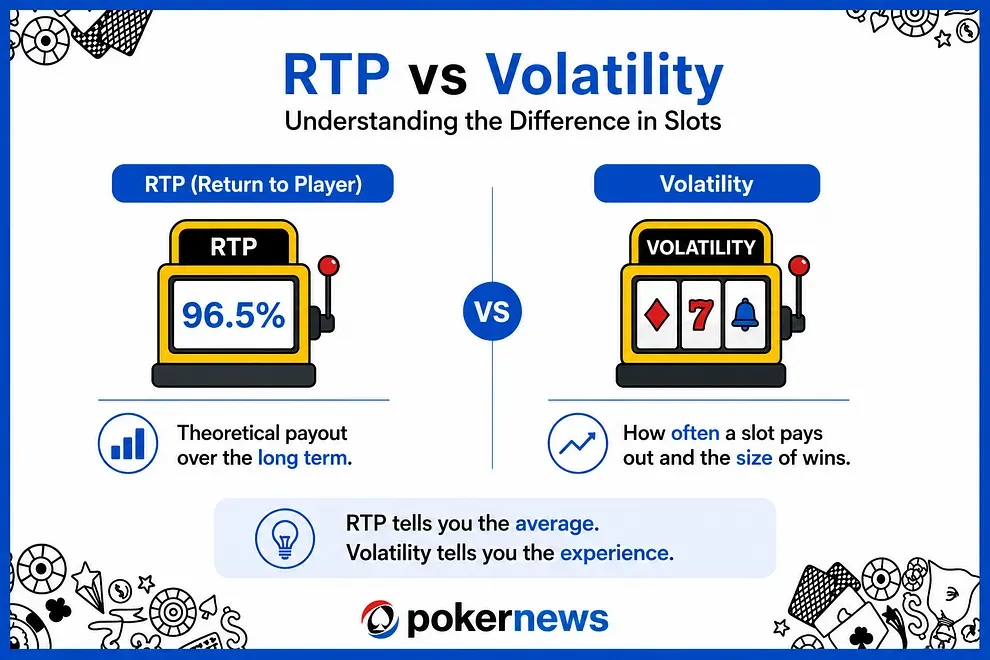
Payout percentage and volatility measure different characteristics of a slot.
Payout percentage measures the theoretical return of money wagered over the long term. Volatility describes the general size and frequency of a game's payouts.
Two slots could therefore have the same 96% payout percentage, but provide very different payout patterns. One could produce smaller, more frequent wins, while another could produce less frequent but potentially larger payouts - and ultimately both could still return exactly the same amount to players.
Can a Slot's Actual Payout Differ From its Payout Percentage?
Yes, your actual returns will almost always be different to the theoretical returns. A slot's stated payout percentage is a theoretical long-term figure, not a guarantee of its actual returns - especially over a short period.
Even the combined results from many players over a limited period can differ from the theoretical figure. This variation tends to reduce as the number of spins increases, although it's crucial to never interpret the payout percentage as a guaranteed return.
Slot Payout Percentage FAQs
What does payout percentage mean on a slot?
A slot's payout percentage is the theoretical percentage of wagered money that the game is designed to return to players as winnings over the long term. So if you wager $100, theoretically you should expect $96 back on a slot with a 96% RTP.
Is slot payout percentage the same as RTP?
The terms are generally used to describe the same concept. A 96% RTP means the slot has a theoretical payout percentage of 96%.
Is a higher slot payout percentage better?
Yes, a higher payout percentage represents a greater theoretical long-term return to players and means the theoretical house edge is lower than other games with a lower payout percentage. However, you might lose more during one session playing a 96% RTP slot than playing a slot with a 94% payout percentage due to short-term variance.
Does payout percentage tell you how often a slot wins?
No, slot volatility relates to how often a slot wins. Payout percentage portrays the theoretical value returned over time.
Can casinos change a slot's payout percentage?
Some slots are produced with multiple RTP configurations that operators may be able to select from. However, this depends on the game, provider and applicable regulations.
Can you use payout percentage to predict when a slot will pay?
No. Slot outcomes are completely random and RTP cannot be used to determine when a win will occur.