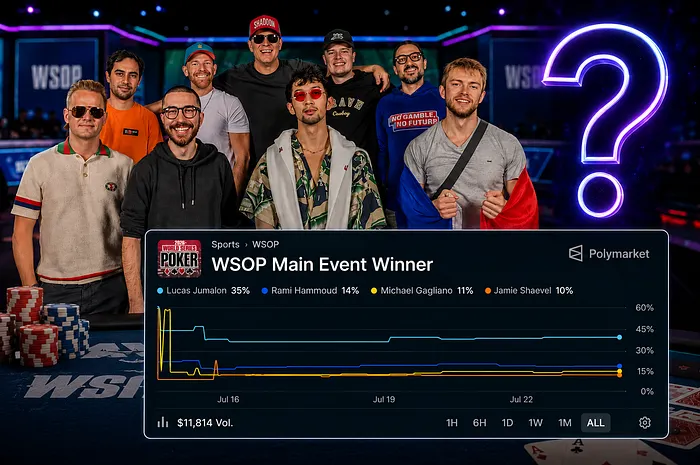
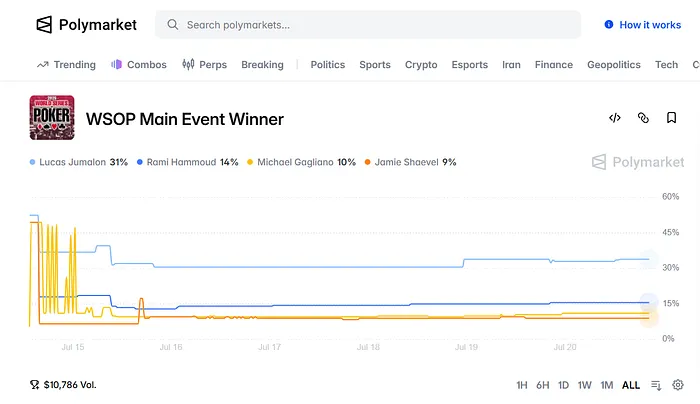
A Polymarket market asking who will win the Main Event has generated just over $10k in trading volume at the time of publishing but expect that number to grow as the Final Table draws nearer. Twenty-two-year-old Lucas Jumalon leads at around 35%, followed by Rami Hammoud at 16% and Michael Gagliano at 11%.
Jamie Shaevel and Greg Mueller are each trading around 9%, while Mario Boos, Han Feng, Lauri Saaskilahti and Evagoras Evagorou make up the rest of the field.
Aggregated percentages of all players equals more than 100% due to liquidity and spreads. Unlike sportsbooks, Polymarket is a 'free market,' where trade volume and market liquidity dictate prices. This can lead to the prices offered not accurately indicating the actual chance of an outcome happening.
Jumalon’s Stack Makes Him the Clear Favorite
Jumalon will return with 194 million chips, or 129 big blinds. That is more than double Hammoud’s second-place stack and more than the next three players combined. His 35% share of the chips is the largest held by a Main Event final-table leader since the tournament expanded to nine players.
That explains why Jumalon is the favorite, but his price also shows the limits of chip-count forecasting in poker. Even with a historic lead, he still has to eliminate or outlast eight opponents in a high-variance tournament.
Jumalon entered the Main Event with roughly $180,000 in live earnings. The Spokane native graduated with a degree in business administration and data analytics and developed his game playing low-stakes home games before moving into larger tournaments. A win would make him the second-youngest Main Event champion in history.
Jumalon’s “Yes” shares traded at approximately 54 cents at 2:30 p.m. on July 14, shortly after the market opened, but have since fallen to around 35 cents. There does not appear to have been a poker-related development behind the decline. The final table and chip counts had already been announced when the market opened at 1:07 p.m. ET, and the remaining players will not return to the table until Aug. 3.
The move instead appears to be an early correction in a relatively thin market. More than $10,000 has traded overall, but much of that volume is concentrated in the Jumalon and Han Feng contracts, while several other players have attracted relatively little trading.
That means one or two larger orders can move the displayed odds substantially. Traders may also have initially placed too much weight on Jumalon’s chip advantage before accounting for the variance of tournament poker and the experience of the players behind him.
Experience vs Chips
Experience isn't everything, but it can play a significant role in determining who comes out on top. In the most prestigious tournament in poker, years of live experience could prove to be a defining factor at this year's WSOP Main Event final table.
Below is a table comparing the top five players' chip stacks with the amount of experience they have playing certified live tournaments.
WSOP Main Event Contenders: Chips Versus Experience
Final-table chip counts compared with documented live-tournament
experience.
Lucas Jumalon3 years
194M chips
Rami Hammoud14 years
79M
Jamie Shaevel15+ years
56M
Greg Mueller23 years
48.5M
Michael Gagliano18 years
46.5M
Chip counts entering the final table. Experience is measured from the
earliest documented live-tournament result and does not include
undocumented cash-game or online experience.
Tournament Earnings vs Chips
How much could previous tournament earnings influence this year's final table? Players who have already won six-figure prizes may be more comfortable navigating the high-pressure moments where a single decision can be worth hundreds of thousands of dollars.
The graphic below shows the top five 2026 WSOP Main Event players, comparing their chip stacks to how much they've won in their careers in credited, live tournaments.
WSOP Main Event Contenders: Chips Versus Live Tournament Earnings
Final-table chip counts compared with all-time live tournament
earnings.
Lucas Jumalon$180,888
194M chips
Rami Hammoud$512,438
79M
Jamie Shaevel$451,177
56M
Greg Mueller$3,540,270
48.5M
Michael Gagliano$2,296,144
46.5M
Chip counts entering the final table. Experience is measured from the
earliest documented live-tournament result and does not include
undocumented cash-game or online experience.
The Other Favourites
Rami Hammoud enters the 2026 WSOP Main Event final table second in chips.
Hammoud is the most obvious alternative at 16 cents for a “Yes” share. The Montreal player is the only finalist besides Mueller and Gagliano to have previously reached a WSOP final table. A regular at Playground Poker Club, Hammoud had never recorded a six-figure tournament score before guaranteeing himself at least $1 million here.
Shaevel may be the most unusual player among the leading contenders. He primarily plays cash games and rarely enters tournaments outside the Main Event, yet has now cashed in poker’s world championship eight times.
His 56 million-chip stack ranks third, though the market has him behind Gagliano and level with Mueller. That appears to be a reflection of the market favoring proven tournament pedigree. Gagliano is a multiple-bracelet winner with years of high-level tournament experience, while Mueller is a three-time bracelet winner and former professional hockey player. Mueller had considered moving away from poker before this run renewed his enthusiasm for the game.
Mario Boos - Polymarket currently gives him an 8% chance of winning.
Boos is priced at around 8% after entering the final table with 44 million chips. The French player had less than $240,000 in previous earnings and reached the final nine after choosing to risk his tournament life with pocket tens rather than wait for a $250,000 pay jump.
The shortest stacks also increase the chances of the bigger stacks laddering up the payout structure. Feng has 17 big blinds, Saaskilahti has 25 and Evagorou has 15. Saaskilahti is already the deepest-finishing Finnish player in Main Event history, while Evagorou is the first Cypriot to reach the final table—and did so in his first Main Event appearance.
The market remains relatively thin, with most displayed volume concentrated in the Jumalon and Feng contracts. That makes the prices an interesting starting point rather than a definitive forecast. When play resumes on Aug. 3, each player will be competing for a $10 million first prize, and the odds could move dramatically after a single pot.
Of course, chips are an important factor. But as any poker player knows, having the largest stack going into a final table far from guarantees you the title. The players' attitudes and strategies will play a major role in deciding the outcome, and ultimately who traders should back on Polymarket.
Are some of the shorter stacks happy to just ladder? Are there some players there who won't be satisfied with anything but gold and a place in poker history? We'll likely only know when the final table resumes in August.
Prediction markets involve risk and are not suitable for everyone. While many platforms offer tools to make informed trades, outcomes are never guaranteed, and users should never risk more than they can afford to lose. Always trade responsibly. Additionally, platform availability and legal status vary by region. It is your responsibility to check local laws and verify that you are legally allowed to use a given platform before participating.

 button in Safari