"The uncertain glory of an April day, which now shows all the beauty of the sun, and by and by a cloud takes all away." - The Two Gentlemen of Verona (Act 1, Scene 3).
The beauty of Shakespeare is that the experiences he captured are permanently enduring aspects of the human condition. That line was written somewhere between 430 and 436 years ago, and yet its spirit endures: April weather is fully uncontrollable and nearly unpredictable.
Nearly... because even though we've learned nothing about controlling the weather, we've learned quite a bit about approximating it. Interestingly, these lessons have not come exclusively or primarily from government bureaucrats in suits, but rather from strange outsiders at the fringes, like those Two Gentlemen of Verona.
Today, prediction markets allow us to crowd source at scale out of the box ideas on weather forecasting and while that may seem crazy a look at the history of weather forecasting presents an interesting trend.
During New York City’s snowstorm this year, it was exciting to watch people share their different methods for predicting the weather and compare them to the odds on Kalshi and Polymarket.
Most of the theories were probably more superstitious than scientific, but it was still a reminder that interesting ideas can come from anyone.
The road to predicting future weather begins with measuring and recording it in the present. In the 1600s, the Western world began using the thermometer and barometer to track temperature and atmospheric pressure (early versions of the thermometer had existed in China for some time prior). This marks the first era of accurate weather data collection, and yet it wouldn’t be deployable at scale until a dejected, starving artist turned amateur engineer proposed an innovative new way to communicate.
In the 1800s, Samuel Morse’s invention of the telegraph allowed weather data to be shared regionally and tracked over time. When Morse initially petitioned Congress for funding to build a long-distance telegraph line, he was openly mocked on the House floor.
He prevailed and his eventual success would be a species-level triumph. Humanity now possessed the ability to form large, meaningful national datasets on weather. Still, utilizing this data for true forward-looking projections remained out of reach.
The Breakthrough
The first significant step in that direction came from Lewis Fry Richardson, who in the early 1900s proposed mathematical weather forecasting. Richardson was a pacifist and conscientious objector who refused to serve in World War I. As a consequence, he was banned from holding any formal academic position. Relegated to fringe research and barred from the institutions of his own time, he went ahead and invented the field of quantitative weather forecasting anyway in his living room.
The personal computer revolution was then ushered in by Steve Jobs, a self-described outsider who famously believed his fruit-only diet made regular bathing unnecessary. The personal computer allowed for decentralized analysis of weather data by individuals, not just institutions with access to large expensive IBM products already being used in weather analysis, producing several major leaps in forecasting accuracy.
Weather Prediction Markets
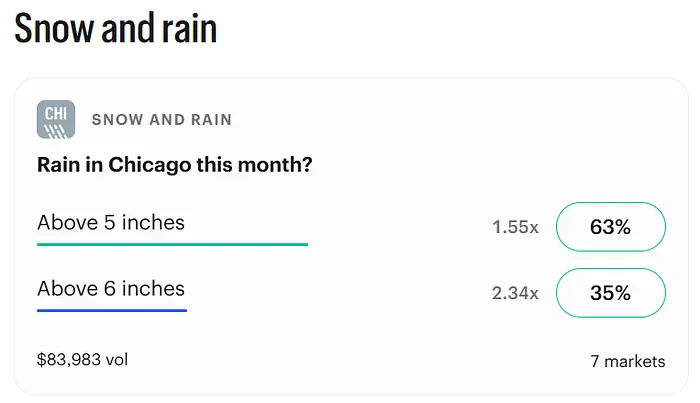
Today, prediction markets let anyone take a shot at forecasting the weather. By buying yes or no shares on specific weather events, will it rain, what will the temperature reach, will it snow, participants can test any model they have against a market of informed individuals. If your model is more accurate than the consensus, it makes money.
Examples of Weather Prediction Markets
Will it rain in [location] today?
Will it snow in [location] this month?
Highest temperature in [location] today?
Anyone who has spent time with professional prediction market traders knows they are a deeply strange cohort, many of whom occupy the outermost fringes of polite society. Which, if you've been paying attention, should make you optimistic.
This type of market-based forecasting has been happening for a long time now. Long before prediction markets were pricing snowfall in Central Park or hurricane landfalls, traders were already betting on the weather, just indirectly.
Trading Orange Futures - Why is Weather Significant with these Markets?
Orange juice futures are the classic example of how traders have been betting (albeit indirectly) on weather for years. The delicacy of orange crop yields, which raises or lowers the cost of orange juice, hinges on the weather, so traders who bet on derivative products that have oranges as an underlying have a natural incentive to seek hyper-accurate weather forecasts.
A freeze in Florida? Prices spike. A mild winter? Prices fall. Traders were forced to understand these things better than almost anyone else, and in many cases, they did.
There's a long-standing belief, enforced in equal measure by scattered academic work and trader lore, that agricultural futures markets often incorporate weather information faster and more efficiently than the National Weather Service. When real money is on the line, people invest in better data, better models, and sharper judgment.
Orange juice futures are super interesting however they carry a problem prediction markets don't. They don't just price in weather, they price in everything: shipping costs, labor shortages, currency fluctuations, disease, invasive pests, long-term climate shifts. That makes them a noisy proxy for the thing we actually care about: what is going to happen in the sky.
Prediction markets are direct and in the limited cases where direct weather prediction markets have been studied, they’ve shown promising, if still evolving, accuracy. Markets on rainfall,temperature ranges, and hurricane landfalls have often produced probability estimates that are competitive with traditional forecast models, especially when aggregated over time.
Like political prediction markets, their strength is not necessarily in beating expert models at every moment, but in efficiently incorporating dispersed information. Traders react quickly to new data, satellite updates, model runs, even subtle shifts in sentiment, and prices adjust in real time.
As methods of predicting weather improve, if I dare to dream optimistically, I hope these markets continue to grow with informed participants challenging each other through new ideas from new teams of new people.
I don’t think the average person should liquidate their 401(k) and put it all on the over for 12 inches of snow tomorrow; however, I hope somewhere out there, someone quirky with an innovative model has been given a new avenue to change the world.
Prediction markets involve risk and are not suitable for everyone. While many platforms offer tools to make informed trades, outcomes are never guaranteed, and users should never risk more than they can afford to lose. Always trade responsibly. Additionally, platform availability and legal status vary by region. It is your responsibility to check local laws and verify that you are legally allowed to use a given platform before participating.

 button in Safari