button in Safari
$11 Million Pot! Was Alex Foxen Right to Call the River All-In with a Flush vs Monarch?

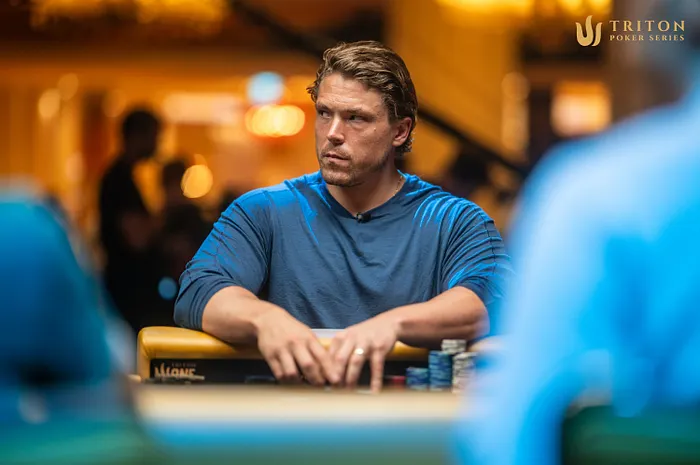
Table Of Contents
Earlier this week, Alex Foxen and Ossi "Monarch" Ketola clashed in a $30,000/$60,000 super-high-stakes cash game at the Triton Poker Series Jeju II. The pair played out a breathtaking hand that resulted in a $10,990,000 pot slide to Ketola when he improved to a full house on the river while Foxen had turned a flush. The pot, the largest-ever in televised poker history, garnered plenty of attention from the poker community, including many questioning Foxen's all-in river call. Here, PokerNews ambassador Lukas Robinson uses GTO Wizard to analyze the record-breaking hand.
Pre-flop Analysis
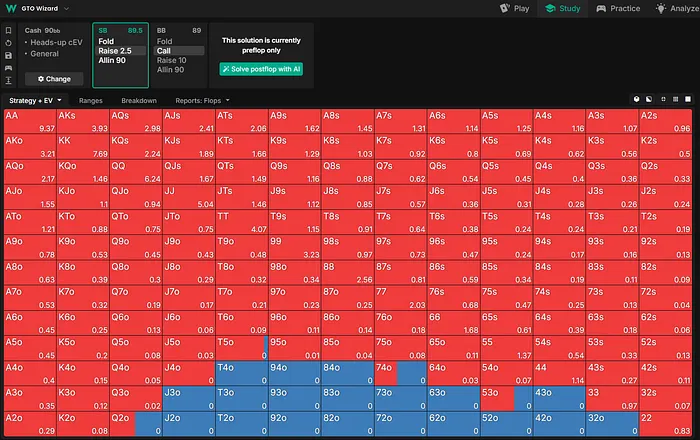
Monarch opens to $150,000 (2.5bb) on the BTN/SB holding K♣J♥ GTO Approved ✔️
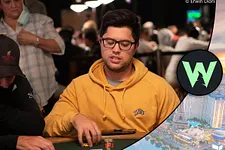
Alex Foxen defends from the BB with 8♦6♦. GTO Disapproved ✖️
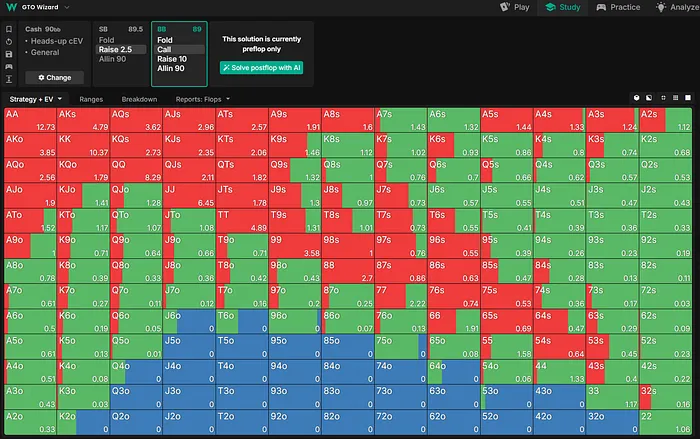
According to GTO Wizard, 8♦6♦ should always be played as a three-bet in this situation, with a recommended frequency of 100%.
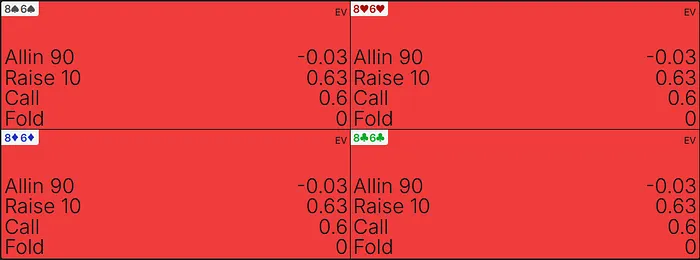
That said, the EV (expected value) of calling versus three-betting in this spot runs very close, meaning Foxen’s decision to just call isn’t a major mistake. Still, the solver leans toward the three-bet as the recommended play, largely for strategic reasons of balance and long-term EV maximisation.
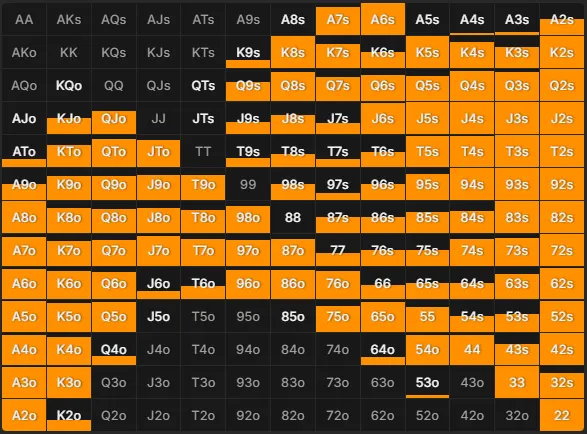
With this in mind, I decided to nodelock Foxen’s calling range to better reflect his actual tendencies, rather than sticking strictly to the solver’s suggested range. Specifically, I adjusted some of the mid-strength suited connectors, such as 86s, to mix between calling and 3-betting. This feels like a reasonable assumption, given that Foxen elected to just call with 86s in this particular hand.
What is Nodelocking?
Nodelocking is the process of telling the solver: “From this point in the hand, one player is going to deviate from pure GTO strategy.” The solver then re-solves the rest of the game tree, taking that adjustment into account.
This is an incredibly powerful tool because it lets you explore how ranges and strategies shift if a player is more passive, more aggressive, or has a specific tendency. In GTO Wizard, this feature is especially easy to use; you can apply AI-assisted nodelocks and get the re-solved outputs in seconds. This is exactly what I am using to analyse this hand.
Post-flop Analysis
Flop ($300,000 Pot): K♦J♦8♣
Alex Foxen Checks the Flop. GTO Approved ✔️
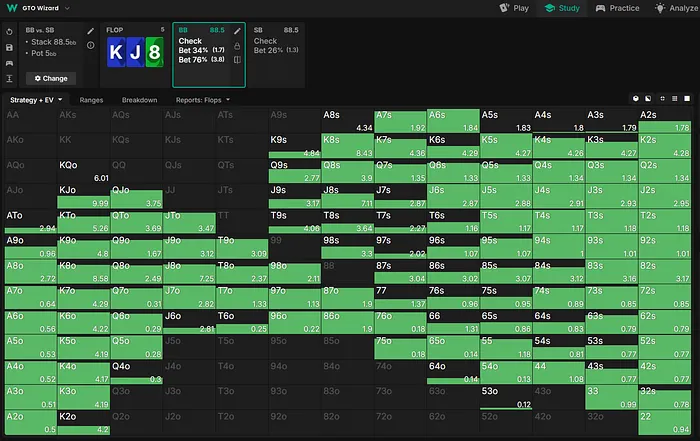
On the flop, the solver recommends that Foxen use a pure check strategy. This is because Monarch holds the clear range advantage on this texture, leaving no incentive for the Foxen to introduce a donk-betting range.
Monarch Checks the Flop with K♣J♥. GTO Disapproved ✖️
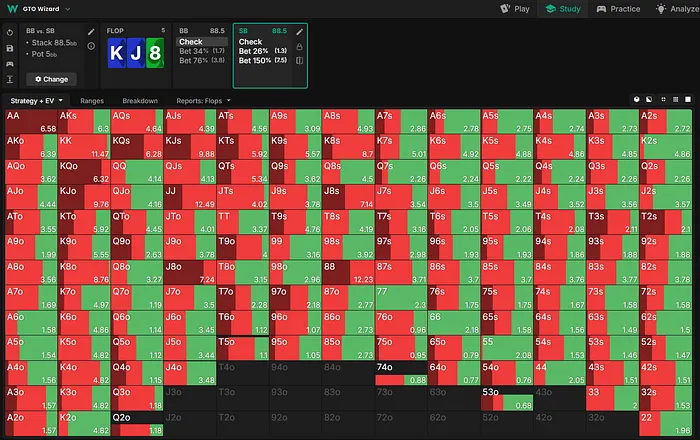
Although the solver recommends checking 43% of the time overall, the highest EV plays for KJo in this spot are to bet either small or big, rather than check.
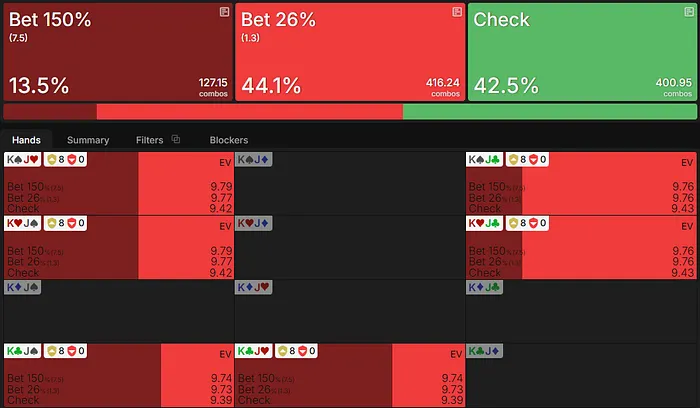
The solver recommends a mixed strategy on this flop, using checks, along with two bet sizes: A small bet of 26% (1.3bb) and a large overbet of 150% (7.5bb). This strategy arises from splitting the range between two types of value hands:
Hands that require a lot of protection, such as AA, KQ, KJ, 88. These hands are strong enough to justify an overbet because they need to protect against draws on this very wet board, while also extracting value from weaker holdings in the BTN’s range.
Hands that don’t require much protection or aren’t strong enough to overbet, including KK, JJ, 88. These hands don’t need significant protection and also block many of the calling combos in the BTN’s range. They also help balance the small bet size, ensuring that this sizing isn’t overloaded with too many weak hands.
Hands like QQ, AJ and K5 are better suited to smaller bets, as overbetting would primarily target stronger hands unnecessarily.
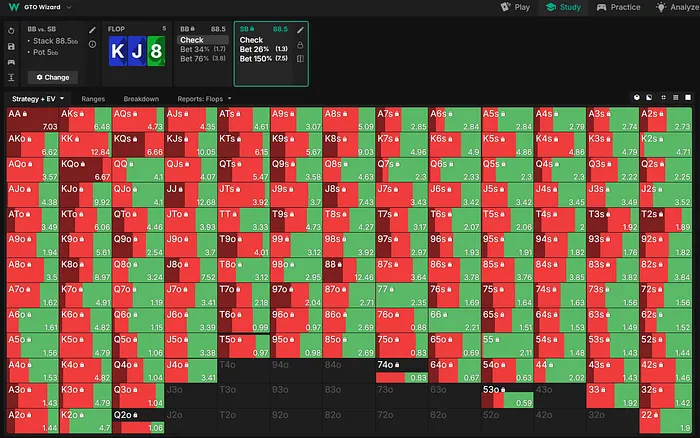
Since Monarch checked the flop with K♣J♥, I again nodelocked his range, mixing in some checks with their strongest hands, such as sets and two pairs, to reflect realistic in-game lines. You can see that nodelocked button range in the image below.
Turn ($300,000 Pot): A♦
Alex Foxen bets $250,000. GTO Approved ✔️
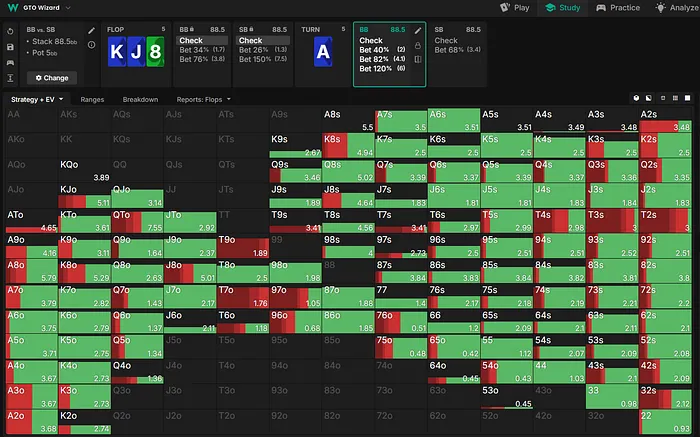
Recommended Bet Sizes and EV for 86s.
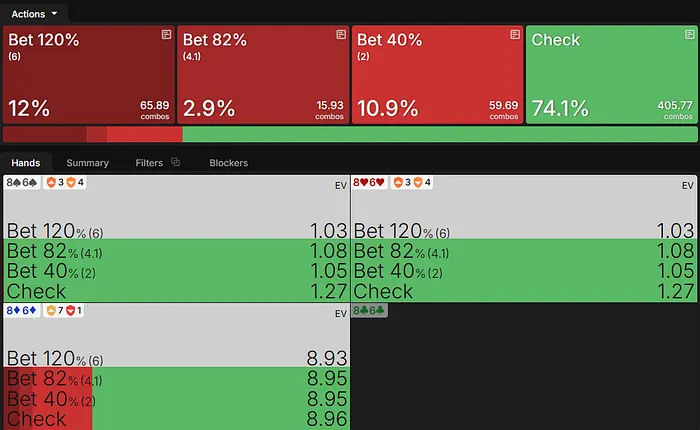
The solver prefers 120% or 40% pot-sized bets over Foxen’s chosen 82% size as an overall strategy, though the EV is very close across all three options. Specifically for 8♦6♦, the solver recommends mixing between checking and betting on the turn. You can see above how close the EV is for all four options. This approach helps balance the checking range with strong hands, ensuring it remains unexploitable.
Monarch calls the $250,000 bet on the Turn. GTO Approved ✔️
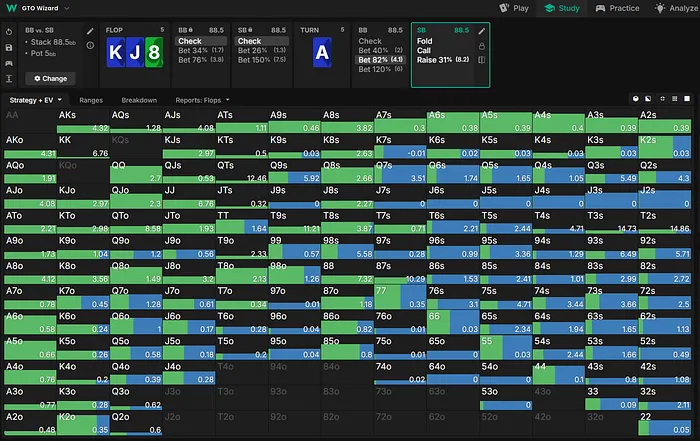
The solver recommends no raises from the BTN in this spot, as the BB now holds a much higher concentration of flushes in their range.
River ($800,000 Pot): K♠
Alex Foxen bets $550,000. GTO Approved (Just) ✔️
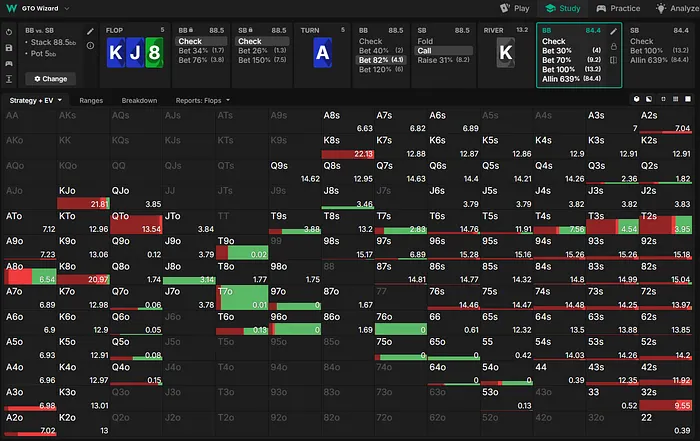
Recommended Bet Sizes and EV for 86s.
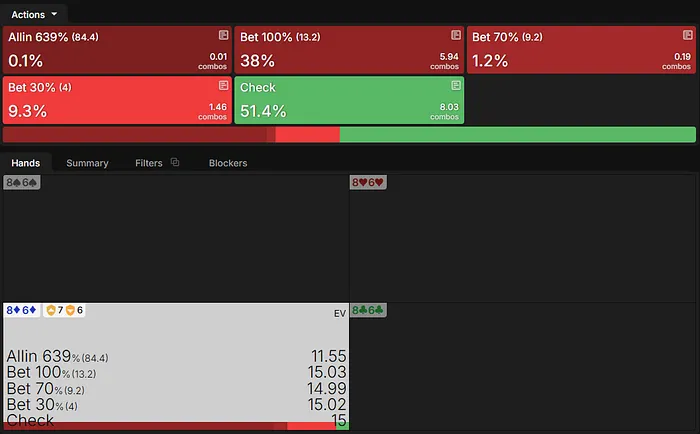
The solver marginally approves the $550,000 (70% pot) bet here, but only at a very low frequency. As shown above, the solver prefers a mix of checking, 30% pot bets, and 100% pot bets. This makes sense: betting 100% allows flushes and straights to extract value from worse hands like two pairs and top pairs, while 30% bets enable some top pairs and the weakest flushes to still get value. This also lets you balance your bluffs between the two bet sizes. For 8♦6♦ on the river, the highest EV plays are either a 100% pot bet or a 30% pot bet.
Monarch raises all-in for an additional $4,500,000. GTO Approved ✔️
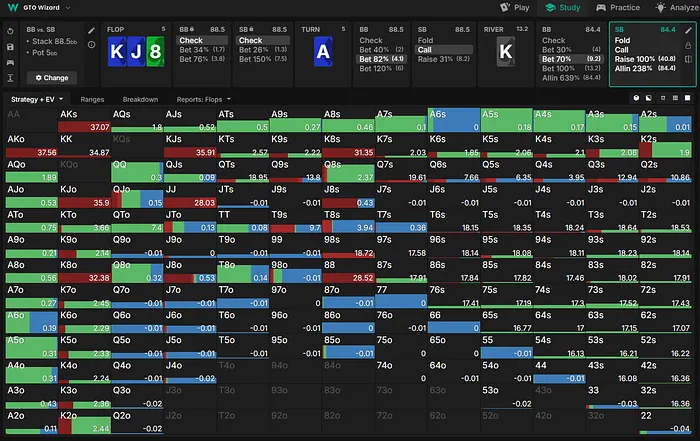
KJo EV on the River.
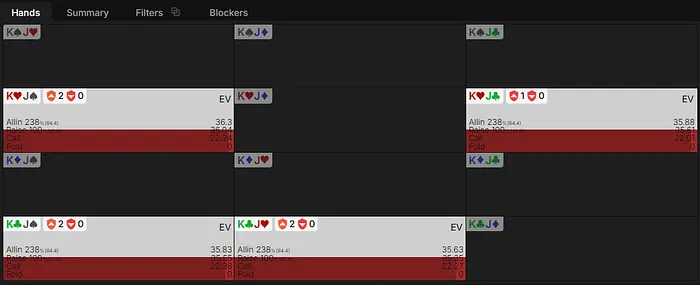
An easy, standard all-in jam with a full house, with no smaller sizings being used with this hand. As shown above, the bluffs are primarily coming from trips and two pairs, which are very difficult to identify when playing for such massive stakes. Notably, no flushes worse than 8♦6♦ are jamming for value in this spot.
Alex Foxen calls the all-in for his remaining $4,500,000. GTO Approved ✔️
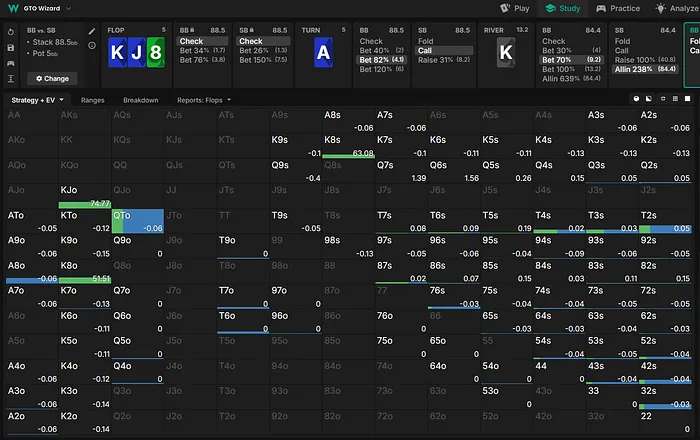
Flush Combos Calling/Folding on the River.
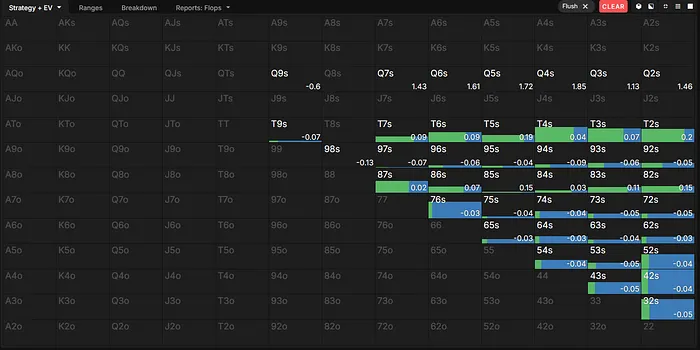
As shown, the primary flushes calling are ten-high flushes. Interestingly, eight-high flushes call more often than nine-high flushes, as they block some of the potential full-house combos in the opponent’s range.
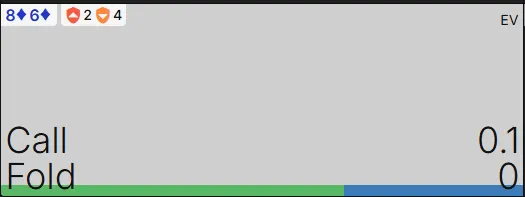
A devastating, but correct call in theory from Foxen, demonstrating why he is one of the best players in the world. While he technically lost to a better hand this time, the call was the highest EV play according to the solver. However, this EV depends entirely on whether Foxen believed Monarch was bluffing enough in this spot.
As we saw earlier, Monarch needed to start bluffing with trips and two pairs. If Foxen assumed he was using these combos, then calling with 8♦6♦ was a great play long-term, as it beats enough of Monarch’s range to make the call profitable, hence why the solver favours it.
Conversely, if Foxen didn’t believe Monarch was capable of bluffing enough, folding 8♦6♦ would have had higher EV. Because KJo theoretically wants to 100% bet the flop, it makes sense that Foxen might have assumed Monarch’s range also contained fewer full houses than it actually did in-game. This hand highlights the fine margins of decision-making in poker, especially when playing for $11,000,000.
Conclusion
Before analysing this hand with the solver, I asked myself two key questions:
- Is the flop check with K♣J♥ solver-approved? (I initially felt it wasn’t.)
- Is Alex Foxen’s river call to the all-in solver-approved? (This one felt close.)
Using the GTO Wizard solver, we can now see that while checkingK♣J♥ on the flop isn’t a catastrophic error, it is suboptimal, as betting would produce significantly more EV overall. That said, if Monarch hadn’t checked K♣J♥ on the flop, would he have gotten maximum value from 8♦6♦ on the river? That’s something we’ll likely never know!
For the second question, the solver shows that the decision was extremely close. The EV difference between calling or folding 8♦6♦ on the river is only 0.1, which is negligible. As one of the best players in the world, Foxen likely recognised this in-game. My guess is that he observed enough from Monarch to believe there were sufficient bluffs and not enough value in his opponent’s range to make the call profitable. So, even though Alex lost the hand, he made the highest EV play by calling.
A very well-played hand by both players, who made history with the largest televised poker pot ever!