button in Safari
BBZ Poker Gives You the Only Blind-vs-Blind Guide You'll Ever Need


Table Of Contents
- Small Blind Strategy When Acting First
- Big Blind Isolation Strategy Against Small Blind Limps
- Playing Postflop in Blind vs Blind Spots
- Why The Small Blind Should Check Most Flops
- How Should the Big Blind Defend Against a 1bb Stab?
- The Overcard and Undercard Framework for Blind vs Blind Defense
- Conclusion
Blind battles are extremely common in tournament poker and among the most misplayed spots, too. Many players are unsure of the correct strategy when the action folds around to them in the blinds, but the decisions made in a blind-versus-blind battle can have a significant influence on a player's win rate.
The strategy experts at BBZ Poker have produced a complete guide to blind versus blind play for multi-table tournaments. Some of poker's sharpest minds have worked together to show:
- How the small blind should construct limping and raising ranges
- How the big blind isolates small blind limps
- Why the small blind should check most flops after limping
- How to calculate minimum defense frequency
- The framework for building big blind defense strategies
The following are snippets from BBZ Poker's excellent article. You can read the article in full, here
Small Blind Strategy When Acting First
According to BBZ Poker, players "should not be playing passively at most stack depths" when the action folds to the small blind. Many people fold too much in this spot, but the question players should ask themselves is how they will enter the pot, not whether they will play.
Indeed, with a stack of 20 big blinds, the correct strategy for opening from the small blind is to play 85.5% of hands! Limping makes up the majority of that percentage (56%), with raising (18%), and shoving (11%) also being options. Only 14% of hands should be folded. Check out the image below for a visual.
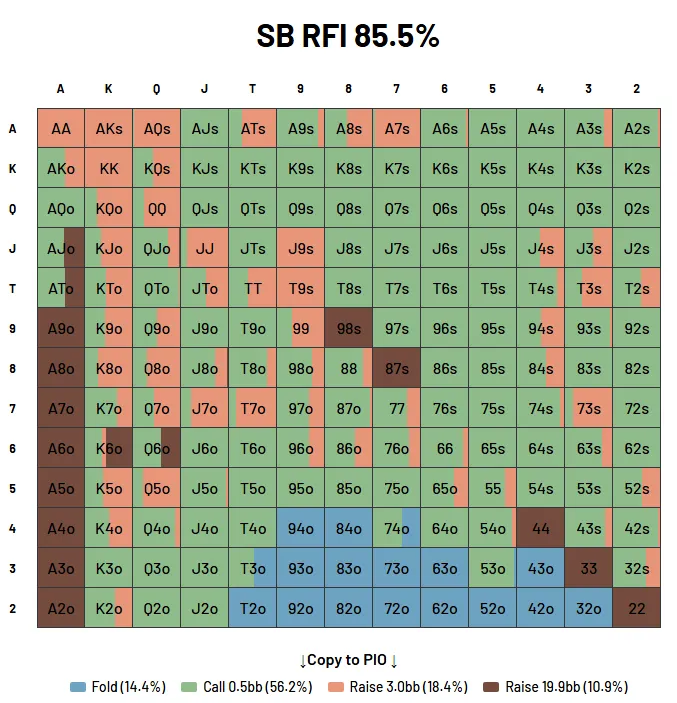
Once you reach 60 big blinds, limping accounts for approximately 75% of hands, including premium hands. BBZ Poker has solver charts for five stack depths available here. Studying structured ranges using tools like these poker range charts can also help players understand optimal preflop decisions at different stack depths.
Big Blind Isolation Strategy Against Small Blind Limps
The big blind has a decision to make whenever the small blind open-limps. A small blind's limping range can include traps, giving the big blind something to think about.
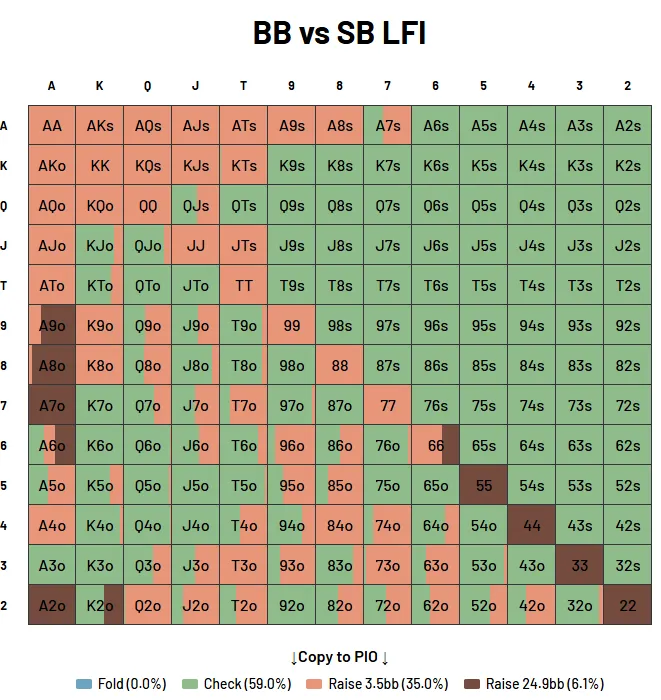
BBZ Poker suggests a polarized isolation range: very strong hands and very weak hands, with fewer medium-strength hands. This structure is well-suited to counter limp-reraises because strong hands welcome the action and weaker hands can fold cheaply. Medium hands are stuck in limbo where they feel too good to fold but too weak to continue.
The image below shows what you should do as the big blind when the small blind limps, with effective stacks of 25 big blinds.
Playing Postflop in Blind vs Blind Spots
Blind versus blind postflop play is dramatically different from other tournament scenarios, mostly because both players have wide ranges. The small blind is out of position, with a strategy that mainly consists of limps and raises, while the big blind has position and a range that includes checked-back hands and isolation raises.
These dynamics often result in significant mistakes and complex postflop situations in games like Texas Hold’em.
Why The Small Blind Should Check Most Flops
According to the BBZ Poker experts, the small blind should check between 55% and 75% of flops after limping in, with some boards increasing that number to 100%.
"There are two structural reasons why the small blind must check so frequently."
"The first is the folding component. Preflop, the small blind had a folding range and the big blind did not. The big blind checks for free and arrives at the flop with nearly every hand that was dealt to them, minus the hands they would have raised preflop. The small blind’s range has already been filtered by the hands that folded."
"The second is the isolation component. When the big blind isolates, they remove their strongest hands from the checking range. The hands that checked back tend to be the middle or lower portion of their range. This creates density, especially on low boards."
This section of the BBZ Poker blog also explains, in depth, why the small blind should overbet on a low board. Be sure to check it out.
How Should the Big Blind Defend Against a 1bb Stab?
When the small blind decides to take a stab in a limped blind versus blind pot, it is usually 1bb into a 2.5 bb pot. This common stab makes it easy to calculate the maximum fold percentage the big blind can have before the small blind's bluffs become automatically profitable.
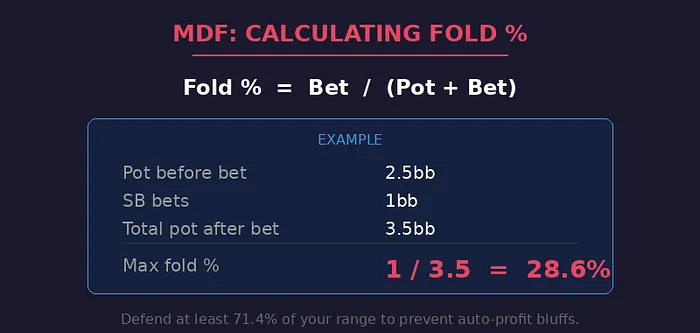
As you can see, that percentage is 28.6%, which means the big blind must defend at least 71.4% of the time to stop the small blind from profiting from indiscriminate bluffs. Players who want to run similar calculations themselves can use tools like the PokerNews poker odds calculator.
The Overcard and Undercard Framework for Blind vs Blind Defense
The next section of the BBZ Poker blog delves into the framework for blind vs blind defence.
"So how do we decide which hands to fold? The answer is a framework built around overcards and undercards relative to the cards on the board. This is one of the fastest and most reliable ways to construct large defending strategies across a wide range of flop textures.
The core insight is that not all board cards are created equal when it comes to determining which hands in your range have strategic value. Some cards on the board are almost irrelevant for the folding decision, while others drive the majority of it."
This section is thorough, and we highly suggest you read and digest it in full as the author intended.
The key takeaway from this section is, "The overcard and undercard framework lets you build large defending strategies quickly. Ignore the ace (everything is equally bad) and ignore the deuce (everything is equally good). Focus on the middle cards. Overcards to higher board cards are rare and valuable. Two undercards to low board cards are worthless. Marginal draws will save hands that would otherwise fold."
Tools like the PokerNews collection of poker tools can also help players study these spots away from the table.
Conclusion
Blind versus blind strategy in tournaments is a multi-layered problem. First, the small blind has to decide how to enter the pot, then the big blind has to decide whether to raise, then on the flop, both players must navigate wide ranges with thin equity margins.
The best way to sharpen you skills in this scenario is to head to BBZ Poker and sign up for one of their courses, daily seminars, private coaching, the MTT Leak Finder, enjoy their quality free blog, or do them all. The choice is yours.
Many of these concepts are most relevant in modern tournament play, particularly in fast-paced online poker tournaments where blind vs blind spots occur frequently.
If you want, I can also show you a really effective internal linking trick PokerNews strategy writers use that can boost Google Discover traffic, which a lot of poker sites miss.