button in Safari
Insane Ten-High Hero Call Vs. Fedor Holtz with Eight Players Left in a $30k Triton Event



Table Of Contents
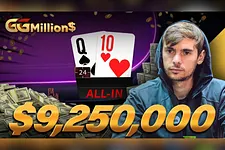
Viktor Kudinov made an epic 10-high hero call to win a crucial pot at the final table of a $30,000 Triton Poker Cyprus event against poker legend Fedor Holz, who had an even worse holding. But was the river call solver approved? Let's find out through the lense of GTO Wizard and other poker tools.
Here's the situation: eight out of 123 players remained — four at each table. Each remaining player had a guaranteed minimum payout of $123,500. The next pay jump was to $164,000, and the winner would take home $930,000, so there were all sorts of ICM considerations in play.
Holz was the second-largest stack at the table with 5.2 million chips (52 big blinds), and Kudinov was the was the shorty with 2.2 million (22 big blinds). Ben Tollerene (5.5 million) and Yuri Dzivielevski (2.5 million) were seated at the same table. The table had 15.4 million of the 24.6 million chips in play.
Action in the Hand
Holz, the small blind with 6♦4♠, began the action by raising to 240,000 (1.4 times the big blind) from the small blind. Kudinov, in the big blind with 10♣9♠, defended. The flop came out K♥Q♥2♣.
With six-high and minimal in the way of potential backdoor draws, Holz checked and so did his opponent, who flopped a gutshot straight draw. The turn was the K♠, which paired the board and didn't improve either hand. Holz, sitting on six-high, fired out a bet of 175,000, to which Kudinov called.
The A♣ appeared on the river, again failing to connect with either hand. Holz, knowing he couldn't win at showdown, bet 390,000 into a pot of 930,000 on a bluff attempt. Kudinov, with just 10-high, risked a significant portion of his stack to make an epic hero call to take down a crucial pot and would eventually go on to finish in seventh place for $164,000. Holz, who lost the big pot, finished two spots higher.
The call was certainly incredible, but was it actually GTO Wizard approved? Let's find out.
Preflop Analysis
Fedor Holz raises to 240,000 from the small blind holding 6♦4♣. GTO Approved.
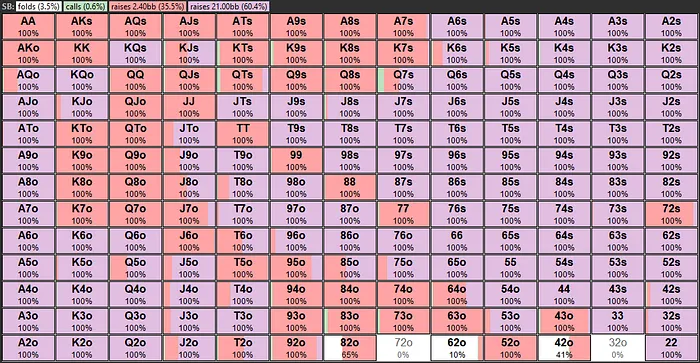
6-4 offsuit is mixed between raising to 2.4 big blinds and shoving all in. Both options generate nearly the same expected value (EV).
The solver recommends that the small blind adopt an aggressive strategy versus the big blind, folding only 3.5% of hands and either raising to 2.4 big blind or shoving all in with the rest. I’ll explain why this is the case with supporting evidence further down.
Viktor Kudinov defends from the big blind with 10♣9♠. GTO Approved.
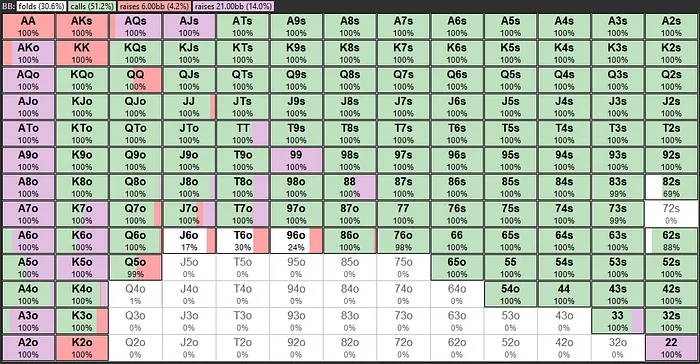
The big blind folds 30% of hands versus this 2.4-big blind raise from the small blind, but 10-9 offsuit is a pure call. Above you can see that calling with 10-9 offsuit is the optimal play, as it produces the highest overall EV.
What is a Bubble Factor and Risk Premium in Poker?
Bubble Factor:
- Measures how much a player’s strategy should tighten when they are close to a payout (the “bubble”).
- A higher bubble factor means losing chips is very costly, so you need stronger hands to play big pots.
Risk Premium:
- The extra equity a hand needs to continue in a spot because losing chips is more expensive than usual.
- In other words, it’s the penalty for risking chips under ICM, the higher the risk premium, the stronger your hand must be to play aggressively.
Bubble Factors and Risk Premiums for this spot:
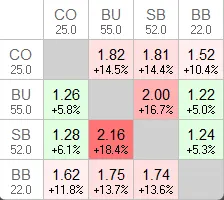
Here you can see that the big blind facing a 2.4 big blind raise from the small blind carries a 1.24 bubble factor and a 5.3% risk premium. This means that in this spot, the big blind needs 5.3% extra equity to continue vs the open, which reflects the combined pressure of having one of the lowest stacks remaining (22 big blinds) and being on the final two tables with eight players left. This explains why making a move with marginal hands in this situation is particularly costly, but also why the small blind can use such an aggressive strategy vs the big blind.
Both players made perfect GTO decisions pre-flop. Now let’s analyse their post-flop play.
Post-flop Analysis
Flop (580,000 Pot): K♥Q♥2♣
Holz checks the flop with 6♦4♣: GTO Approved.
Small Blind Strategy on the flop:
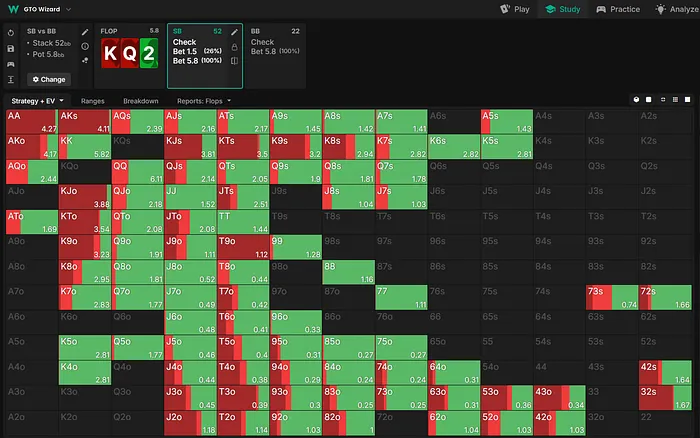
The solver recommends using the 100% bet size as the highest frequency play when betting. This applies pressure on the big blind’s range due to the risk premium, and a polarised strategy is employed in doing so.
What is a Polarised betting strategy?
- A strategy where you bet only your very strong hands and your bluffs, while checking all medium-strength hands.
- The goal is to maximize value with the best hands and apply pressure with bluffs, making it difficult for opponents to exploit your range.
Recommended Strategy and EV for 6-4 offsuit on the flop:
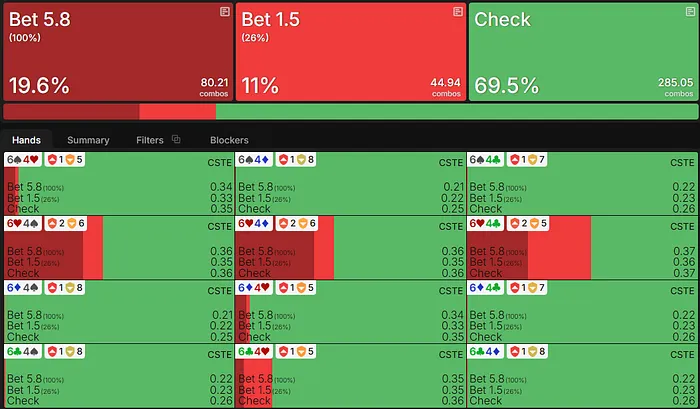
Above you can see that the solver recommends betting only 64o combos containing a heart to gain some extra equity if called, while checking 6♦4♣ provides the highest overall EV on this flop.
Kudinov checks back the flop with 10♣9♠. GTO Approved.
Big blind Strategy on the flop versus small blind Check:
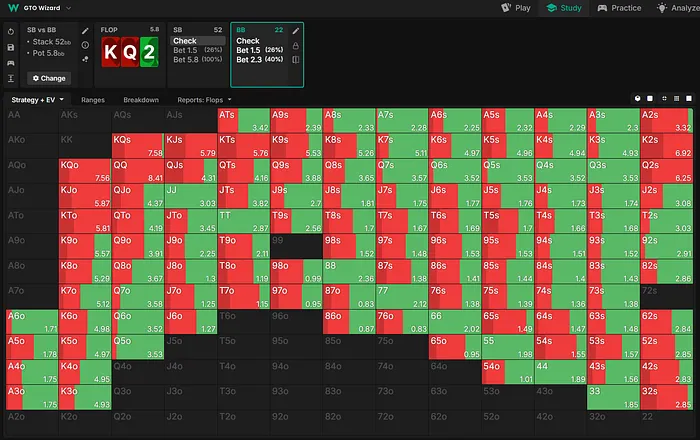
Recommended Strategy and EV for 10-9 offsuit on the flop:
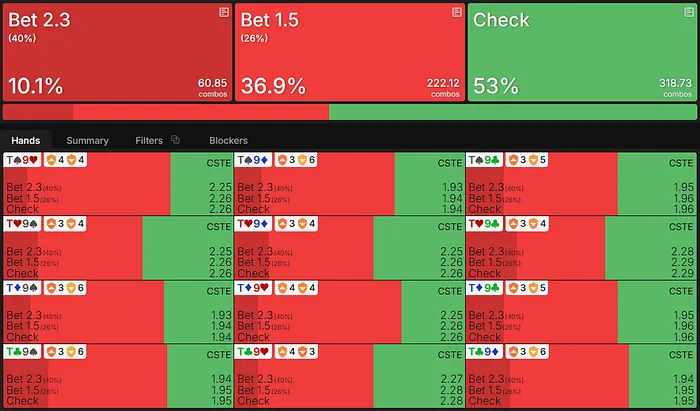
The solver recommends mixing between checking and betting with all 10-9 offsuit combos, along with many other combos in the big blind’s range. Let’s do a range comparison to see why.
Small Blind Vs. Big Blind Range Comparison on this Flop:
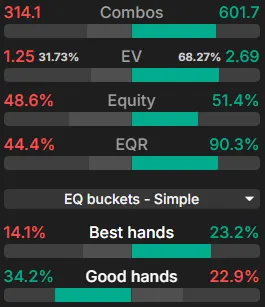
So, although the big blind had a 5.3% risk premium pre-flop, you can see that on this specific flop the big blind holds both the EV and equity advantage, along with the positional advantage. This is why the solver recommends 47% betting from the big blind on this flop, compared to just 30% from the small blind.
If you want to study preflop structures for spots like this, tools like poker range charts can help contextualize which hands are typically defended blind vs blind.
Turn (580,000 Pot): K♠
Holz bets 175,000 on the turn with 6♦4♣. GTO Approved.
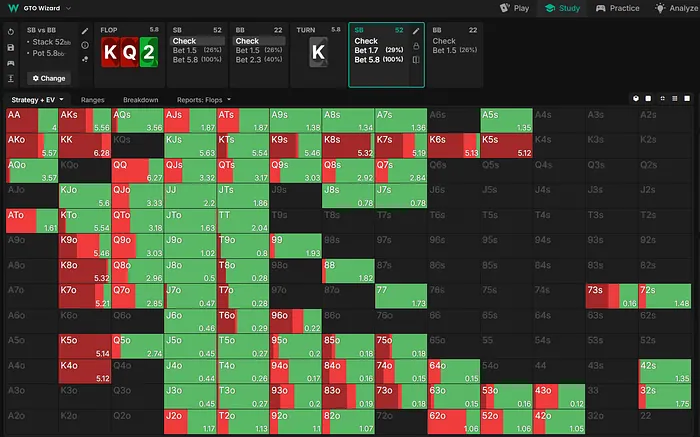
A polarised betting strategy is again recommended on the turn by the solver, although some combos, including 6-4 offsuit, use a smaller betting size.
Recommended Strategy and EV for 6-4 offsuit on the turn:
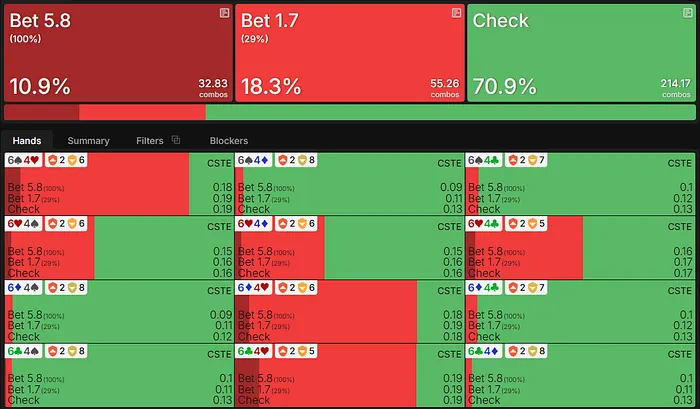
However, you can see that 6-4 offsuit combos containing a heart are again preferred to those without a heart, as betting them produces significantly higher EV. Specifically, for 6♦4♣, the solver generally prefers checking, but there is a small amount of betting with the 29% size that Holz used. The EV is almost identical between betting this size and checking.
Kudinov calls the 175,000 bet with 10♣9♠ on the turn. GTO approved.
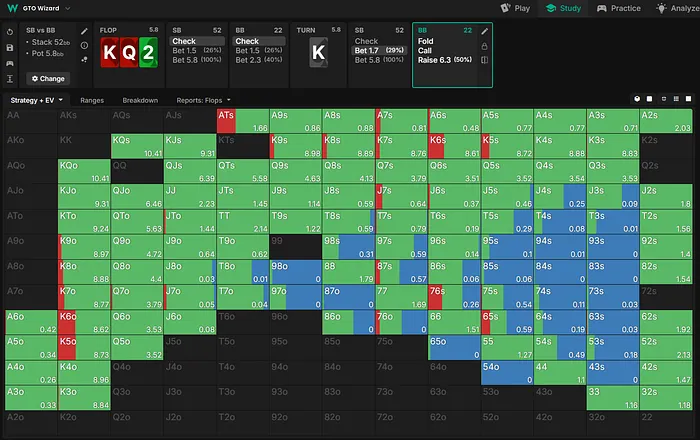
The solver only recommends folding 23% of your combos from the big blind versus this size from the small blind. However, the combos highlighted in blue are the ones that fold, showing the value of betting this size from the small blind with hands like 6-4 offsuit, as it forces many dominating combos to fold.
Recommended Strategy and EV for 10-9 offsuit on the turn:
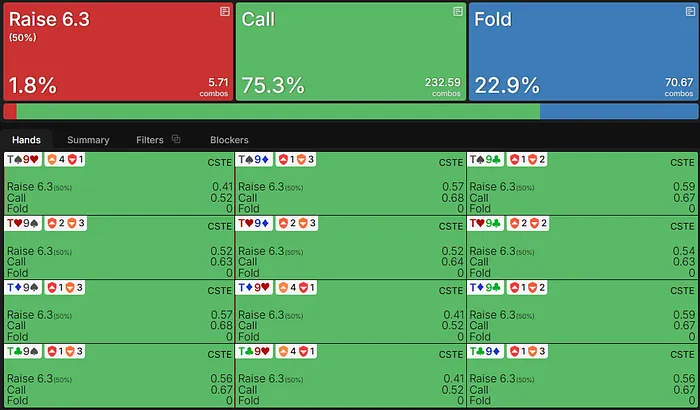
10-9 offsuit, however, is not one of these folding combos, as it has a gut-shot straight draw and the potential to be ahead with ten-high.
River (930,000 Pot): A♣
Holz bets 390,000 on the river with 6♦4♣. GTO disapproved.
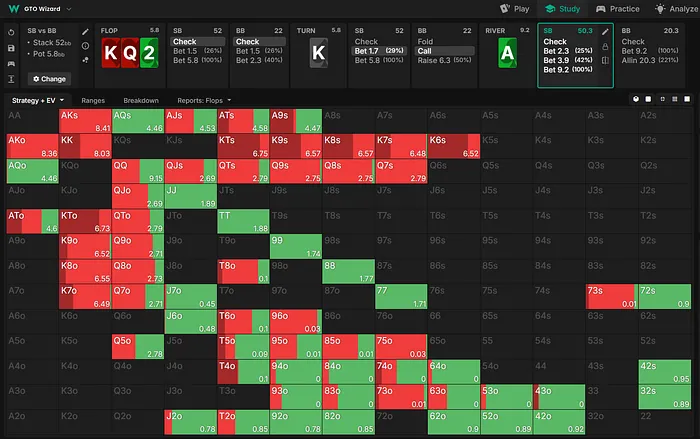
The most common bet size recommended on this river from the small blind is actually 25%, not the 42% size that Holz used. Let’s take a closer look at why this is the case.
Small Blind vs Big Blind Range Comparison on this River:
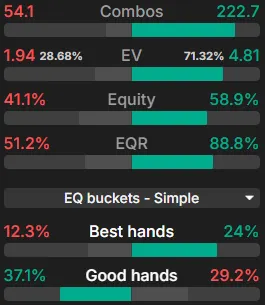
Since the bigblind still holds the EV and equity advantage on this river card, the small blind uses a small 25% bet size to apply some pressure and extract value without overcommitting. This allows the small blind to control the pot against a stronger range, bluff lightly, and polarise their range without taking on too much risk.
Recommended Strategy and EV for 6-4 offsuit on the river:
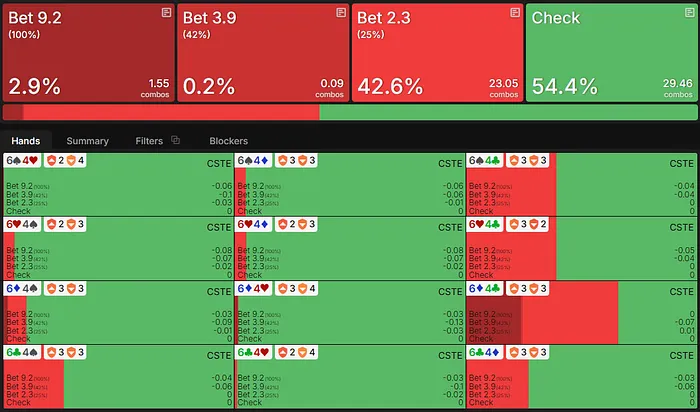
Although the difference between betting 25% and 42% may not seem huge, the EV impact is actually significant. The most optimal play overall for most 6-4 offsuit combos on this river is to check, but specifically for 6♦4♣ it is to bet 25%. Fedor was therefore not far from being GTO perfect on this river card, though he may have opted for a bigger size to try and fold out hands like 10-9 offsuit.
Kudinov calls a 390,000 bet with 10♣9♠ on the river. GTO disapproved.
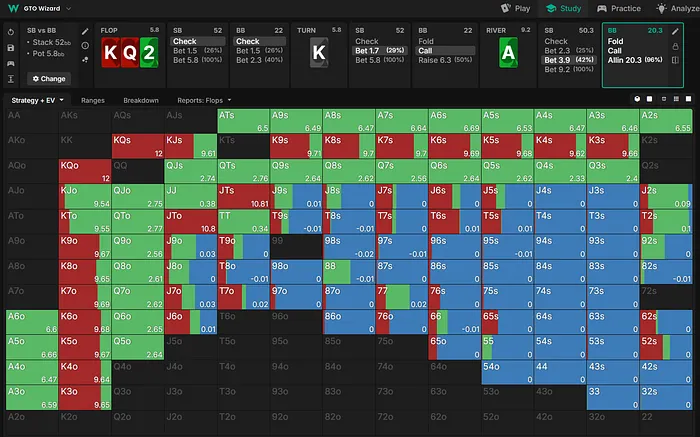
Recommended Strategy and EV for 10-9 offsuit on the river vs 42% bet size:
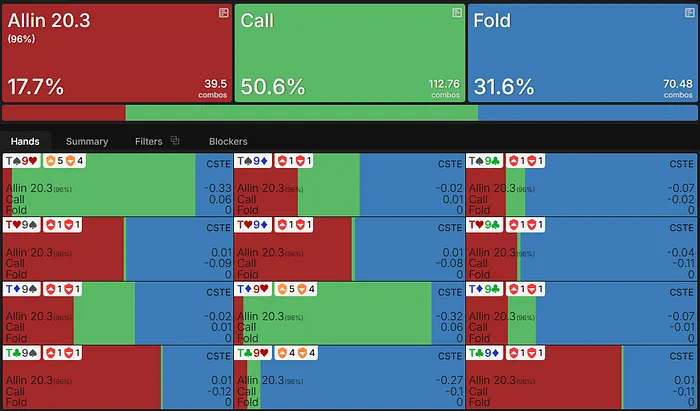
Specifically, 10♣9♠ prefers to either shove all-in or fold, rather than call, while other 10-9 offsuit combos still lean towards calling. Now let’s see how these combos perform vs a 25% bet size.
Recommended Strategy and EV for 10-9 offsuit on the river vs 25% bet size:
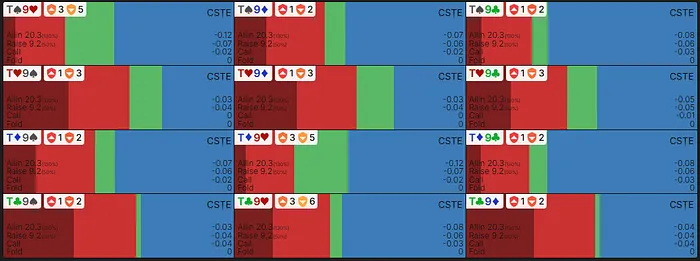
Interestingly, vs this size, all 10-9 offsuit combos achieve the highest EV by folding. However, this is against an small blind range that isn’t meant to use the 42% size very often, so I will nodelock the small blind range to include more hands at this 42% size to see if 10-9 offsuit then becomes a profitable call.
Recommended Strategy/EV for 10-9 offsuit on the river vs Nodelocked Range & 42% bet size:
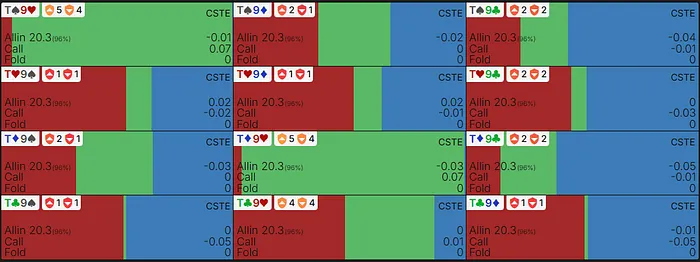
Unfortunately for Kudinov, 10♣9♠ is still a fold, although some other 10-9 offsuit combos do generate a profit when calling. This means that while the call wasn’t completely solver-approved, it was close to being theoretically correct. Most importantly, he made the right decision in-game and ended up scooping the pot with just ten-high.
If you want to sanity-check bluff-catch spots away from the table, the PokerNews poker odds calculator and our broader poker tools section are a good place to start, along with the Poker Cheat Sheet for key concepts.
If you want to analyse your poker hands just like I did with this one, use the link below to download GTO Wizard for free.