button in Safari
Were These Two Players Playing GTO Poker at the 2015 WSOP Main Event Final Table?


Solver-based study has transformed how poker hands are understood, but long before GTO became standard, players were still making high-stakes decisions under intense pressure.
PokerNews Ambassador Lukas “RobinPoker” Robinson — using GTO Wizard — went back to a hand from the 2015 WSOP Main Event final table to see how two players handled extreme ICM spots, and how closely their decisions aligned with modern GTO strategy and other poker tools.
The Hand
The hand took place eight-handed at the final table of the 2015 WSOP Main Event. Blinds were 250,000/500,000 with a 50,000 ante, first place paid more than $7.6 million, and a six-big-blind stack was still in play.
Pierre Neuville sat with 22,925,000 (45.9bb), while Thomas Cannuli was under significant pressure in the big blind with 8,250,000 (16.5bb). With these stack sizes and the payout structure, every decision carried major ICM implications.
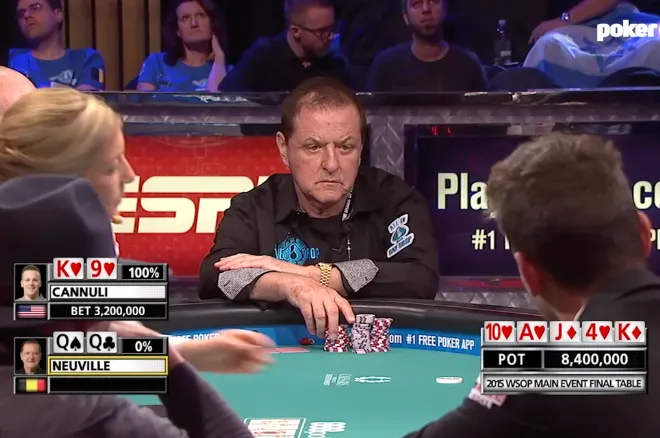
Neuville opened to 1,275,000 holding Q♠Q♣ from the cutoff (CO). Cannuli defended the big blind (BB) with K♥9♥.
The flop came A♥J♦10♥. Both players checked.
The turn was the 4♥. Cannuli now made a king-high flush and led out for 1,000,000. Neuville called.
The river brought the K♦. Cannuli bet 3,200,000 into a pot of 5,200,000. Neuville called and revealed that he had made a straight on the river, but Cannuli’s flush was still best and took down the pot.
Pre-flop
Neuville’s open with pocket queens is fully solver-approved.
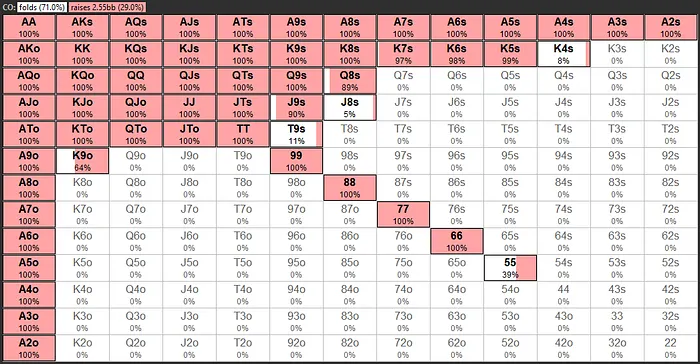
Cannuli's call with king-nine suited is GTO disapproved.
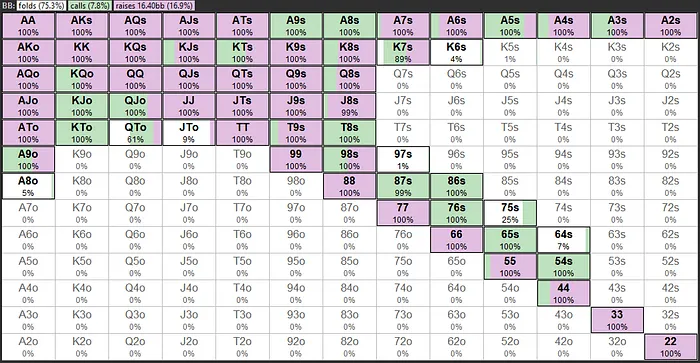
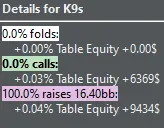
The the solver actually recommends shoving with K9s and 17% of hands. Shoving here far outperforms calling in terms of $EV.
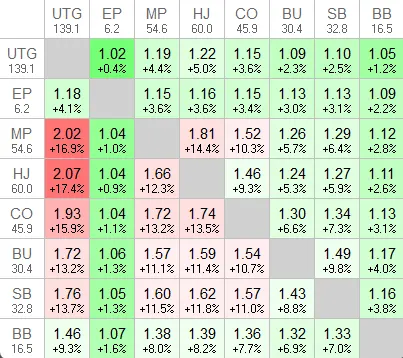
Here, the BB facing a CO open carries a 1.36 bubble factor and a 7.7% risk premium. With only 16.5bb and the CO covering with 46bb, plus a 6bb stack still at the table, the BB needs 7.7% extra equity to continue. This allows the CO to apply pressure post-flop, forcing the BB to play out of position and make tough decisions. Let’s also analyse the CO’s calling range to this all-in to see what hands fold.
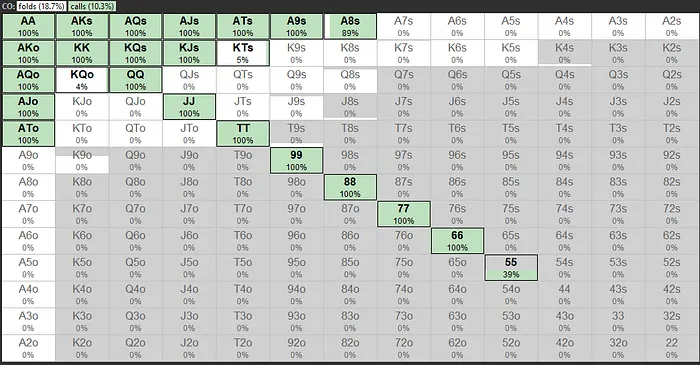
Here you can see how many better and dominated hands the BB can force to fold from the CO’s range when shoving all-in. With Cannuli holding only 16.5bb, calling and flopping top pair would likely force him to commit his remaining stack, making it crucial to fold out many of these dominating hands.
Another thing to note is that Neuville opened to 2.55bb, which gives the BB a worse price to call but a better price to shove all-in.
All of these factors combine to make shoving with K9s the most profitable pre-flop play.
Since Cannuli called pre-flop, I will nodelock him to include more calls, allowing us to analyse the rest of the hand using the actual ranges played by both opponents. This is a really effective AI feature within GTO Wizard that I highly recommend using to analyse the actual in-game ranges players use. You can adjust the ranges and then see the optimal strategy for the rest of the hand within seconds.
What does $EV mean?
Also known as ICM EV. It’s the expected real-money value of your tournament stack or decision after applying the payout structure.
It tells you how much your chips are worth in actual dollars according to ICM.
Players who want to compare baseline opening and defending ranges can also reference these poker range charts for common tournament spots.
Flop
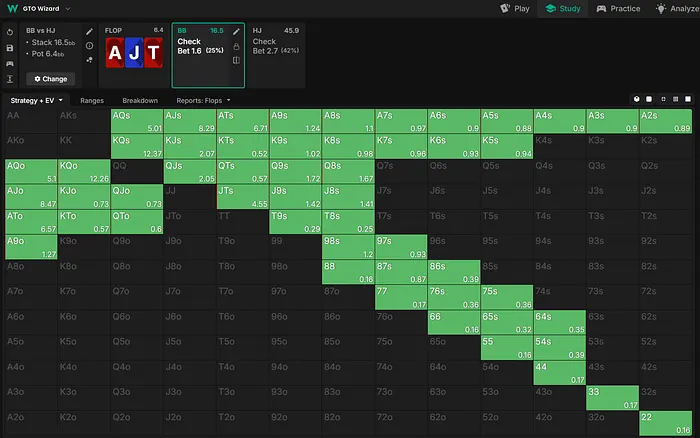
On the A♥J♦10♥ flop, Cannullo makes the solver-approved check with his big combo draw. The solver recommends zero donk-betting from the BB on this flop, as the CO holds the EV and equity advantage, along with positional superiority.
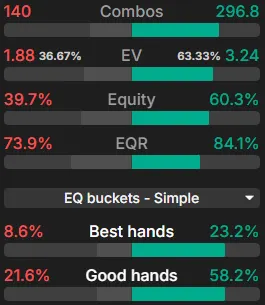
Neuville, with second pair, also checked.
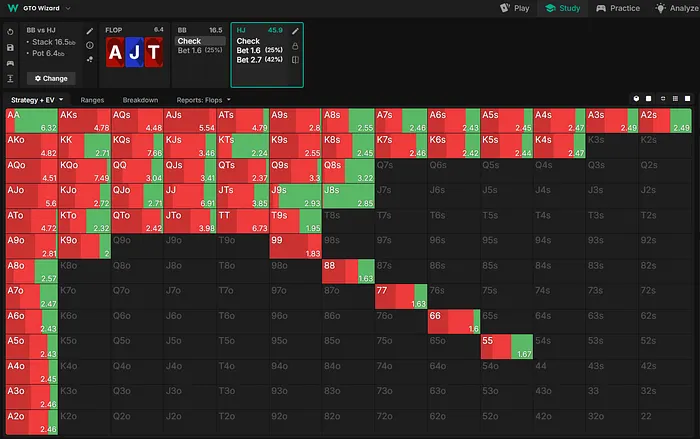
The solver recommends a high percentage of betting on the flop from the CO vs the BB, due to the CO’s EV and equity advantage. Only 22% checking is recommended from the solver, with checks mixed in among some QxQx combos.
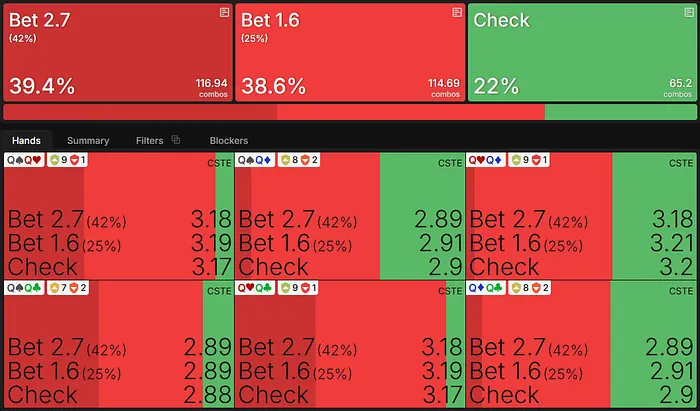
Above you can see that all QxQx combos are recommended to bet at a high frequency, using both the 25% and 42% bet sizes. However, checking has a similar EV to these betting options, so it is recommended at a low frequency to balance the checking range on this board.
This type of range interaction is most commonly studied in Texas Hold’em, where position and board texture heavily shape solver outputs.
Turn
Cannuli made his flush on the 4♥ turn and bet 1,000,000 into a pot of 3,200,000, which the solver liked.
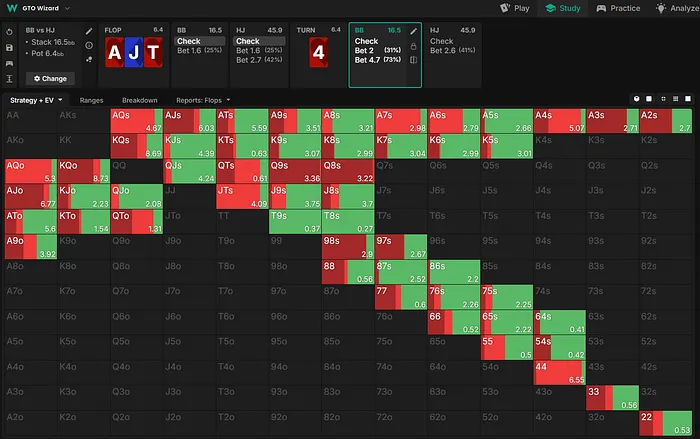
The solver now recommends the BB to start betting 46% of their range on this specific turn card.
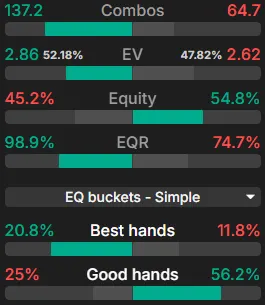
You can see that the EV has now shifted in favour of the BB’s range, along with a higher percentage of the best hands, although the equity advantage still remains with the CO. So, what does this actually mean?
Best Hands = Flushes, Straights and Sets
This means the BB now holds more of these strong hands in their range than the CO does (20.8% vs 11.8%). As a result, the BB’s range gains an EV advantage on the turn, since they can extract more value. However, the CO still retains the equity advantage, meaning that if the hand were played to showdown without betting, the CO’s combos are still slightly more likely to win overall, largely thanks to the positional advantage.
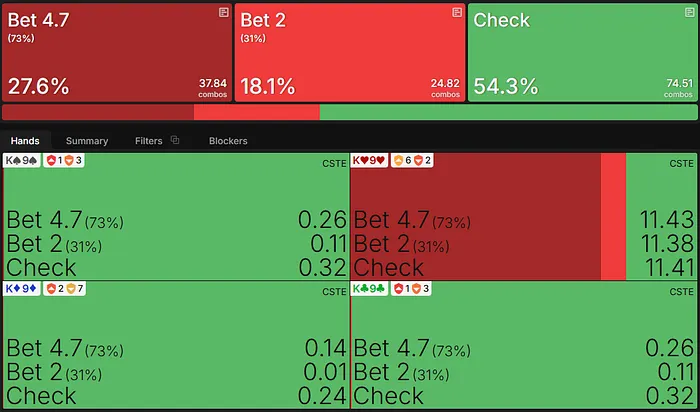
The solver recommends the larger bet size of 73% over the 31% that Cannuli used in-game, although the difference in EV between the two is not significant.
The solver recommends using the 73% size because it is a geometric bet.
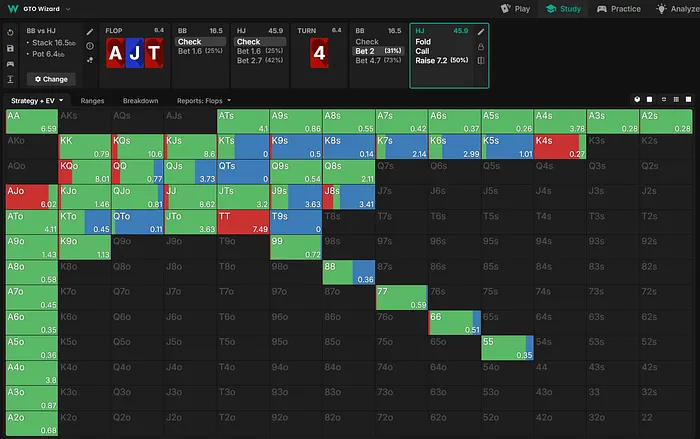
Neuville called the turn bet with his Q♠Q♣, but the solver wasn't a fan of this play and disapproved.
Only 19% of combos fold to this size on the turn from the CO, but unfortunately for Neuville, Q♠Q♣ falls within that 19%.
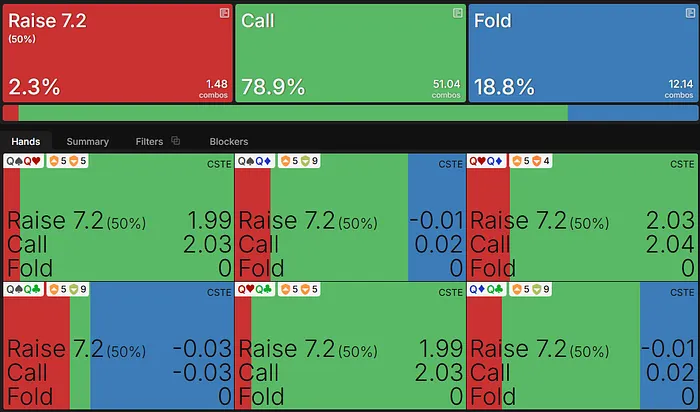
Q♠Q♣ is actually the only pocket queens combo that is not profitable to call vs this turn bet. So, although it was a mistake from Neuville, it wasn’t a major one. Because this specific queens combo wouldn’t call the turn in theory, I will nodelock it to call, allowing us to analyse the rest of the hand.
What is a geometric bet size?
A geometric bet size is one where you bet a consistent percentage of the pot on each street so that stacks end up effectively going all-in on the river. This approach is optimal when your range is perfectly polarized, as it maximizes minimum defense frequency (MDF) while ensuring that the full stacks are committed by the river.
River
The K♦ completed the board, and Canulli made a solver approved bet of 3,200,000 into 5,200,000.
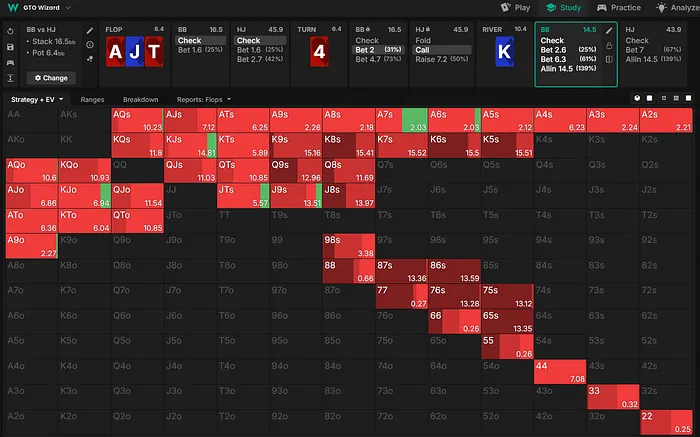
The BB is essentially range-betting on this river card, mixing between 25%, 61%, and all-in sizes.
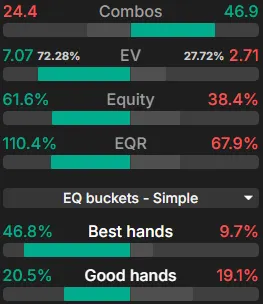
This is because the BB now holds a significantly higher EV and equity advantage overall on this river card.
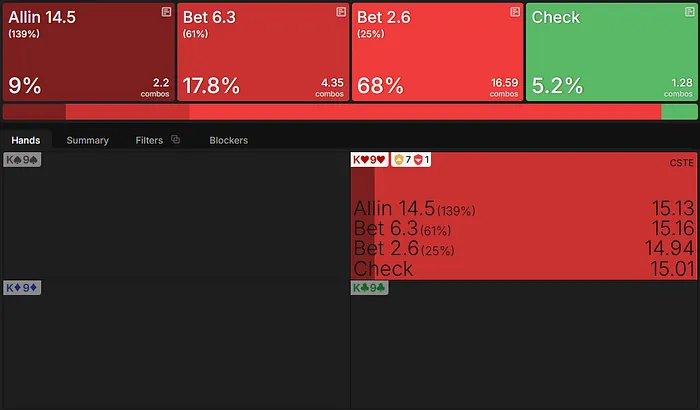
Cannuli found the highest EV play on this river card by using the 61% size with K9s. A very well-played hand by him.
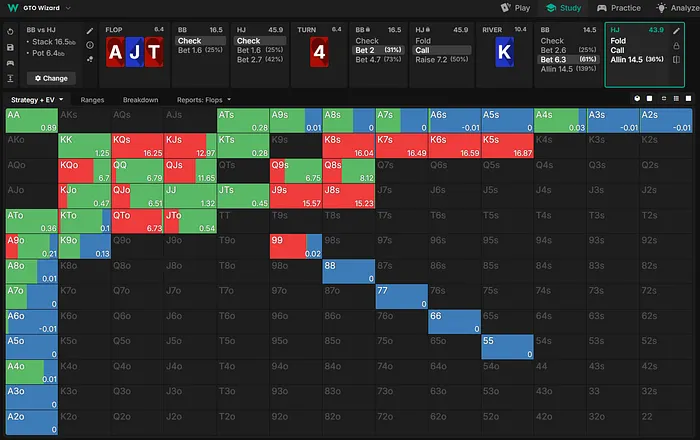
Neuville improved to a straight and called. This was GTO approved.
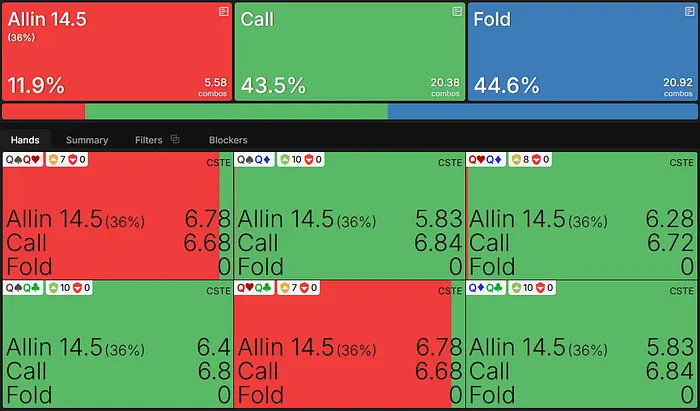
Neuville found the highest EV line on the river with Q♠Q♣, calling a straight and making a profitable play.
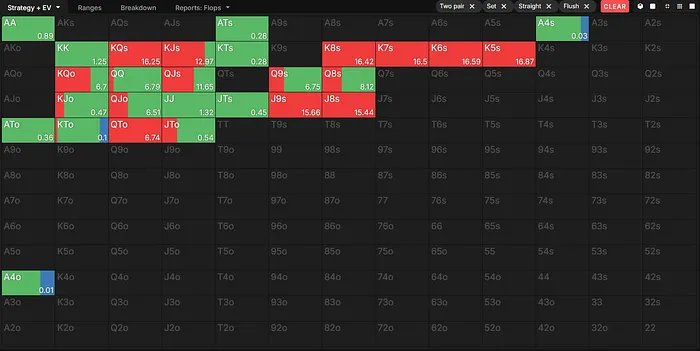
You can see above that most of the two pair, set, and straight combos in the CO’s range never fold, with folds only starting to occur against this size for top pair hands.
Conclusion
To answer the title question: Were these two players playing anything close to GTO poker back in 2015 on the WSOP final table? They were close.
The biggest pre-flop mistake was Cannuli only flatting vs the 2.55bb open. Post-flop, however, both played the hand very close to optimal GTO. Cannuli’s largest EV misstep was using a 31% bet size on the turn, costing him 0.05 EV compared to the solver’s preferred 73% size. Neuville’s biggest mistake was calling the turn with QQ, losing just -0.03 EV.
So, although neither played the hand 100% according to solver recommendations, it’s impressive how close they came, especially considering this hand was played 10 years ago, when solvers were still a new tool in the game.
If you want to analyse your own poker hands and see how close your play is to GTO according to the solver, download GTO Wizard for free today!