button in Safari
Learn How to Adapt to Opponents With New GTO Wizard Player Profiles Tool

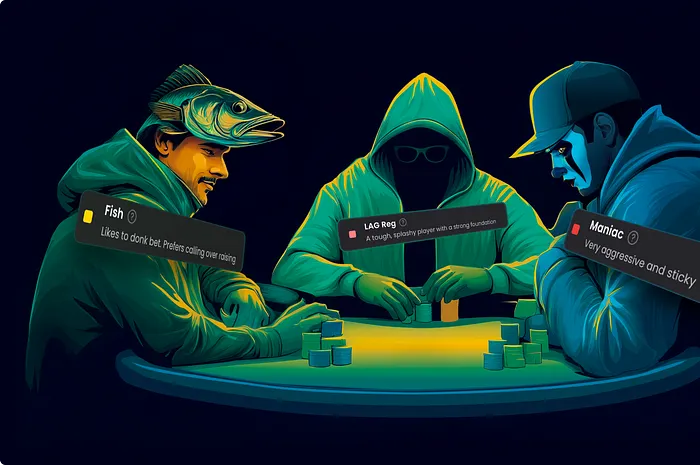
We’re rolling out an update today that we think you’re seriously going to love: Player Profiles, a new approach to studying exploitative poker.
Profiles enable you to model opponents with persistent leaks and exploitable tendencies. You can apply a profile to any solvable spot in GTO Wizard AI. Want to beat a calling station, shut down a maniac, or navigate a nit that suddenly shows strength? Simply attach a profile, and study the best response.
Profile behavior is defined by action incentives. These tell the engine “this player likes betting” or “prefers to check,” and it propagates that bias across the tree.
In this article, we’ll cover how profiles work, what you can expect in the future, and how to study with profiles to become an exploitative master.
Profiling vs Nodelocking
Before Profiling, the standard way to study exploits was nodelocking: defining a player’s strategy locally, at a single decision point. But real exploits are global. You exploit players, not one decision point. Profiles encode persistent exploitable tendencies across the game tree. Instead of studying how to beat some type of mistake, you’re learning how to beat some type of player.
For example, when modeling a nit, you’re not saying “they overfold this exact turn node.” You are saying “this player overfolds everywhere” and letting the engine find the best counter automatically.
Meet the Player Types
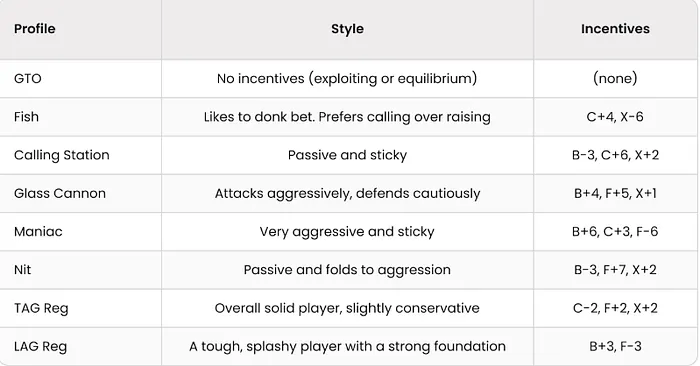
The initial profiles are designed to represent common player types you’ll encounter in the wild. These represent typical tendencies and are valuable to study for exploitative purposes.
Under the Hood
GTO is the default profile. The GTO player will exploit any non-GTO profile you pit it against. If all players are GTO, they will produce an equilibrium strategy (QRE).
Profiles work by adding virtual incentives to some player’s actions. At each decision, the engine treats these incentives as if they carried a small bonus or penalty for taking specific actions.
There are four actions that can be incentivized:
- Check (X)
- Bet/Raise (B)
- Fold (F)
- Call (C)
For example, let’s say you wanted to model a sticky player. Add +5% pot incentive to calling, and the profile behaves as if every call is rewarded with an extra 5% pot bonus. Calling becomes more attractive, so the profile calls more often. The profile behaves as if there were some bonus or punishment for taking specific actions, but these incentives are ignored in the final expected value calculations.
This core idea isn’t brand new. We have to give a nod to Alex Sutherland, who wrote about “unexploitable exploitation” way back in 2014, proposing this exact concept for toy games. He was ahead of his time, and we’re proud to bring that idea to life in full, complex game trees.
The same mechanism powers our frequency locking algorithm. Suppose you want some player to raise 35% of their range at some node, with minimal EV loss. We attach a virtual incentive to raising and auto-tune it while solving until we achieve the desired frequency. The result is the least-exploitable strategy subject to that constraint.
What’s Next: Our Roadmap for Profiles
This is the very first version of Profiles, and we’re just getting started. We’re laying the foundation for an exciting new era of solver tech.
Coming soon:
- Custom Profiles: Right now, you’re using our pre-built profiles. The very next step is to give you the tools to build and save your own profiles from scratch. This is our top priority.
- More Granular Control: Currently, a profile is applied to the entire hand (at the tree level). We’re working on giving you more fine-grained control, letting you apply incentives at the street level, or perhaps even at the node level.
Now, a quick but important note on how the solver exploits these profiles. It’s not a “max exploit” in the purest sense. The solver punishes the profile’s mistakes on the current street, but it assumes the opponent will play perfectly on later streets. This is the nature of how GTO Wizard AI solves spots. While this is a technical limitation for now, it can actually be a good thing. Full-on max exploits can lead to some wild and fragile strategies. This approach gives you a more robust and practical exploit that takes advantage of tendencies without going completely off the rails.
Looking further down the road, we’re exploring some incredible possibilities, like adding simple knobs to control bluffing frequencies or even modeling human play from hand history data. This is just the beginning, and we can’t wait to keep building!
Exploiting the “Fish” Profile
Let’s dive into a practical example to see what this can really do. I’ll examine a BTN vs BB SRP, 100bb deep, NL500 rake structure. Here’s the spot. You’re playing the BTN against a known recreational player in the BB.
The Setup
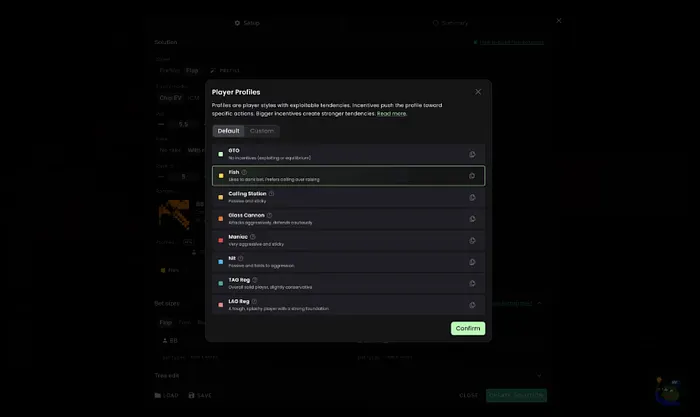
Open the tree builder and click here to choose a player’s profile:

First, I’ll open the tree builder and assign the “Fish” profile to the Big Blind. This profile has a +4% pot incentive to call and a -6% pot incentive to check, which creates a sticky player who loves to donk bet. Sound familiar?
Next, I’ll select the flop: Q♠10♠7♥. This flop is entirely free, so you can fire up GTO Wizard AI and follow along!
Profiles are indicated by color-coded icons. You can hover over these icons to see the profile’s incentives.
First: A Quick Disclaimer
I want to be clear that we aren’t claiming this simple “Fish Profile” perfectly represents every recreational player. Human psychology is way more complex than a couple of tree-level incentives. But even a simple model like this one holds immense value for the studying player.
The Counter-Strategy
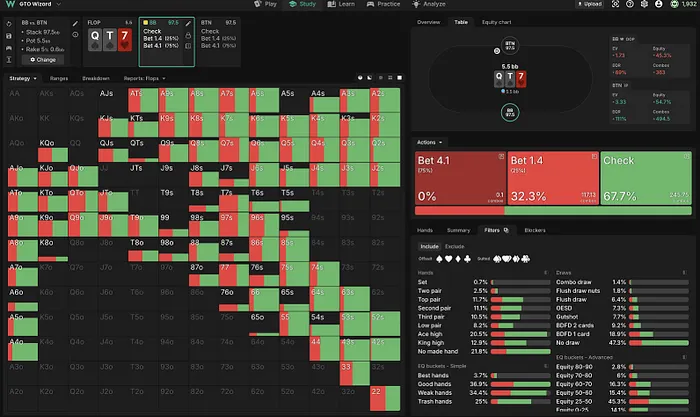
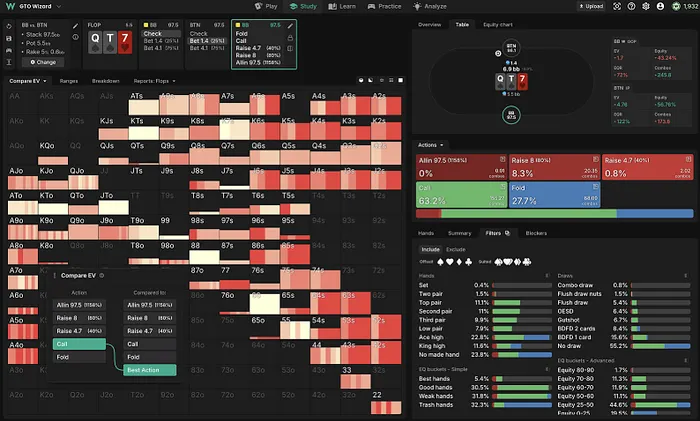
Let’s look at what the Fish profile does. On this board, it donk bets about one-third of the time; a massive departure from the GTO solution, which always checks here. This donking range is wide and weak.
So, how do we punish it? The counter-strategy is direct and powerful.
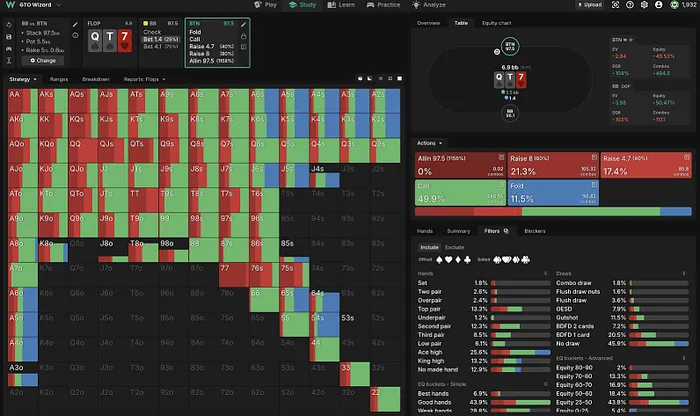
1. Punish Their Donk Bets: Stand Your Ground & Raise Relentlessly
Stand your ground: When the Fish profile donks, we barely fold anything; only about 12% of our range folds. This is our board, and we’re not giving up without a fight. They do not get to lead a capped range full of nonsense and get respect.
Raise like a maniac: As you can see, BTN raises almost 1/3 of the time! The logic is simple: BB’s donking range is weak, and their profile is coded to call too often rather than countering us with a ton of 3-bets. So, we hammer them with a wide, semi-linear range. Vulnerable made hands, draws, and even hands like a single overcard with a spade are good enough to raise.
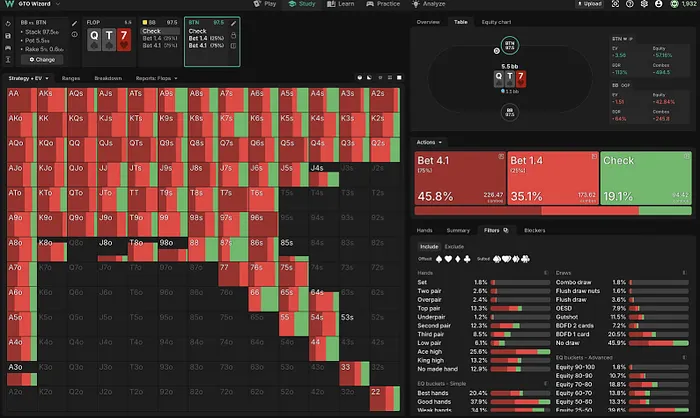
2. Attack Their Checks Very Aggressively
This is a crucial adjustment. A good player protects their checking range. The Fish weakens its checking range by donking out with many of its strong hands. Because it also prefers to just call, it doesn’t check-raise often enough to deter your thin value bets.
How the Exploit Pays Off
The Fish will try to defend against our aggression by over-calling on the flop. But that’s precisely what we want. Their range is now filled with unprofitable hands that simply can’t hold up on later streets.
In this next shot, I’ve highlighted all the -EV calls in the Fish’s range. See all that red? That’s money in your pocket. Those hands represent untenable defends that you can milk on later streets.
Training Against Profiles
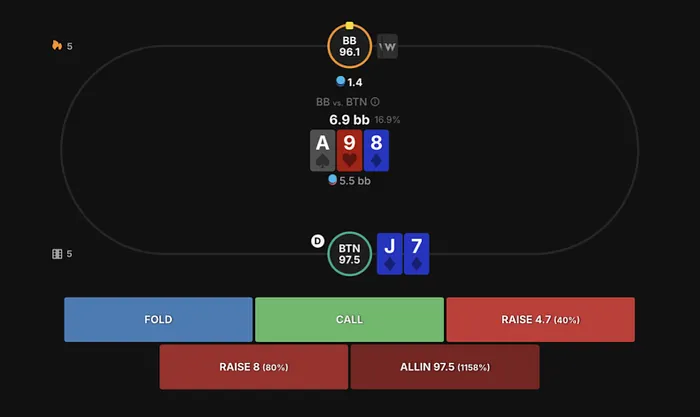
Now it’s all good and well to study one flop, but realistically, this type of study requires practice and repetition. It requires honing your strategy all the way to the river. Luckily, setting up a drill is easy. Just click the drill icon in the top-left corner, clear the board to randomize it, and you’re ready to start crushing!
A New Way To Approach Exploits
As you can see from that one example, Profiles are designed to bridge the gap between pure theory and reality. This is the first time you can set up a simulation against a specific player type and see the mathematically sound counter-strategy emerge.
But it goes deeper than just learning to raise more against a donk bet. By watching the solver adapt in real-time, you start to build a much stronger intuition for why GTO works the way it does. You see the foundational principles in action, which makes your own decision-making at the table faster and more precise.
This is the direction we’ve wanted to take poker study for a long time. It’s about creating tools that don’t just give you the answers, but help you understand the questions more deeply. We’re incredibly excited to see the strategies you’ll uncover with it.