button in Safari
GTO Wizard: How to Steal on the Bubble With a Short Stack


Table Of Contents
If you're short-stacked on the bubble of a tournament, raising into bigger stacks might seem like a huge risk.
After all, you’re risking your tournament life at a point where folding guarantees you inch closer to a payday. But according to poker pro and strategy author Andrew Brokos, that fear doesn’t mean you should stop stealing altogether.
In a GTO Wizard article, Brokos explores one of tournament poker’s trickiest spots: stealing from the button as a short stack near the money bubble, when opponents in the blinds have you covered.
Using GTO Wizard solver-backed analysis, Brokos shows how ICM pressure warps preflop incentives and influences postflop decisions in ways many players overlook. The key is understanding how your tight opening range creates fold equity, even when your actual hand isn’t all that strong.
Preflop Pressure and ICM Considerations
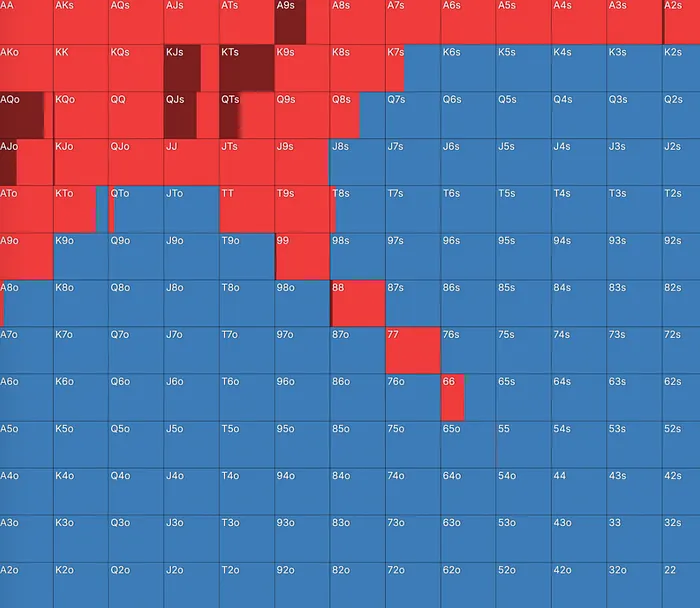
In the spot Brokos focuses on, the button has 18 big blinds and is facing blinds of 41bb and 26bb near the bubble of a 1,000-player MTT. The average stack is about 35bb, and every decision is shaped by ICM.
The button (BTN) opens just 17% of hands and jams another 2%, a huge drop from the ~50% you’d expect without bubble pressure. That range is heavy on suited Aces and Kings, which both block resteal ranges and retain decent equity when called.
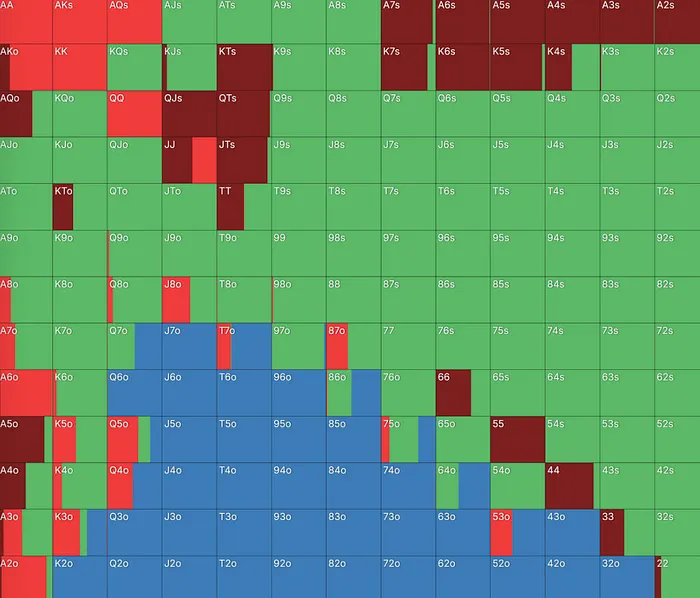
Even with such a strong opening range, the Big Blind (BB) (with 26bb) defends widely, folding only small, disconnected offsuit hands. As the covering stack, the BB is getting great odds to call and has less to lose in terms of ICM risk.
That dynamic puts the short-stacked BTN in an awkward spot. Folding has a positive EV as just surviving to the money is worth something. So any raise must be even more +EV to justify the risk. The upside? Because it’s so risky to open, opponents often assume you’re strong, and that gives you leverage.
What to Do When Called
When called, Brokos explains how postflop play should change across different board textures, based on this ICM-heavy preflop setup.
On Ace-high flops like A♠6♦2♦, BTN has a major equity and nuts advantage. Their range is packed with AxXx, while BB has many hands that miss entirely. That means BTN can simplify with a small contininuation-bet across almost their entire range and force folds from the BB’s weaker hands.
On boards like A♠Q♥2♦, BTN has an even bigger equity edge but continuation-bets less often. That’s because many of their hands like QxJx and JxJx have showdown value but don’t want to get raised. These hands opt to check and realize equity more passively, especially since BB is likely to fold anyway.
But low, disconnected flops like 8♦5♥3♥ are a different story. These boards favor the BB, who holds more small connectors and suited hands. Brokos shows how, at equilibrium, BB leads for a small size about half the time, a strategy most won’t use. Facing a donk bet, BTN mostly calls and rarely raises, waiting for better spots on the turn.
On connected low flops like 8♦5♥4♥, BB is in even better shape and actually leads with their entire range. BTN, in turn, avoids bloating the pot. If BB checks, a sign they may be deviating from GTO, BTN should consider checking back their entire range as an exploit.
Know When to Bet and When to Survive
"You don’t want to go broke on the bubble, but that doesn’t mean you immediately wave the white flag when you miss the flop," says Brokos. "Your opponent, getting a great price and incentivized to bully you, will often miss the flop themselves, and you can leverage the stronger hands in your range to protect the weaker ones."
To dig into the specific solver outputs, hand charts, and flop-by-flop breakdowns, you can read the full piece at GTO Wizard.