button in Safari
How Costly Was This Mistake on the Final Table Bubble of a $250K Tournament?



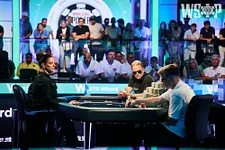
The $250,000 Triton Invitational at WSOP Paradise reached a critical juncture on the final table bubble, with just 10 elite players remaining and a massive $7,725,000 awaiting the champion.
In a decisive hand against chip leader Kayhan Mokri, a shove from Mikita Badziakouski saw the Belarusian immediately regret his "stupid jam" and led to his elimination.
In this GTO Wizard hand analysis, we take a deep dive into the solver's view to see if Badziakouski's self-criticism was justified, and how the subtle, but crucial, difference in his actual stack size turned a seemingly correct aggressive play into a costly ICM mistake.
Pre-Flop Action
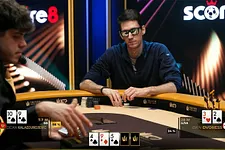
With action is on the final table bubble, chip leader Kayhan Mokri opened to 250,000 from the HJ. Mikita Badziakouski raises to 2,000,000 in the cutoff, leaving just one 25,000 chip behind. It folds back to Mokri, who announces all-in.
Badziakouski removes an earphone and mutters, “I thought I had 1.5 million,” before reluctantly putting his remaining 25,000 chip in the middle and sighing, “Wow, what a stupid jam.”
Action pauses until the hand at the other table concludes, and the cards are revealed.
Mikita Badziakouski: A♦10♥
Kayhan Mokri: 9♣9♦
While Badziakouski continues to berate himself, Mokri reassures him, “I don’t think it’s the end of the world.” But will it be the end of the tournament for Badziakouski?
The flop brings K♥5♦2♥, the turn K♦, leaving Badziakouski with just six outs. The river 7♠ seals his fate, and he is eliminated.
Badziakouski is one of the world’s top NLH players, but did he make a big mistake shoving A♦T♥ here? He certainly thinks so, but let’s see what the solver has to say.
Watch the full hand here on the Triton Poker YouTube Channel: (01:40:25)
Pre-Flop Analysis
Kayhan Mokri opens to 250,000 from the HJ with 9♣9♦. This is GTO approved, as this is a standard open from the HJ as the chip leader.
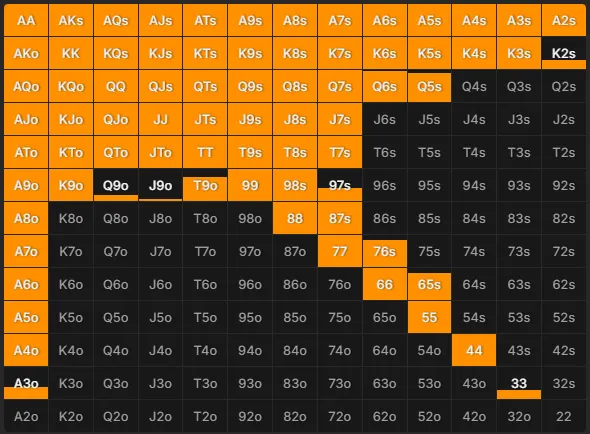
However, Badziakouski's three-bet to 2,025,000 is GTO Disapproved. Here's why.
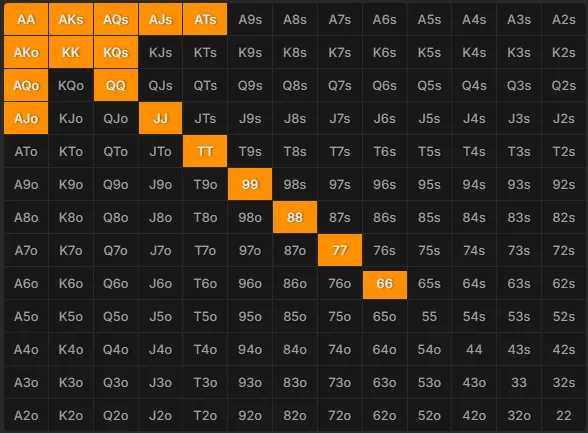
CO Jamming Range vs HJ Open
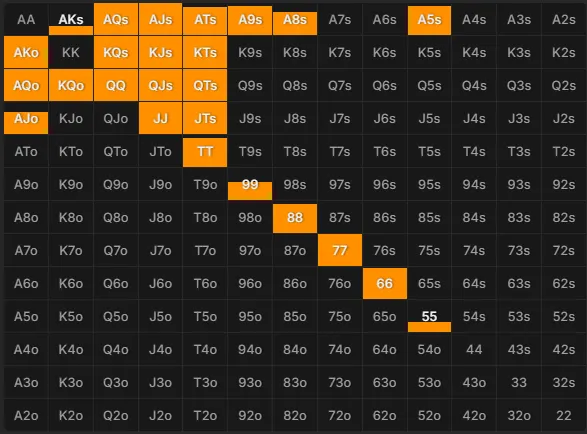
Whole CO Strategy vs HJ Open
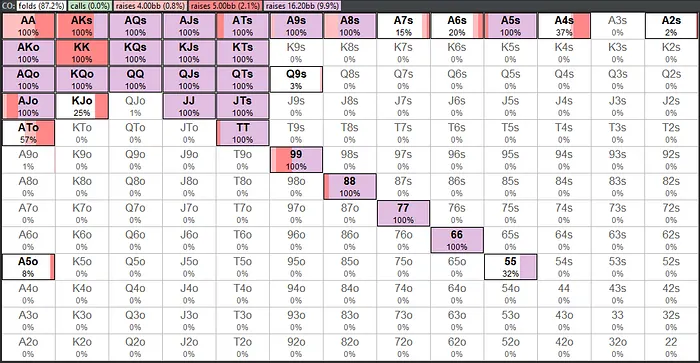
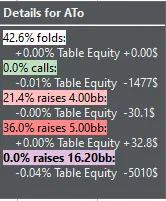
Unfortunately for Badziakouski, his frustration was justified. The solver never jams ATo here. Instead, it prefers a mix between folding, 3-betting to 4bb, and 3-betting to 5bb, making the all-in shove a clear mistake.
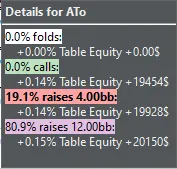
Let’s look at the $EV of each play with ATo in this spot:
What does $EV mean?
Also known as ICM EV. It’s the expected real-money value of your tournament stack or decision after applying the payout structure. It tells you how much your chips are worth in actual dollars according to ICM.
So in Badziakouski’s spot with ATo, the solver gives us the following $EVs:
- Folding: $0
- Calling: -$1,477
- 3-bet to 4bb: -$30.10
- 3-bet to 5bb: +$32.80
- 3-bet jam: -$5,010
Bubble Factors and Risk Premiums
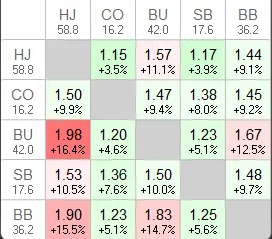
Here you can see that the HJ vs CO carries a 1.15 Bubble Factor and a 3.5% risk premium. This means that in this spot, you need 3.5% extra equity to continue versus an open, which explains why going all-in with ATo is a losing play.
“I don’t think it’s the end of the world,” Kayhan Mokri said to Badziakouski. Sadly, the 3-bet all-in was the most costly decision he could have made in this spot. The solver shows that the optimal play with ATo would have been a 3-bet to 5bb, yielding $32.80 in EV. Badziakouski, however, made the all-in under the assumption that he had a 1,500,000 stack. Let’s now see whether the 3-bet all-in would be more optimal given this actual stack size.
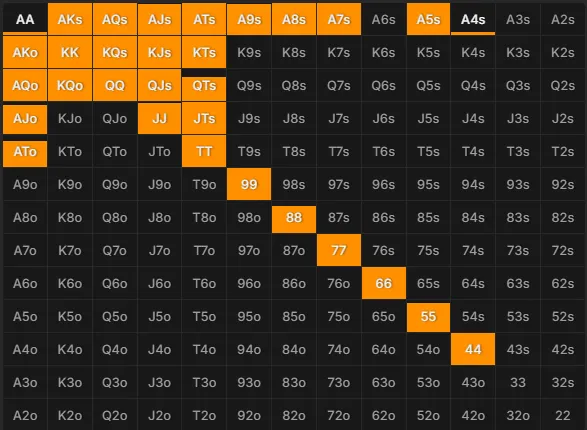
With this actual stack size, the solver shows that the optimal play with ATo would have been all-in. Here's the $EV Comparison for ATo.
Raising all-in with ATo would have produced +$20,150 in $EV.
Some good news but also bad news for Badziakouski. The good news is that he did not make a strategic mistake if he had truly held 1,500,000 (12bb) as he thought. Under that stack size, the all-in with A♦10♥ is the solver-recommended play, generating the highest $EV. The bad news is that he actually had 2,025,000 (16.2bb), which made the all-in the lowest $EV option in this spot.
To wrap up the analysis of this hand, the next question is: was Mokri’s call solver-approved? Let's take a look at the HJ strategy, facing a 2,025,000 all-in from the cutoff.
Yes, Mokri’s call vs the all-in with 9♣9♦ was solver-approved, producing $109,219 in $EV.
Conclusion
This hand demonstrated that even the best players in the world can make mistakes at the highest level. Unfortunately for Badziakouski, this error not only cost him $5,010 in ICM EV, but also his tournament life. It also highlights the fine margins of how different stack sizes affect optimal strategies with hands.
In the heat of the moment, Badziakouski knew that jamming ATo with 12bb would have been optimal, hence why he made the play. His biggest mistake was not realising he actually had 16.2bb. This may not seem like a huge difference, but it shows how just a few extra big blinds can completely change a hand from a profitable play to a losing one, as it did with ATo in this spot.
Picture courtesy of Triton Poker Series