button in Safari
The WSOP "Do-Over": What Actually Constitutes a Misdeal?

Table Of Contents
At the World Series of Poker (WSOP), players love to chime in with their own interpretations of the rules of poker.
You’ll often hear someone shout "Misdeal!" the moment a card flips face up on the felt. But in the world’s most prestigious poker tournament, a "do-over" isn't granted just because someone feels like it.
The WSOP has a very specific set of criteria that determines when a hand is dead on arrival and when the game must play on. Here is the definitive guide to what actually constitutes a misdeal and the "Point of No Return" known as Substantial Action.
Pre-Flop Errors
A misdeal is almost always triggered during the initial deal. According to the WSOP, the following scenarios require the dealer to pull the cards back and start over:
- Boxed Cards: If two or more cards are found face-up (boxed) in the deck during the initial deal.
- Counting Mistakes: If two or more extra cards are dealt incorrectly right out of the gate.
- The Wrong Start: If the very first card is dealt to the wrong seat.
- Seat Errors: If a hand is dealt to a seat that shouldn't have one, or if a player entitled to a hand is skipped entirely.
There are also specific rules for exposed "down" cards in both Stud and Flop Games. In Stud, it is ruled a misdeal if either of a player's first two down cards are exposed by dealer error.
For Texas Hold'em it's more complex. It's a misdeal if either of the first two cards dealt are face-up, or if two down cards in total are exposed by the dealer.

The Re-Deal Protocol
If a misdeal is declared, the hand doesn't just vanish; it's repeated exactly the same. That sometimes means some time travel is involved, as the blinds don't increase, no new players who joined the table in the meantime get to play, and even players who were away from their seats or on penalties can't play in the "new" hand. That's because, in essence, it's not "new" at all. It's an exact replay of the misdealt hand.
Substantial Action: The Point of No Return
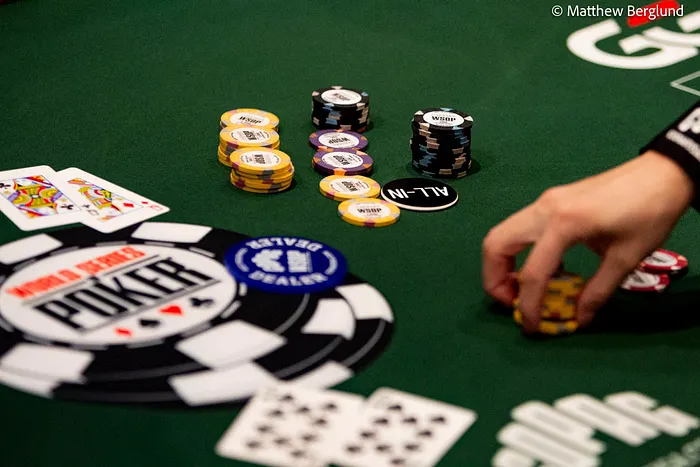
This is where most table arguments happen. Once Substantial Action occurs, a misdeal cannot be declared, even if a mistake is discovered. The hand must proceed.
But what counts as Substantial Action?
- Any two actions where at least one involves putting chips in the pot (e.g., a fold and a bet, or a call and a raise).
- Any three actions in a row, even if no chips are moved (e.g., fold, fold, fold).
The only exception is if a dealer forgets to burn a card before the flop, but at least one player has checked, the action stands.
Fouled Decks and Technical Failures
Sometimes the error isn't the dealer's coordination, but the equipment itself. These are "Fouled Decks."
- Wrong Backs: If a card with a different color back appears during a hand, the hand is void and chips are returned. However, if the "foreign" card is tucked safely in the deck (the stub) and won't be dealt, and Substantial Action has already happened, the hand plays on.
- Duplicates: If the deck contains two identical cards (e.g., two Aces of Spades), the hand is immediately voided and all chips are returned to the bettors.
An extra rule has also been added by the WSOP for if a dealer accidentally spreads four cards for the flop instead of three. This isn't an automatic misdeal. Instead, the dealer scrambles the four cards face down, and a floor supervisor randomly selects one to serve as the "burn card" for the next street. The remaining three become the official flop.