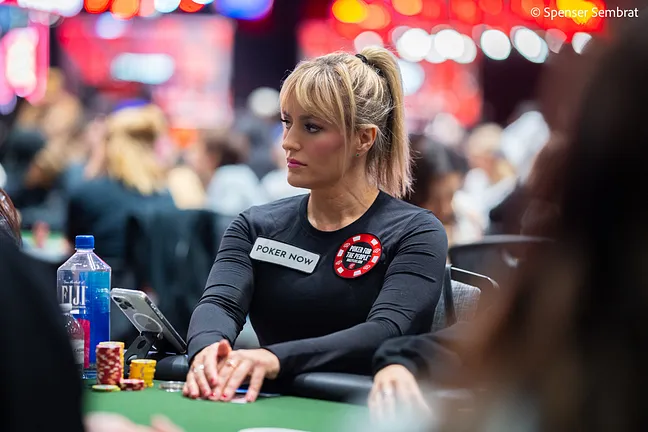
Action picked up on the turn with a board of 2♦6♣J♣9♦ and Marle Spragg had put in enough chips to put Orathai Nasathaen all in for about 60,000 and received the call.
Orathai Nasathaen: J♥10♣
Marle Spragg: A♣J♦
The river was the irrelevant 3♣ and Spragg won with her pair of jacks with the best kicker.
With around 55,000 already in the pot, Marle Spragg check-called Vivian Saliba's bet of 25,000.
Both players checked the 7♦ turn.
On the 10♥ river, Spragg led with a bet of 75,000. After some consideration, Saliba called. Spragg revealed A♠10♠ for two pair, tens and fours, which was enough to beat Saliba's hand, sending her cards into the muck. Spragg now joins the ranks of those with a stack over 500,000.
Amanda Holmquist called the big blind of 5,000 from the hijack. Kasey Mills then raised to 18,000, which Holmquist called. The board ran out J♣8♠10♠6♦4♣, and both players checked it down to showdown.
Holmquist revealed A♥5♦, while Mills showed A♣2♥, resulting in a split pot.
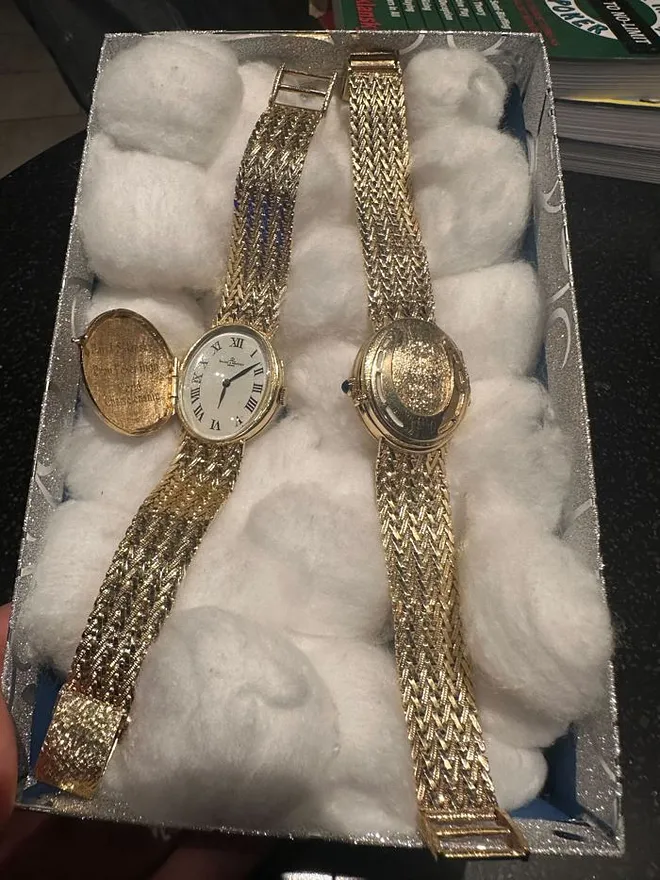
Earlier this year on an ordinary Monday afternoon, a bespectacled man walked into the Gold & Silver Pawn Shop on Las Vegas Blvd. Tucked under his arm was an uninteresting box that only he knew contained something rather interesting – a pair of gold watches dating back more than 40 years.
These were not your run-of-the-mill wristwear, but rather evidence of a unique and often overlooked time of poker history, a year when the World Series of Poker (WSOP) gold bracelet, now the game’s highest accolade, was replaced in favor of watches.
1982 WSOP watches
The man holding the box was David Sklansky, who in 1978 forever changed poker by advocating a mathematical approach to the game in his groundbreaking book The Theory of Poker. Nicknamed “The Mathematician,” he proved his prowess just four years later when he won two WSOP tournaments in five days.
First, he won the 1982 WSOP Event #7: $800 Mixed Doubles Limit Seven Card Stud, a tournament that paired one man with one woman, alongside Dani Kelly, and followed that up by taking down Event #12: $1,000 Limit 5-Card Draw High. A year later, the Binions reverted back to the beloved bracelets players know today, and Sklansky captured his third piece of WSOP hardware by winning Event #11: $1,000 Limit Omaha.
It was a remarkable accomplishment, and for more than four decades he’s kept safe the evidence of his victories, both of which still worked. So, why was Sklansky carrying his 1982 WSOP gold watches, two of only 15 ever awarded, into a pawn shop? Well, he was looking to sell them of course, but not to just any of the dozens of pawn shops spread across Las Vegas. Oh no, he was walking into arguably the most famous pawn shop in the world, the home to the wildly popular television show Pawn Stars, and he was there to do it with cameras rolling.
Melanie Kaye was in the hijack and raised to 5,000 and Katie Lindsay defended from the small blind. The flop came out with 4♣10♣5♠ and Kaye bet out 20,000 and received the call.
On the turn 2♦ Kaye continued with the aggression and bet 35,000 and Lindsay made the call.
Kaye was waiting for Lindsay to decide what to do for a few minutes and then realized she had checked. Kaye shoved her chips in with the superior stack and Lindsay thought for a bit and folded.
With around 85,000 already in the pot and the board showing 2♠8♥A♣4♠, Jiexi Guo checked first to act. Ismaray Reigosa bet 60,000, and after some consideration, Kasey Mills called. Guo folded.
On the 5♦ river, Reigosa checked, and Mills bet 200,000. Reigosa took some time to decide whether to call. Eventually, she made the call, boosting the pot to over half a million. Mills showed 8♠8♦ for a set of eights, and Reigosa's cards found the muck.