button in Safari
Maine Becomes Ninth US State to Legalize Online Poker

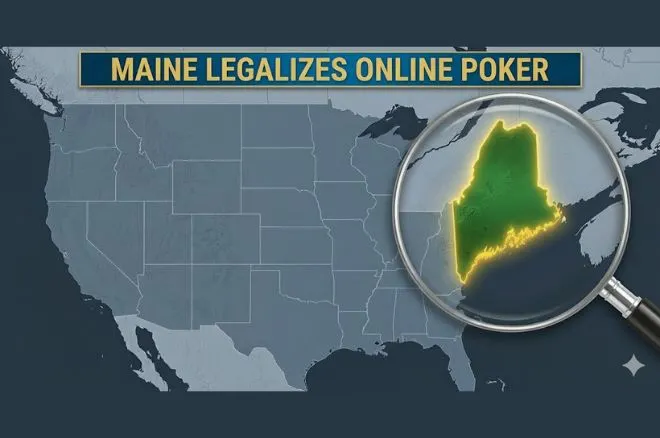
Table Of Contents
Maine has officially joined the ranks of U.S. states offering legal online poker, becoming the ninth state in the nation to authorize online poker. The move comes after LD 1164, titled “An Act to Create Economic Opportunity for the Wabanaki Nations Through Internet Gaming,” became law at midnight on Saturday, January 10, 2026.
Governor Janet Mills, who had previously expressed reservations about the expansion of gambling, opted neither to sign nor veto the bill. Under Maine law, this allowed the bill to become law automatically after the expiration of a ten-day review period.
"I considered this bill carefully," said Governor Mills. "And while I have concerns about the impacts of gambling on public health, I believe that this new form of gambling should be regulated.
"I am confident that Maine's Gambling Control Unit will develop responsible rules and standards to hold providers of this new form of gambling accountable while ensuring that Maine's tribes benefit from its operations."
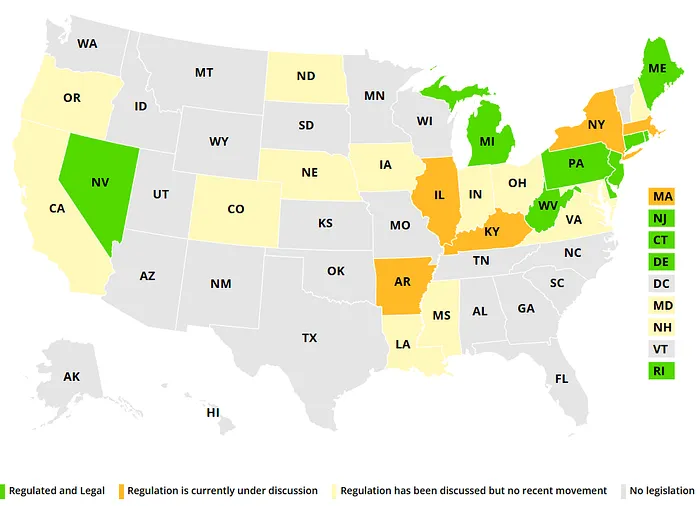
Maine joins Nevada, New Jersey, Delaware, Pennsylvania, Michigan, West Virginia, and Rhode Islandand Connecticut as the only states to have cleared the path for legal, regulated online poker.
The Online Poker Landscape in Maine
The centerpiece of the new law is its focus on Maine’s four federally recognized tribes: the Houlton Band of Maliseet Indians, the Mi’kmaq Nation, the Passamaquoddy Tribe, and the Penobscot Nation. Collectively known as the Wabanaki Nations, these tribes have been granted exclusive rights to operate online poker and casino gaming in the state.
Under the framework of LD 1164:
- One Skin Per Tribe: Each of the four tribes is permitted to partner with a single platform provider (or "skin"). This opens the door for sites such as BetMGM, BetRivers or WSOP to compete for Maine’s four available licenses.
- Revenue and Taxation: The state will impose a 10% tax on adjusted gross gaming revenue. These funds are earmarked for the tribes, as well as state initiatives for gambling addiction prevention and emergency medical services.
The "Poker Island" Challenge
While the legalization is a historic milestone for poker enthusiasts, the prospect of online poker in Maine still faces a significant hurdle: liquidity.
According to reports from Pokerfuse, the current version of LD 1164 does not explicitly authorize Maine to join the Multi-State Internet Gaming Agreement (MSIGA). MSIGA is the interstate compact that allows players in states like New Jersey, Michigan, and Nevada, where various legal poker sites exist, to compete against one another in a shared player pool. In April 2025, Pennsylvania also joined the compact.
Without joining this compact, Maine will operate as a "poker island." Given Maine’s relatively small population of 1.4 million, an intrastate-only market would likely result in smaller prize pools and fewer active tables compared to larger markets. More work will need to be done in addition to the passing of this legislation before Maine players can join forces with other states.
In any case, players must still wait for regulation to be drafted, with the Maine Gambling Control Unit responsible for drafting the specific rules and licensing requirements. While a firm launch date has not been set, industry experts anticipate that the first legal poker hands could be dealt later in 2026 or early 2027.