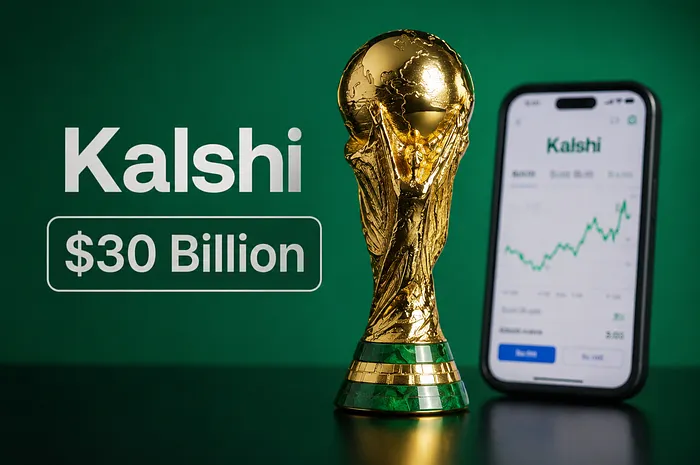
The 2026 FIFA World Cup has given prediction markets their first true mainstream global sports trading test - and $30 billion in trading volume suggest they passed.
Kalshi and Polymarket both reached record levels in June as soccer trading surged across the industry. Kalshi reportedly handled more than $30 billion in trading volume during the month, up more than 70% from May’s $17.9 billion, while Polymarket reached a record $10.8 billion in June volume. Together, the numbers suggest that prediction markets are no longer just a niche product for politics, crypto-native traders, or forecasting obsessives.
They are beginning to operate at the scale of major sports betting products and, by extension, replace them.
Prediction Market
June Volume
May Volume
Kalshi
$30 billion
$17.9 billion
Polymarket
$10.8 billion
$7.1 billion
Appealing to the Casual Trader
The World Cup is a good example. Unlike U.S.-specific sports calendars, the tournament offered a global audience, a steady stream of matches, and markets that casual users could understand immediately.
Traders did not need to be experts in monetary policy, election modeling, or obscure legal outcomes. They could trade on something complicated and granular, but nonetheless familiar: their favorite team.
Want to get involved in the World Cup action? Read our World Cup Trading Guide and learn how to start trading the biggest tournament in global soccer.
For years prior to 2025, the prediction market industry has argued that event contracts are a trading product rather than traditional sports betting. For better or worse, that difference is shrinking as users experience sportsbook-grade products through an exchange model, i.e., contracts, order books, and market prices rather than vig-generated odds.
The Challenge with Sports Prediction Markets
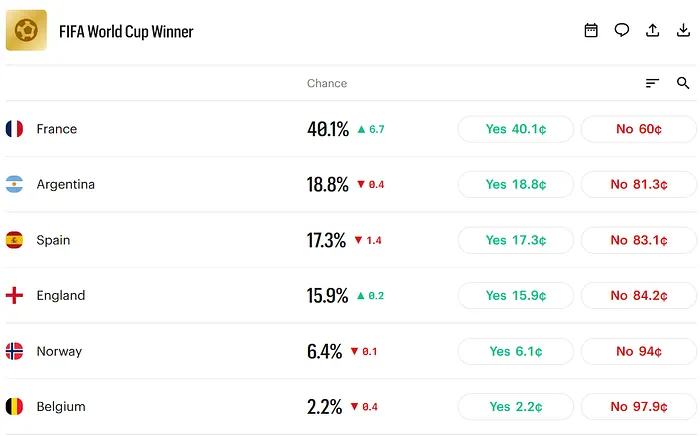
Kalshi's World Cup outright (winner) market
This represents a significant milestone for sports markets. It’s easy for a platform to work well, albeit not accurately in terms of forecast signal strength, when volume is limited and users are concentrated within a small community. It is harder to work when a global sports event brings in significantly more activity, more casual users, and more pressure on payments, market making, liquidity, and customer support.
June showed that the leading platformscan absorb that pressure. That does not mean the regulatory questions have gone away regarding sports markets. If anything, they are becoming more important as the category’s trading grows.
Could Prediction Markets be Regulated, Not Banned?
State regulators and lawmakers are still debating whether sports event contracts should be treated as federally regulated financial products or as gambling products that fall under state betting rules.
New Jersey has already considered a proposal that would place a 9% surtax on prediction market operators’ income, with lawmakers expected to revisit the issue in the fall. That kind of proposal is notable because it is not purely prohibitive. Rather than simply trying to ban the industry, some lawmakers appear to be looking for ways to regulate it, tax it, and fold it into existing state frameworks.
That may be where the next phase of the debate is heading. Prediction markets are increasingly large enough that states may see them not just as a legal challenge, but as a category to shape.
The World Cup did not settle the debate over what prediction markets are. But it did show that they can support the kind of volume and user interest that puts them in the same conversation as the biggest sports betting products in the world.
Prediction markets involve risk and are not suitable for everyone. While many platforms offer tools to make informed trades, outcomes are never guaranteed, and users should never risk more than they can afford to lose. Always trade responsibly. Additionally, platform availability and legal status vary by region. It is your responsibility to check local laws and verify that you are legally allowed to use a given platform before participating.

 button in Safari