button in Safari
Call or Fold? Solving Negreanu's WSOP Final Table Bustout With GTO Wizard



With this fall's WSOP Online series now wrapping up, there's a little time and distance to look back at some of the storylines that defined the past few weeks. As is often the case in poker, Daniel Negreanu provided plenty to talk about, with the Poker Hall of Famer's final-table bustout in the $25,000 WSOP Online High Roller Championship proving a particularly fascinating spot.
Negreanu held pocket tens. But should he have called or folded? With the help of poker pro Lukas Robinson and GTO Wizard's new preflop ICM AI feature, we take a closer look at the hand and find out what the numbers say.
-
Event Information
Event: $25,000 WSOP Online High Roller Championship - Event #29
Players Left: 4
Blind Levels: 100,000/200,000 (25,000 ante)
| Place | Payout |
|---|---|
| 1st | $906,647.32 |
| 2nd | $699,120.76 |
| 3rd | $539,095.76 |
| 4th | $415,699.75 |
Stack Sizes and Positions:
Erwann Pecheux (CO): 11bb
Fabiano Kovalski (BTN): 7.9bb
Casimir Seire (SB): 57.1bb
Daniel Negreanu (BB): 28bb
Pre-flop Action
The action folds around to chip leader Casimir Seire in the SB, who puts Negreanu all-in for 28bb effective. Sitting second in chips with two much shorter stacks still in play, Negreanu faces significant ICM pressure and needs to call relatively tight.
However, Daniel doesn’t even think about it. He snap calls with pocket tens while saying, “f**k off, let’s go!” followed by, “You wanna f**k around? Let’s f**k around!”
Seire turns over 98o, putting Negreanu in a great position to double up and take the chip lead. However, the board runs out A-9-6-8-K, giving Seire two pair and eliminating Negreanu in fourth place for $415,699.75.
With Negreanu playing for the win and chasing his ninth WSOP bracelet, he was never folding pocket tens in spot. But should he have?
Let’s use GTO Wizard’s new ICM preflop solver to find out whether TT is actually a call or fold in theory, and exactly how much $EV Negreanu gains or loses by making the call.
Solver Outputs
Let’s jump straight into the solver outputs to see whether Seire’s shove with 98o was correct, whether Negreanu should have called with TT, and then break down why the solver recommends these strategies.
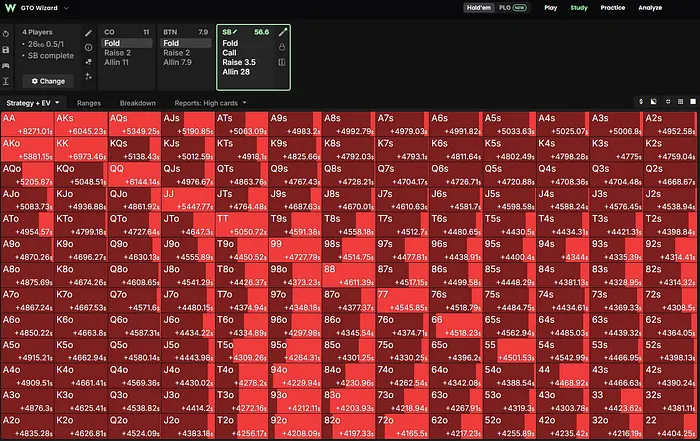
SB Strategy

$EV of 87o:
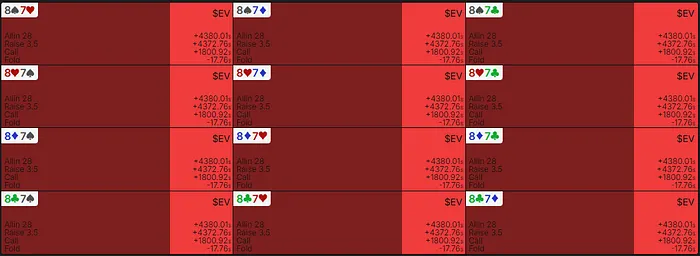
The all-in is being recommended by the solver in this spot with 87o, with the all-in making +$4380.01 and raising to 3.5bb making +$4372.76. Therefore, Seire made the most profitable play here, according to the solver.
BB Strategy vs SB All-in
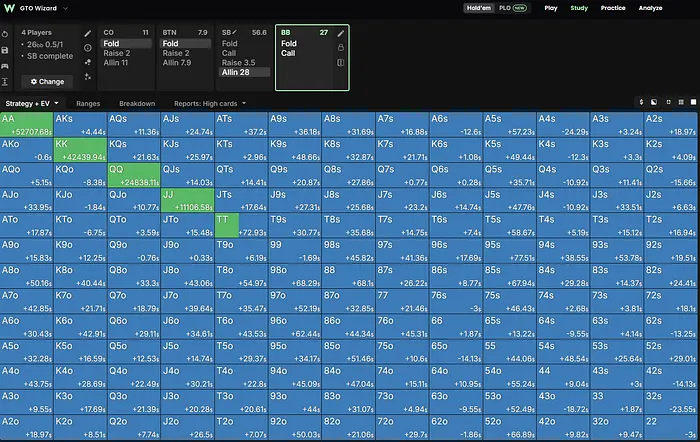
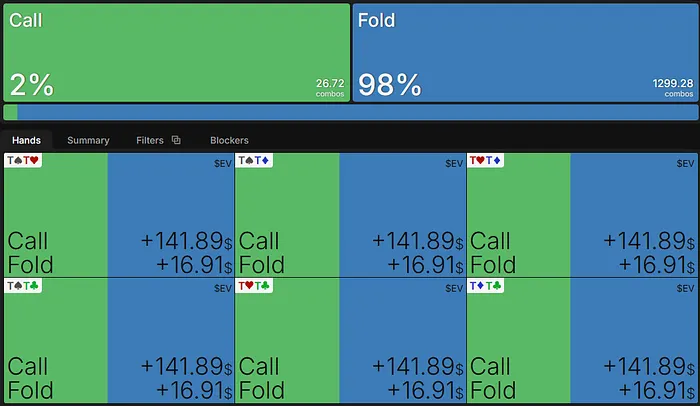
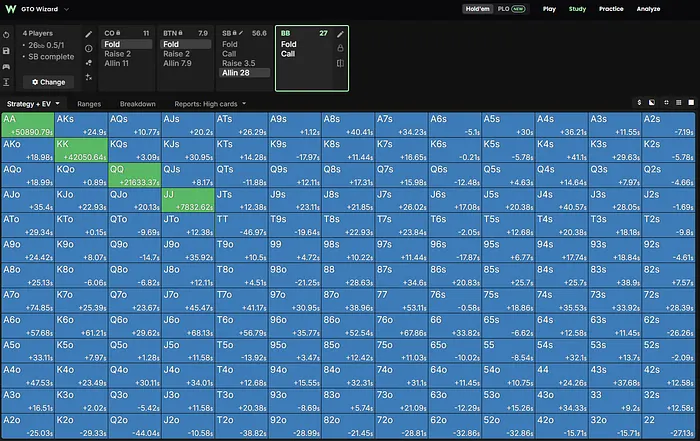
TT just about makes it into the solver’s 2% calling range, so well played, Daniel!
Both players made the most profitable overall decisions in this spot, but let’s take a deeper look at exactly why these strategies work.
Analysis
Bubble Factors:
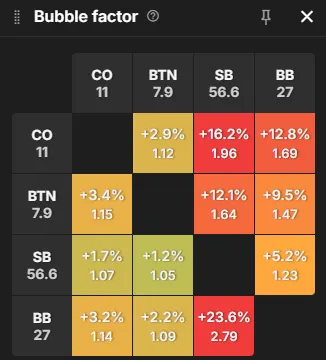
What is Bubble Factor?
Explanation taken from GTO Wizard:
Bubble Factor measures ICM pressure - how much more losing hurts than winning helps you in MTTs.
Bubble Factor is defined as the ratio between how much tournament equity ($EV) you’d lose getting stacked, divided by how much $EV you’d gain stacking some player in the tournament.
Risk Premium is a percentage defined as how much extra equity you’d need, compared to a chip EV pot odds calculation, to breakeven against a shove against some player.
Every player in the tournament has a different BF vs every other player.
What Is Negreanu’s Bubble Factor and Risk Premium Here?
Negreanu has a massive 2.8 Bubble Factor against the chip leader, meaning the $EV he risks losing by busting is 2.8 times greater than the $EV he gains by doubling up. This translates to a +23.7% Risk Premium, meaning Negreanu needs 23.7% more equity than he would in a standard chip-EV calculation to profitably call the all-in. With two much shorter stacks still in play, this forces Negreanu to call significantly tighter than he would without ICM.
SB Strategy Analysis
As shown in the graphs above, the solver recommends zero calls or folds for the chip leader in this spot, taking advantage of the huge ICM pressure faced by the second-place stack in the BB.
Instead, the SB uses a polarized 3.5bb raise with the top and bottom of its range (28.3%), while shoving the remaining middling hands (71.7%). But why is this?
This strategy takes advantage of the huge ICM pressure on the BB. At the top of the range, hands such as AA prefer the smaller 3.5bb raise to maximise $EV by keeping weaker hands in and encouraging action, rather than simply forcing folds with a shove.
Interestingly, even the very bottom of the range, such as 72o, prefers the smaller raise. While jamming is still profitable, raising to 3.5bb generates slightly more $EV while risking far fewer chips when the BB does decide to call. The middling hands therefore make up most of the all-in range, benefiting the most from maximising fold equity and avoiding difficult post-flop decisions.
$EV of AA
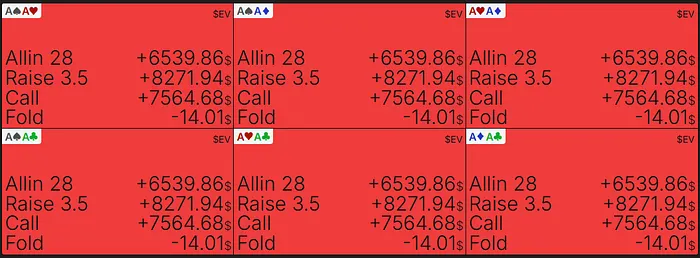
AA: Raising to 3.5bb generates $8,271.94 in $EV compared to $6,539.86 when going all-in, making the smaller raise worth $1,732.08 more.
$EV of 72o
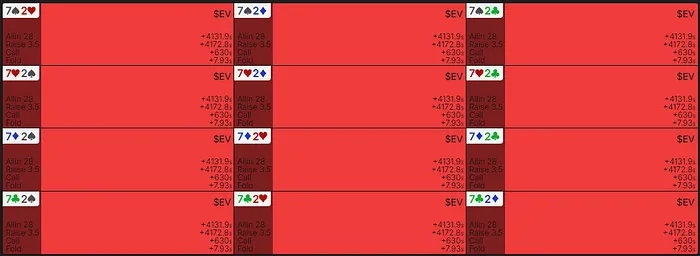
72o: Raising to 3.5bb generates $4,172.80 in $EV compared to $4,131.90 when going all-in, making the smaller raise worth $40.90 more.
$EV of 87o
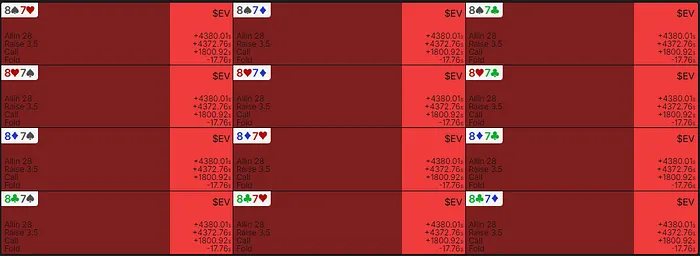
87o generates very similar $EV with both options, making $4,380.01 when going all-in compared to $4,372.76 when raising to 3.5bb. With just $7.25 separating the two actions, the solver mixes between both, as it does with several other hands.
BB Strategy Analysis
Again,as shown above, Negreanu’s 2.8 Bubble Factor and +23.7% Risk Premium force him to call incredibly tight, with the solver continuing with only TT+.
Interestingly, even AK has to fold. This is largely due to how AK and the pocket pairs perform against Seire’s specific shoving range, which contains plenty of unpaired Ax, Kx and weaker hands, while many pocket pairs prefer the smaller 3.5bb raise. TT and JJ are already ahead of a large portion of this range, whereas AK blocks some of the weaker Ax and Kx hands and is often left flipping against the pairs that do shove. Under such extreme ICM pressure, AK simply doesn’t have enough equity against this range to justify risking elimination.
These solver solutions assume both players are following the GTO strategy shown above, which, based on the hands revealed, they appeared to be doing in game. However, let’s run some nodelock tests to see how the strategies change if either player is playing too tight or too loose.
Test 1: SB 100% All-in Strategy
What is the response from the BB if the SB is going all-in with any two cards in this spot?
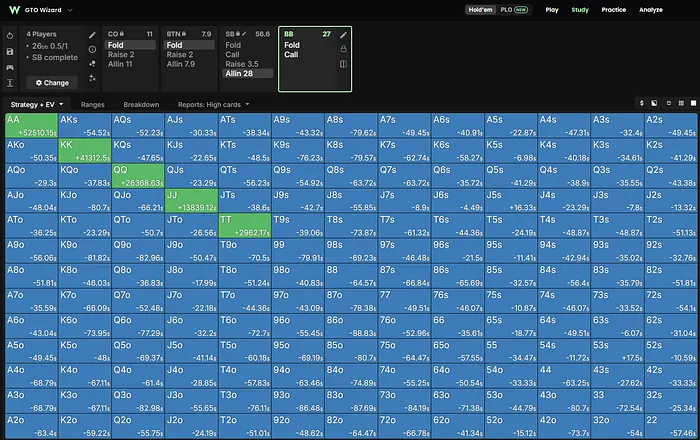
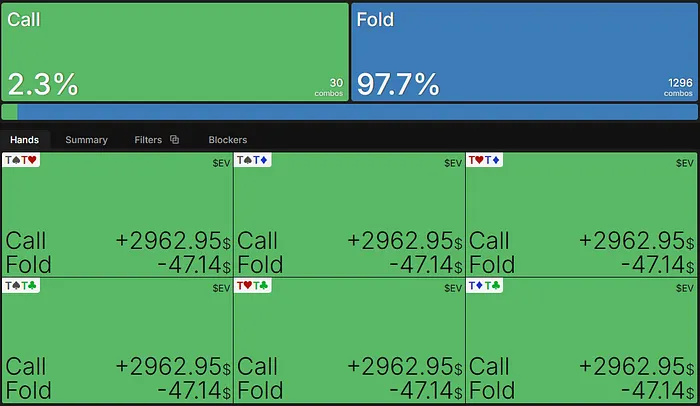
Interestingly, the BB’s calling frequency increases by just 0.3%, with TT+ still making up the entire calling range. This makes sense because the SB now has all of its strongest hands in the shoving range, preventing the BB from calling significantly wider.
However, TT+ becomes much more profitable against this wider overall range. TT now generates $2,962.95 in $EV compared to just $141.89 previously, showing how much the additional weaker hands increase the value of the call.
Test 2: SB Uses 50% All-In and 50% 3.5bb Raises
SB Nodelocked Range
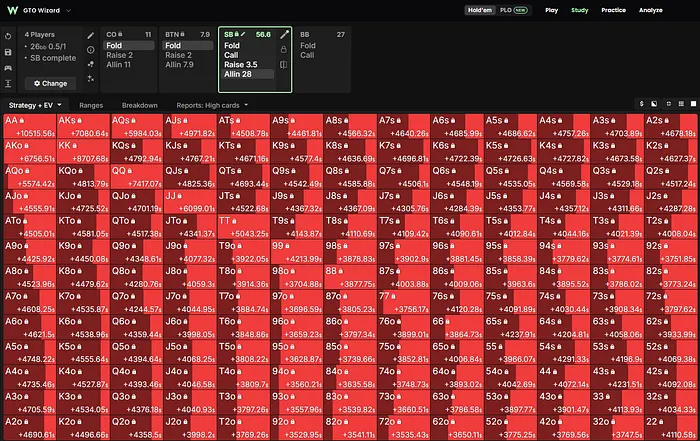
SB Response
Calling TT is now a losing play and it’s only JJ+ that is a call in this spot.
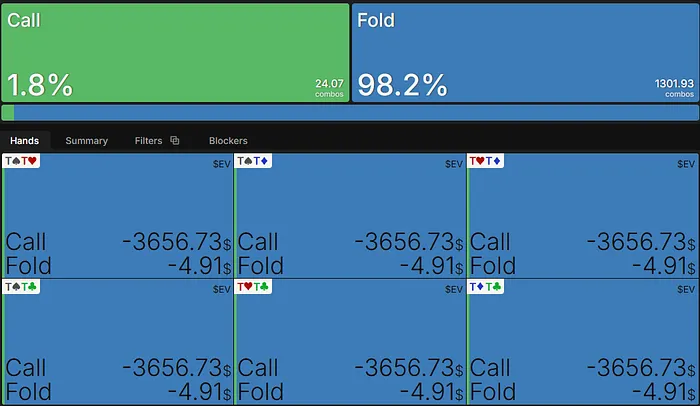
Calling TT against this all-in range would lose $3,656.73 in $EV, highlighting just how significantly a change in your opponent’s strategy can impact your own optimal response.
Test 3: If the BB Is Calling Wider vs an All-in
If the BB is calling wider, increasing from just 2% of hands to 4.2%, here is their range:
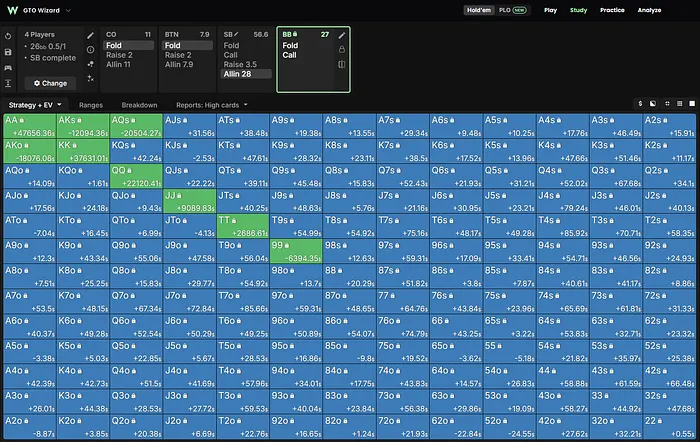
SB Response
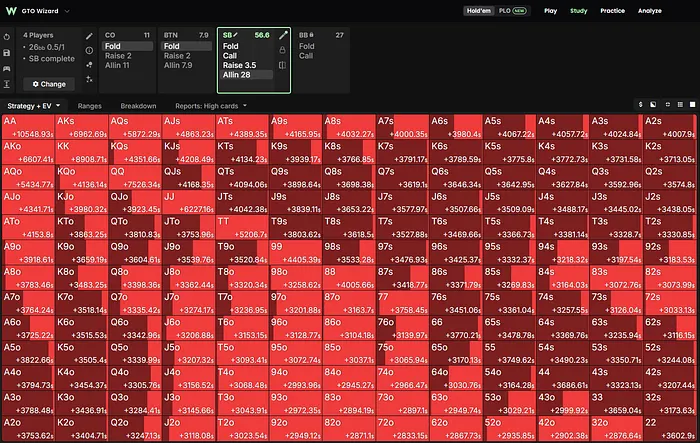
With the BB now calling wider, the SB responds by reducing its all-in frequency from 71.7% to 43.8%, while increasing its 3.5bb raises to 56.1%. Interestingly, the solver still recommends zero calls or folds.
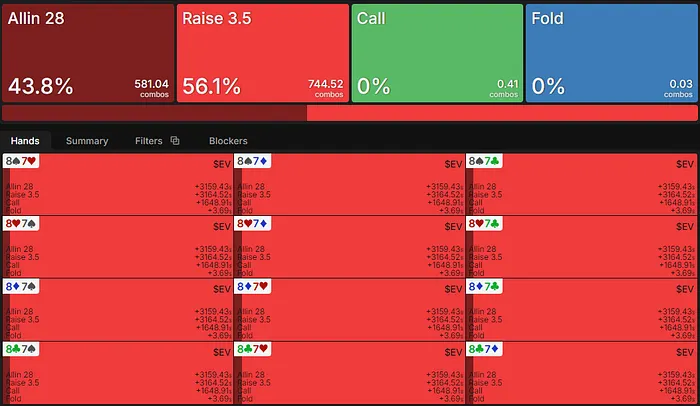
Against this wider calling range, raising to 3.5bb with 87o now generates slightly more $EV than going all-in, although both options remain very similar in profitability.
Test 4: If the BB Is Calling Too Tight
Let’s say the BB is extremely risk-averse and only calls an all-in with KK and AA. How does the SB adjust its strategy to exploit this much tighter calling range?
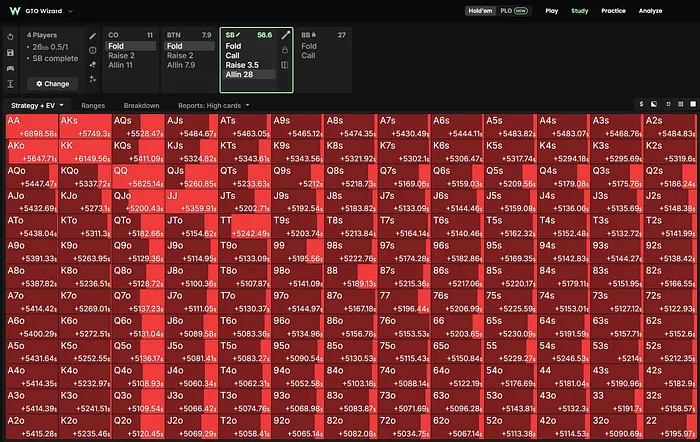

The SB still doesn’t shove any two cards, but the all-in frequency increases significantly to 81.8%, while the 3.5bb raise decreases to just 18.2%. With the BB only calling KK+, the SB can exploit this overly tight strategy by shoving far more hands and taking advantage of the additional fold equity.
Want to try these spots for yourself? Click the link below to use GTO Wizard’s new ICM Preflop Solver and start analysing your own final-table decisions today.