button in Safari
Big Blunders: Premium Hands Edition


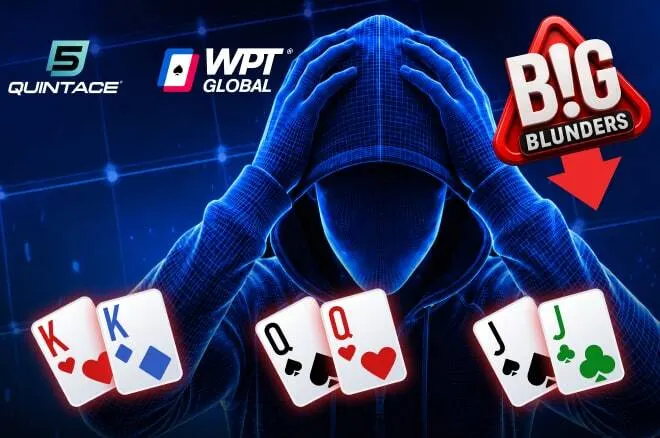
Table Of Contents
Everyone loves looking down at a big pocket pair. There's quite possibly no better feeling in poker than peeling a high card, before seeing that your second card matches it. That being said, all that glitters ain't gold, and KK, QQ and JJ cost their holders dearly in big pots this week. Let's have a look at what went wrong.
Brad Wilson (professional poker player, coach, and founder of Poker Forge) contributed commentary throughout. His take on what makes premium pairs so dangerous sets the tone.
"A premium is hard to let go. That's exactly what makes it dangerous. The board doesn't care what you had before the flop, and neither does your opponent's range."
Brad Wilson
Blunder 1 - Pocket Kings
The 3-bettor opting to fire three streets out of position on an ace-high board gives away a lot of information: their range is Ax heavy. On the flop, KK, which is so often an overpair, became an underpair to the ace. The solver folds to pressure in this spot and sometimes releases as early as the flop. Calling the turn was already a mistake. Calling the river made it an expensive one.
| Spot | Solver Direction | Net Result |
|---|---|---|
| K♠K♦ vs 3-bettor's triple-barrel on ace-high board | Must fold turn. Should never reach river. | -550 BB |
The light fix. On an ace-high board, ask what value hands in the 3-bettor's range KK actually beats. When the turn bet is 100% pot, that list is nearly empty.
Blunder 2 - Pocket Queens
C-betting Q♠Q♥ on this flop is a low-frequency play that creates problems. After villain raises, the only real option is to call and continue out of position in an inflated pot with a hand that is already behind.
On the turn, facing a half-pot sized bet, Q♠Q♥ is at the very bottom of this range. Folding is the only correct move. Jamming all-in is not a play the solver ever makes here. It is a costly decision driven by impatience.
| Spot | Solver Direction | Net Result |
|---|---|---|
| Q♠Q♥ jamming into a 50% pot bet on a flush-draw board | Hero is at the bottom of the turn range. Must fold. | -456 BB |
The light fix. A flop raise followed by a turn bet narrows villain's range considerably. By the time the turn comes, Q♠Q♥ is a weak underpair with nowhere to go. Mucking it is the only sensible play.
Blunder 3 - Pocket Jacks
C-betting J♠J♣ on K♠Q♣7♦ out of position, simply put, gets chips in with the worst of it. When the 7♣ comes on the turn, continuing compounds the error. Calling the all-in at that point is giving away the rest of the stack with a hand that cannot win often enough to justify it.
| Spot | Solver Direction | Net Result |
|---|---|---|
| J♠J♣ betting flop and turn, then calling it off with two overcards on board | Check flop. Check turn. | -175 BB |
The light fix. Price does not matter when you are not ahead. UTG limped, called a 3-bet, called the flop, and jammed the turn. Two overcards are sitting on the board. Reading that line correctly points to one option: fold.
The takeaway
"Three hands, three different spots, the same mistake. Nobody stopped to ask what they were actually ahead of. They saw a strong pair and decided that was enough. The solver says otherwise every time."
Brad Wilson
Each player held on because the pair felt too good to release. But KK, QQ, and JJ stop being strong the moment the board says so.