A flush draw is a common and powerful drawing hand in poker. But what exactly is a flush draw, what are your odds of hitting it, and how many outs do you have? This page isn't just a simple breakdown of the poker hand rankings. Instead, it's a guide explaining everything you need to know about flush draws in Texas Hold’em, giving you a better understanding to help elevate your game.
Quickly navigate to the relevant section on this page:
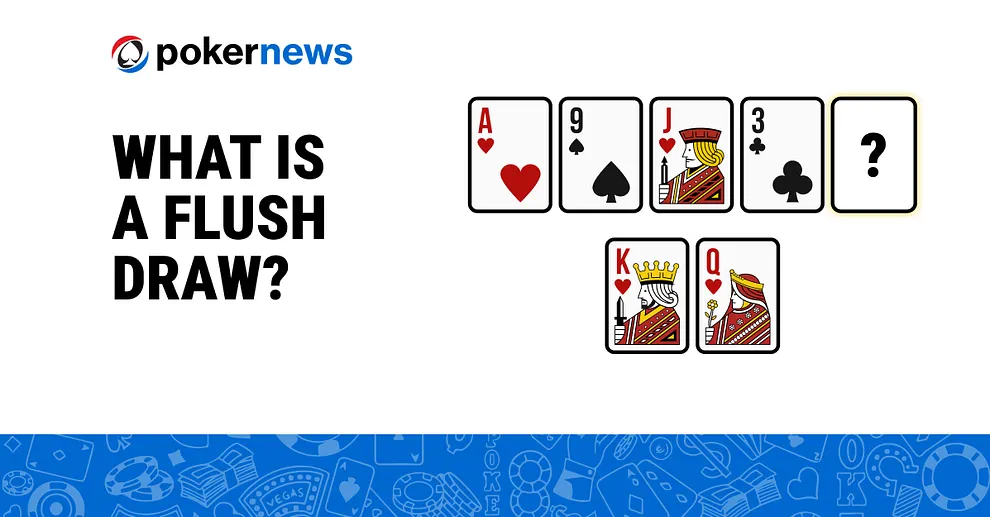
A flush draw in poker is when you have four cards of the same suit and need one more to complete the flush.
In Texas Hold’em, this usually happens when your two hole cards and two of the community cards share the same suit, giving you a four-card flush. With this, you then have the chance to complete the full five-card flush by the turn or the river.
A flush draw is not a made hand, but it does have strong potential. While a flush isn't one of the top hands in poker, it beats a lot of other hands and is generally considered a strong holding. Making it will give you a good chance of winning the hand, depending on the strength or connectivity of the board.
Summary - A Flush Draw is...
• The potential to make a flush by the river
• Stronger than a straight draw but...
• Not a made hand
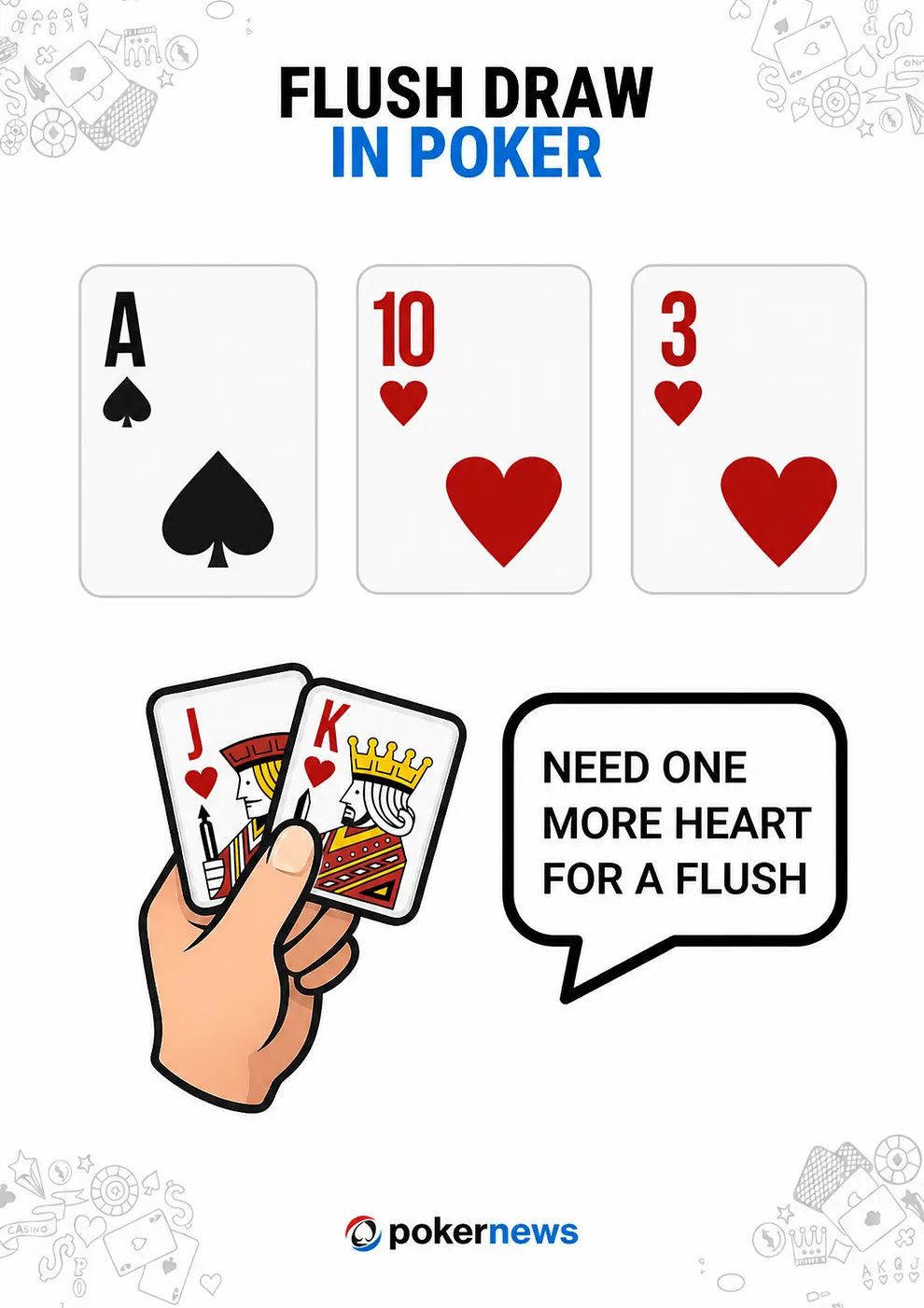
Example of a Flush Draw
Hole Cards: K♥ J♥
Board: A♥ 10♠ 3♥
In this example, you have four hearts - giving you a flush draw. The highest heart is an ace, and you hold the second-highest heart, which means you have a very strong flush draw that can't be beaten by other, higher flushes if you hit. This is an example of a nut flush draw.
What is a Backdoor Flush Draw?
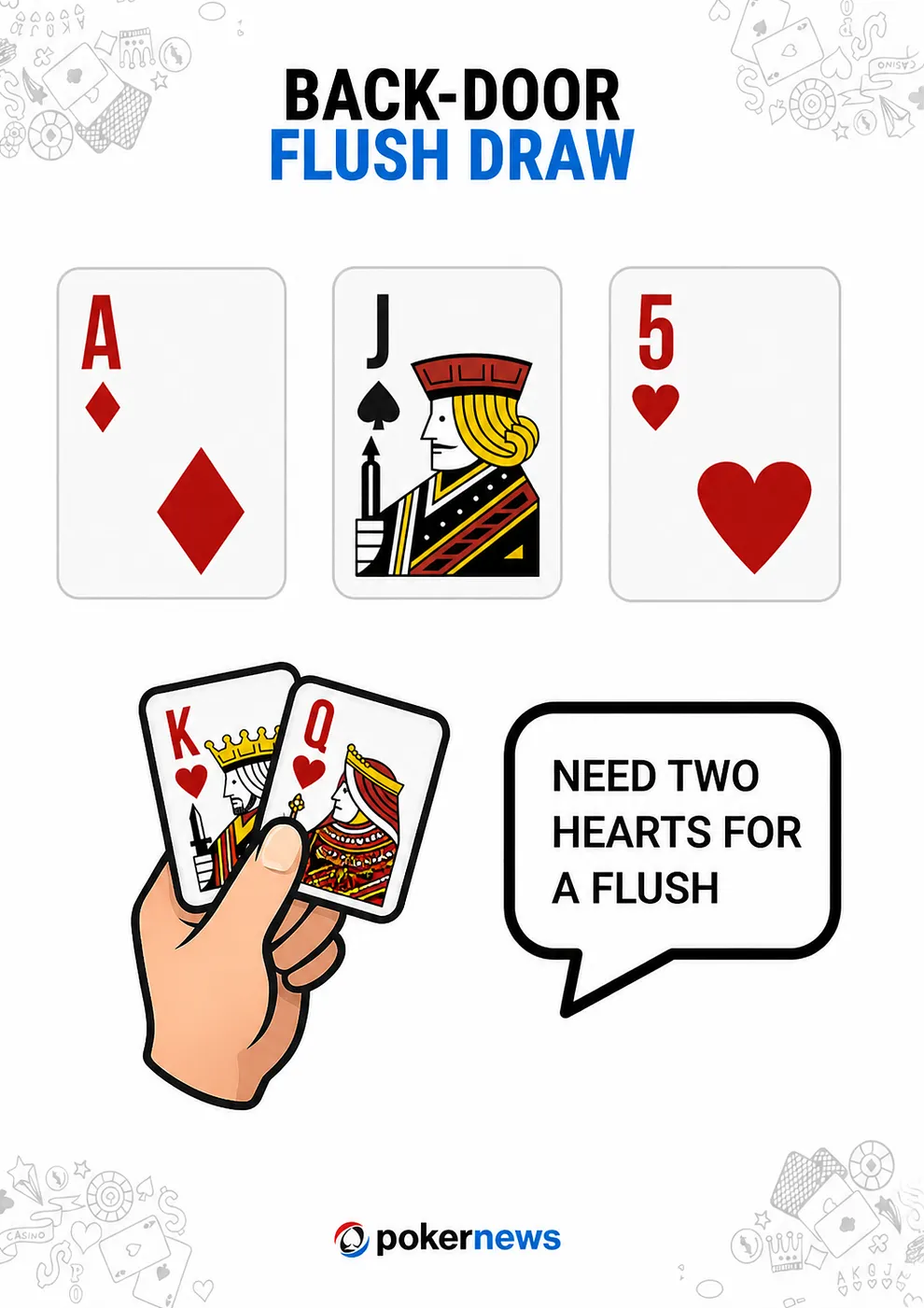
A backdoor flush draw is when a player holds three cards of the same suit on the flop, from the two hole cards and three community cards.
Backdoor flush draws are significantly weaker than regular flush draws because you need a suited card to land on both the turn and the river. This is rare, but does still happen. For this reason, a backdoor flush draw isn't a strong hand. It adds equity if you already have a lesser, made holding like two pair or three-of-a-kind, but you should seriously consider folding backdoor flushes in most spots if you have little potential to make any other strong hands.
Summary - A Backdoor Flush Draw is...
• The potential to make a flush by the river by hitting running cards (E.g. suited turn and river)
• Weaker than a standard (4-card) flush draw
• Not a made hand
Example of a Backdoor Flush Draw
Hole Cards: A♥ 10♥
Community Cards: 6♦ 3♠ 9♥
In this example, the player has three hearts on the flop. With two cards left to land (the turn and the river), a heart is needed on both upcoming streets in order to hit the flush.
Flush Draw vs Straight Draw - What's the Difference?
Flush draws are generally stronger because they have more outs and make a higher-ranking hand. Straight draws can still be powerful but are slightly less reliable.
Both share some similarities, but below are three main factors demonstrating how flush draws are different to straight draws in poker.
Drawing to make different hands - The main difference is that with a flush draw, as the name suggests, you're drawing to a flush. Whereas with a straight draw, you're looking to make a straight. This is relevant, as flushes beat straights in Texas Hold'em and most other formats, making it the stronger draw.
Number of outs - A standard flush draw has nine outs, while a standard straight draw has eight outs at most. This can vary when blockers, dead outs and backdoor draws are taken into account, but in general there will be more cards available to hit to complete your flush draw compared to a straight draw.
Odds of hitting - Given that there are more outs for flush draws, you have better odds of making the flush versus making the straight. We go into this in more detail below.
Let's get into the numbers. Here is a table showing the odds of hitting each type of draw. Values can vary depending on what cards have already been dealt and other factors, so these aren't always going to be exact but are correct in a general sense.
Factor
Flush Draw
Straight Draw
Number of Outs
9
8
Odds of Hitting on the Turn
~35%
~31.5%
Odds of Hitting on the River
~19.6%
~17.4%
Hand Strength (Ranking)
Flush (#5)
Straight (#6)
Flush draws are often played more aggressively, especially with additional equity (like overcards). Straight draws may require more caution depending on the board.
How Many Outs Does a Flush Draw Have?
A flush draw typically has nine outs, meaning nine cards can complete your hand.
Things get more complicated in games like Omaha Poker, where you might have four hole cards with the same suit, but can only use two of these. But in terms of Texas Hold'em, a flush draw has nine cards you can hit to make your flush.
Two hole cards + two suited cards on the board = nine outs
There are 13 cards in a suit. If you can see four, there are nine remaining that complete your flush.
Watch for dead outs - If opponents hold cards of your suit, your true number of outs is reduced.
Be cautious on paired or suited boards
If the board pairs or has multiple suited cards, your flush might not be the best hand (e.g. Full house or higher flush).
Understanding odds in poker is crucial. This puts many beginners off, but in reality it's much more straightforward than it seems and can benefit your game tenfold. Here are the basics of odds around flush draws.
Flop to river: ~35% chance to complete
Turn to river: ~19% chance to complete
These figures are important because they help guide your decisions at the table. A flush draw will complete by the river roughly 1 in 3 times, and from the turn to the river around 1 in 5 times. Understanding these odds is key when calculating pot odds.
For example, if you have a flush draw on the turn, you have roughly a 19% chance of hitting it. If there’s $80 in the pot and your opponent bets $10, calling creates a $100 pot, meaning you only need to risk 10% of the total pot to continue. Since your 19% chance of winning is greater than the 10% cost of calling, it’s profitable in the long run - even though you’ll still miss most of the time.
The Rule of 2 and 4
The rule of 2 and 4 is a great hack that allows you to quickly calculate the percentage of hitting your draw based on the number of outs. Again, poker is all about working out probabilities and using it to inform your decisions to help make you profitable in the long run. This rule is a great way to simplify this process.
The Rule of 2 and 4 is where you:
Multiply your outs by 4 (flop)
Multiply your outs by 2 (turn)
So with 9 outs:
9 × 4 ≈ 36%
9 × 2 ≈ 18%
It’s not exact, but it’s quick and accurate enough to help you make swift decisions mid-hand based on math.
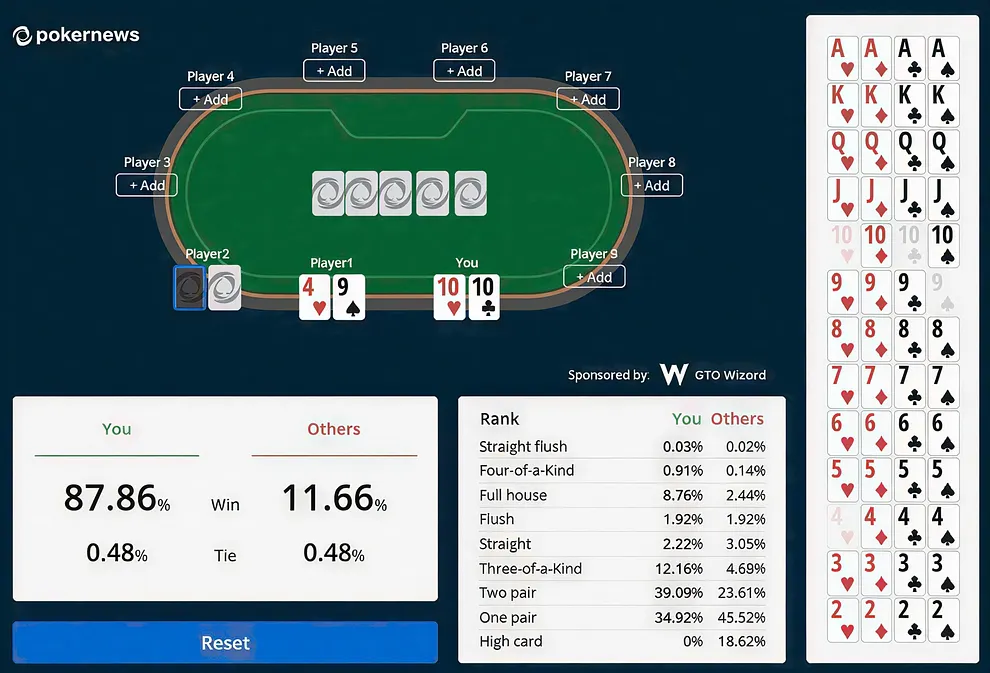
Texas Hold’em Poker Odds Calculator
Want exact numbers instead of estimates? Use our Poker Odds Calculator to break down any hand and see the percentages each player has of winning a hand with any given cards. Click the link below to use our free calculator.
Input your cards, your opponent’s cards, and the board to see precise winning probabilities in real time.
Let's run through a Flush draw in detail within an actual hand. Here's a quick example of a flush draw.
You’re dealt two hole cards: A♠ 7♠
The board comes: K♠ 5♠ 3♦
Here, you have a flush draw with nine outs. There are still two streets left to come (the turn and the river) where you can hit one of nine cards to make your flush. If an opponent also holds a spade in their two hole cards, your number of outs will be reduced as that spade cannot land on the turn or river. However, you won't know if this is the case as you cannot be sure of the cards they hold.
An opponent might also hold two spades in their hand, but because you have the ace you have a nut flush draw. This means that if one more spade does land on future streets, you'll both make a flush but your ace-high flush will be the higher one. Unless your opponent makes a straight flush, which is highly improbable based on the odds in poker, you'll win the hand.
Your opponent then bets, and you call.
The turn card lands: J♣
The jack of clubs doesn't improve your hand. You still have just ace-high with a flush draw. Your equity and chances of winning the hand by hitting your flush has halved from the flop to the river, with only one card remaining to hit a spade and complete your flush.
This is significant as it means calling a large bet becomes less profitable in the long run. Sure, you'll hit your flush around 18% of the time and win a big pot, but the other 82% of the time you'll miss and likely lose the hand after committing a lot of chips into the middle. That's not to say you definitely shouldn't continue, but weigh up what your opponent might hold and make an informed decision on whether to call based on the probabilities.
Your opponent bets small and you decide it's worth continuing to see if you hit your flush on the river.
River: Q♠
You hit your flush. It's the nut flush, so even if your opponent also has two spades they cannot make a higher flush. You must consider that your opponent could have a full house or four-of-a-kind, but there are no straight flush or royal flush possibilities, so your ace-high flush is likely to be the best hand.
How to Play a Flush Draw in Poker
Flush draws are strong, but not automatic money printers. A common mistake beginners make is overplaying flush draws. By this, we mean committing too many chips under the assumption that they will hit the flush, and then losing a ton of chips when they don't.
That being said, aggressive play is often the way to go, but not to simply build the pot. Ultimately, a flush draw is nota made hand and you'll miss more than you hit. Therefore, when playing against one other opponent, aggression can be good as you might force them out the pot without even needing to make your flush. Alternatively, if they remain in the pot you have the 'insurance' of potentially hitting your flush and scooping a huge amount of chips.
Aggressive play often works best, especially when you have:
Calling can be fine if the pot odds justify it, but blindly chasing every flush draw is a fast way to burn chips.
Good players balance aggression with awareness - knowing when to push and when to fold. It's easier said than done, but weigh up all the information you can possibly get in a hand and make a more informed decision based on that.
A flush draw in poker has nine outs because four of the 13 suited cards are already either held by a player within their hole cards or have landed on the flop.
Should you chase flush draws?
You should only chase flush draws when the pot odds and hand situation make it profitable to do so in the long run.
Should you play flush draws aggressively?
Often, playing flush draws aggressively is the way to go. This is especially the case when you have added equity, such as overcards, additional straight draws, nut-flush potential or have already made another hand. Aggression also adds the benefit of fold equity, where opponents might fold their hand before showdown when facing a bet.
Is a flush draw a good hand in poker?
A flush draw is not a made hand in poker, but it’s one of the strongest drawing hands you can have and carries a lot of strong potential.

 button in Safari