
 button in Safari
What is a High Card in Poker? Hand Definition & Examples

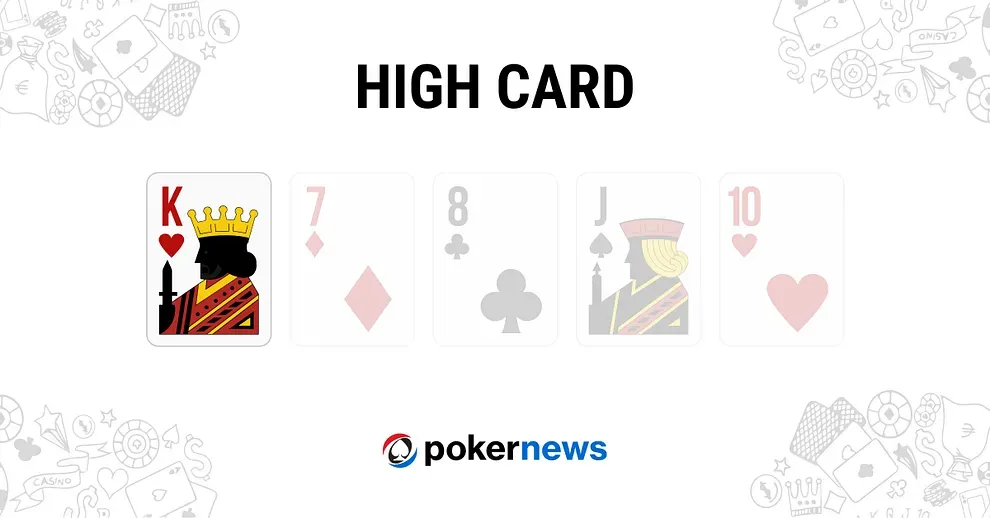
High card is the lowest ranked hand in poker where no hand combination can be made, with its exact value determined by the highest card.
It's beaten by every other ranked poker hand, including pairs, two pairs and three-of-a-kinds. However, players can still win at showdown with a high-card hand if their opponent also cannot make a better hand and if their highest valued card is lower.
An example would be a player holds K♥2♣ with the board showing J♠10♥8♣ 7♦ 3♣, meaning the player just has a high-card hand.
Skip to the relevant section on this page:
- What is a High Card in Poker?
- How High Cards Rank in Poker Hands
- How Rare is a High Card Hand?
- How to Play High Cards
- High Card FAQs
What is a High Card in Poker?
A high card in poker is a very weak hand. By default, every player will at the very least hold a high card hand - as it's just the highest card in a player's five-card hand when no better combinations can be made.
This means that even preflop, if you're dealt 3♣7♣ you will have a high card hand. If the five community cards are dealt and do not improve your hand (for instance, a seven lands and you improve to a pair), you'll still have just a high card by the river.
However, like some straights can beat other straights, or some flushes are higher in value than others, high card hands can outrank one another as well. It's simply based on whichever player has the single highest valued card.
How High Card Rank in Poker Hands
High cards rank in the lowest position in the poker hand rankings in almost all variants, including Texas Hold'em, Pot-limit Omaha and Stud.
From strongest to weakest, the top of the poker hand hierarchy looks like this:
- Royal Flush: A-K-Q-J-10, all the same suit
- Straight Flush: Five consecutive cards of the same suit (not A-K-Q-J-10)
- Four of a Kind: Four cards of the same rank
- Full House: Three of a kind plus a pair
- Flush: Five cards of the same suit (not in sequence)
- Straight: Five consecutive cards, mixed suits
- Three-of-a-Kind: Three cards of the same rank
- Two Pair: Two sets of two cards the same rank
- Pair: Two cards the same rank
- High Card: Five cards where none of the hands above can be made
Real practice is a good way to learn and master how hands rank in poker. If you want first-hand experience, using a poker welcome bonus can be a lower-risk way to hone your skills and build experience.
Why High Card Loses to Every Other Hand
High card hands lose to any other made hand as it's the lowest valued hand in the rankings. No cards combine or connect to make a better hand. Even a pair of 2s will beat high card hands. To answer why this is, we need to look into the probabilities in poker.
The hand rankings aren't just random - they're determined by which combinations are statistically more or less likely to be made. This is why in games like Short Deck (6+) Hold'em, the hand rankings don't match Texas Hold'em's.
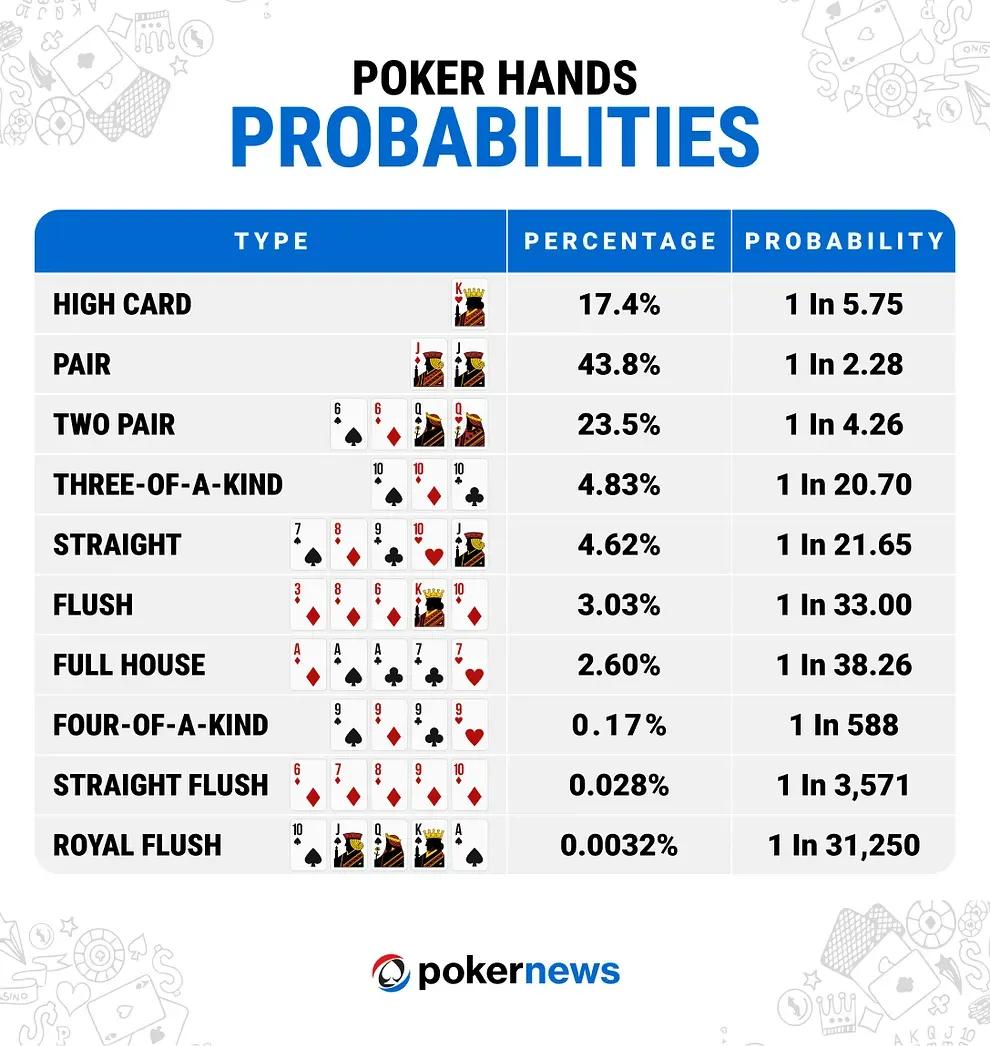
Based on odds of the two hole cards plus the five community cards, there's a 17.4% chance that you have just a high card hand by the river. So, looking at the table below, you're actually more likely to make a pair (43.8% of the time) and two pair (23.5% of the time) by the river than you are to still have just a high card.
This might seem counterintuitive, as hands that are more likely are ranked higher, but it's simply because every player will always at the least have a high card - no hand is worse.
High Card vs High Card - Which Hand Wins?
There is one, and only one, situation where high cards can win (at showdown): When up against another high card hand.
If we refer back to the chart above, it's rare that two or more players are still in a hand by showdown and are left with just a high card, but it does happen. In this instance, you still take all players' best five-card hand combination, and whoever has the highest card wins. If both hands are tied with the same high card, we move to the second highest card, then the third and so on.
If all five cards are identical, the pot is split. However, if just one of those five cards outranks an opponent's, that hand will be the winner.
For example, let's say Player 1 has A♣3♠, and Player 2 holds A♥8♦. If the community cards run out K♦Q♠9♥ 4♣ 2♠, no player makes any hand combination like a pair, or a straight.
Both players have a high card hand
Player 1: A♣ 3♠
Player 2:A♥8♦
Board: K♦Q♠9♥4♣2♠
In this instance, Player 2 will win the hand. Both have A, K, Q, 9 as their four highest cards, but the fifth card here is the key one. Player 1's fifth highest card is the 4 that's on the board, while Player 2's fifth highest is the 8 in their hand. Therefore, they take down the pot with a high card hand.
You can see that kickers come into play in some circumstances, and Player 2's kicker outranked Player 1's in this example.
High card is the worst hand in poker and while it will lose most of the time, it won't lose all of the time.
Pair vs High Card
By now, you will have hopefully realized that a pair beats a high card hand.
One pair is the 9th best hand in the poker hand rankings, while a high card hand is the worst ranking. It doesn't matter if a player has an ace or a three as their high card, even the lowest pair (twos) beats it.
How Rare is a High Card Hand
High card hands are interesting, in the sense that every player will technically have at the very least a high card at any time in a poker hand. For instance, in a hand of Texas Hold'em, if your two hole cards are dealt and you see anything but a pocket pair, you have a high card hand.
So high cards are very common. It's not a rare hand and as such, it's not a very strong hand either.
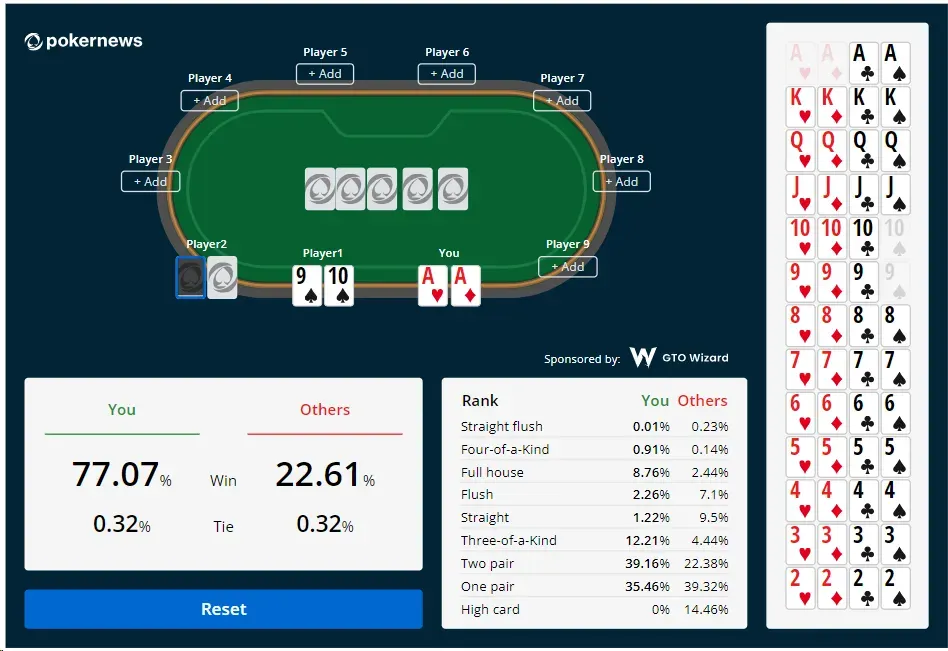
Check out our Poker Odds Calculator below, where you can find the exact probabilities of winning a hand when you have high cards.
How to Play High Cards
There are only two realistic situations where high cards have any sort of value, which in a way makes playing them simple. It's mostly a hand that you can fold if facing any sort of aggression or betting action, and play passively if the action's checked round to you. The only exception to this is when:
- It's early in a hand and you have strong high cards like an ace and a king
- You have strong drawing potential
1. Strong High Cards
Let's say you're dealt A♣K♠ and the flop comes 2♥7♦Q♠. Not only do you have strong high cards that will give you top pair if they land on future streets, but the three community cards are an unconnected flop. There are no straight draws or flush draws, you have two overcards and the Q♠ is the only likely card that your opponents might have hit based on their ranges if there was betting preflop.
In this instance, of course you shouldn't be wedded to your hand. If a big bet comes your way, folding is best as you only have a high card and it's not all that likely you'll improve by the river. However, an opponent betting small might make it worth your while to stick around. What's more, you might be up against other ace-high hands, where you have the best kicker (K♠).
2. Strong Drawing Potential
Let's now say you have Q♣J♣ and the flop comes 10♣9♣2♥. You still have a high card hand, but you have really strong drawing potential. With an open-ended straight draw and a flush draw, you have a total of 15 outs (9 clubs + 4 kings + 4 eights, although one king and one eight are already included among the club outs) to make a strong hand. Applying the Rule of 4 and 2, you have approximately 60% equity at this point.
This only accounts for the equity from your draws. Your total equity may be even higher if pairing your queen or jack also gives you the winning hand!
Therefore, even when facing a larger bet you have a lot more justification to stick around. If you hit on the turn or the river, you can expect to get good value with your straight or flush.
While high cards are very weak and are the worst hand in poker, they're not always an automatic fold. If you have strong drawing potential, the board is unconnected or you suspect your opponents are similarly weak, it might be worth sticking around in the hand to see how future streets play out.
Poker Hands Quiz
Want to test your knowledge of which hands beat which in poker? Prove your skills and try get 100% in our poker hands quiz.
High Card in Poker FAQs
Can you win a hand in poker with a high card?
Yes, you can win at poker with a high card. Although rare, it's more common than most people think. The most common scenario is often where a player has ace-high with a strong kicker, beating a player also with ace-high but a weaker kicker.
What is a high card hand in poker?
A high card hand in poker is where none of a player's two hole cards and the five community cards connect to form a hand combination such as a pair, two pair or straight.
What happens if two players both have high cards?
When two or more players both have high card hands, the one with the highest card will win the pot. If both players have the same high card, the tie-breaker goes to the second-highest card and so on. If both players' highest five cards are all the same value, the pot is split.
How do you play a high card hand in poker?
Most of the time, you'll just want to fold high card hands as they're the lowest ranked poker hand. However, if you have straight or flush draws, or have strong high cards like an ace or a king, your equity is slightly higher. Depending on the situation and what stage of the hand you're at, it might be worth seeing future streets and re-evaluating your hand then.
What is the highest card value in poker?
An ace is the highest card in poker. It outranks all other cards in value alone, but also can be used as a '1' to complete wheel straights - E.g. A (1)-2-3-4-5.