
 button in Safari
What is a Flush in Poker? Definition & Examples

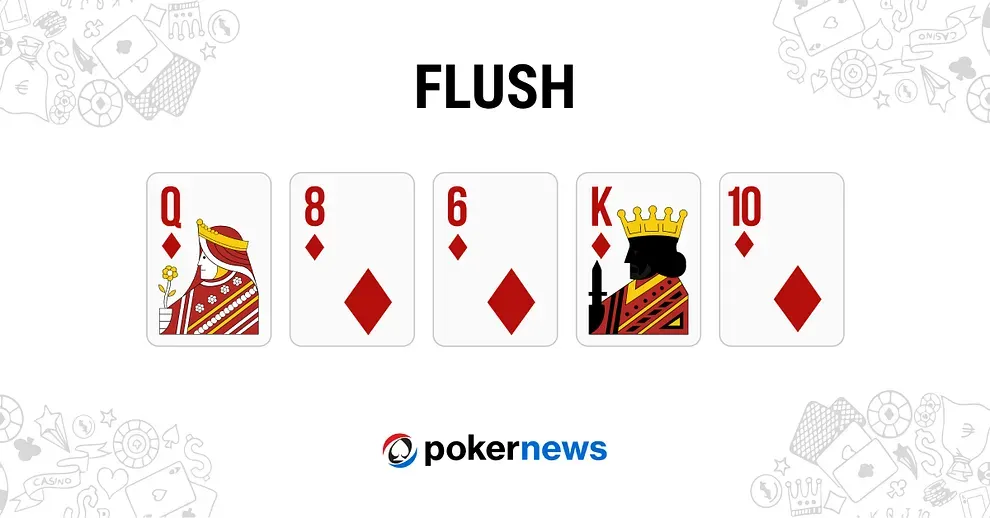
A flush in poker is a hand that contains five cards of any rank but all the same suit, e.g. Q♦8♦6♦K♦10♦. It is a strong hand, placed fifth in the poker hand rankings.
Skip to the relevant section on this page:
- What is a Flush in Poker?
- How a Flush Ranks
- Flush vs Other Hands
- How to Play a Flush in Poker
- Flush FAQs
What is a Flush in Poker?
A flush is a very powerful poker hand in which all five cards are of the same suit. For example, K♠Q♠8♠6♠3♠ is a king-high flush because the king of spades is the highest-ranked card.
It is easy for you to spot if you have made a flush because all five cards are of the same suit. The main issue with flushes is that many players play suited cards, particularly suited aces, so you must be wary of an opponent holding a better flush.
Flushes are ranked by their highest card, with an ace-high flush being the strongest possible flush. The only exception to this rule is when you make a straight flush ace-to-five, also known as a Steel Wheel, but a straight flush is a different hand entirely.
See the full Poker Hand Rankings Chart
How a Flush Ranks in Poker Hands
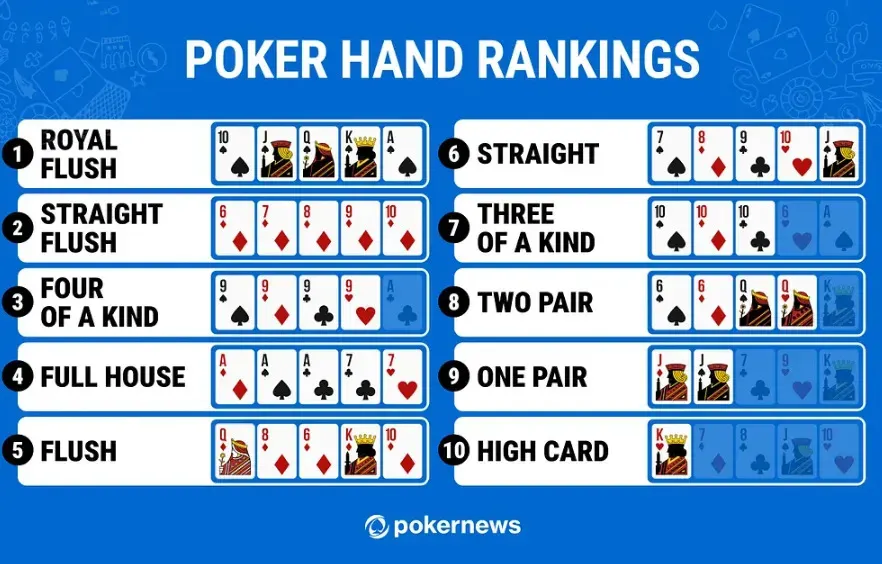
A flush is the fifth-strongest hand you can make in Texas Hold'em, Omaha, and Seven-Card Stud. A player holding a flush beats high card, one pair, two pair, three-of-a-kind, and even a straight.
Though it loses to a full house, four-of-a-kind, a straight flush, and a royal flush, these hands are much rarer.
You are not guaranteed to win the pot when you make a flush – that honor is only bestowed on a royal flush - but you have a very good chance of having the best hand when you go to showdown.
- Royal Flush: A-K-Q-J-10, all the same suit
- Straight Flush: Five consecutive cards of the same suit (not A-K-Q-J-10)
- Four of a Kind: Four cards of the same rank
- Full House: Three of a kind plus a pair
- Flush: Five cards of the same suit (not in sequence)
- Straight: Five consecutive cards, mixed suits
- Three-of-a-Kind: Three cards of the same rank
- Two Pair: Two sets of two cards the same rank
- Pair: Two cards the same rank
- High Card: Five cards where none of the hands above can be made
Flush vs Other Poker Hands
Flushes place fifth in the Poker Hand Rankings, which may give the impression that they are overly strong because there are only ten hand rankings. However, in a game like Texas Hold'em, one pair is often strong enough to win a hand, and three-of-a-kind is very strong on most boards; a flush beats those hands easily.
A full house, four-of-a-kind, straight flush and royal flush, the hands that beat a flush, are extremely difficult to make so the chances that an opponent has one of those hands at the same time that you have a flush is rare.
Flush vs Flush - Which Hand Wins?
It is possible for more than one player to make a flush at the same time. When that happens, the winner is decided by the highest card in the flush sequence. If the highest card is equal, you move to the second highest, then the third highest etc.
For example, A♦K♦9♦6♦5♦ beats Q♦9♦6♦5♦2♦. Both are strong hands, but the first is an ace-high flush while the second is just a queen-high flush.
If both players hold the exact same flush, the result is a tie, and the pot is split. Suits do not carry any weight in most poker variants, so a flush made with spades is no stronger than a flush made with the other three suits. The rare occurrence of two players having different-suited flushes in the same hand only occurs in games like Seven-Card Stud.
| Hand | Which Wins? | Example |
| Flush | ✅ Wins | A♠K♠10♠6♠3♠ |
| Flush | ❌ Loses | A♠K♠10♠6♠2♠ |
Flush vs Straight Flush
Although a flush and a straight flush have similar names, there are completely different hands. A straight flush is the second-strongest poker hand, beaten only by a royal flush, which is a straight flush running from ace to ten.
Flushes have five cards of the same suit, while a straight flush has five consecutive cards AND they are all of the same suit. The latter is extremely strong and very rare.
| Hand | Which Wins? | Example |
| Flush | ❌ Loses | A♠K♠Q♠3♠2♠ |
| Straight Flush | ✅ Wins | 9♠8♠7♠6♠5♠ |
Flush vs Straight
Flushes and straights are commonly confused by beginners, with some struggling to remember which hand wins. A flush always beats a straight in almost every poker format, but the confusion can come from the fact that both hands sit next to one another in the rankings.
This is because it's more difficult to make a flush than a straight, with fewer possibilities when looking at the probabilities in poker. Both are still strong hands, but keep in mind that if three suited cards have landed on the board, a flush is possible.
| Hand | Which Wins? | Example |
| Flush | ✅ Wins | A♠K♠Q♠3♠2♠ |
| Straight | ❌ Loses | 8♠7♥6♦5♣4♣ |
Flush vs The Rest of Hands
Although a flush sits fifth out of ten in the poker hand rankings, the top four hands are extremely rare, which means a Flush will often win at showdown. A flush loses to a full house, four-of-a-kind, straight flush, and a royal flush, but beats everything else. Here's how a flush compares to other strong poker hands.
| You Have | They Have | Result |
|---|---|---|
| Flush | Four-of-a-Kind | Lose ❌ |
| Flush | Full House | Lose ❌ |
| Flush | Three of a Kind | Win ✅ |
How Rare is a Flush?
Flushes in Texas Hold'em are quite rare, which is why they sit in the middle of the poker hand rankings. Discounting royal flushes and straight flushes (which contain flushes), you will make a standard flush by the river in Texas Hold'em:
• 1 in 33 hands
• 3% probability
If you have two suited cards, you have approximately a 1 in 118 chance of flopping a flush. If you hold a flush draw on the flop, the chances of you completing your flush on the turn are around 19%, but 35% by the river.
What Beats What in Poker: Quiz for Texas Hold’em Beginners
Practice your poker hand rankings knowledge and see if you can get 100% in our quiz below.
Playing and Maximizing Value with a Flush
Flushes are one of the more powerful poker hands, but making one isn't as rare as you would initially believe. If you play a long enough online poker cash game session, it is highly probable that you will make a couple of flushes before you log off.
As you are unlikely to flop a flush, the real decision-making happens before you make the hand. You need to figure out if the flush is worth chasing and how to squeeze maximum value from it once you do complete your flush.
Drawing to a Flush
It should be obvious that you are more likely to make a flush in poker if you have suited hole cards. It is possible to improve to a flush without having two hole cards of the same suit, but the chances of that happening are dramatically reduced because you need four community cards to come in one of your suits, not three.
As flushes are ranked by their highest card, chasing an ace-high flush is a better idea than chasing a six-high flush. Playing a hand like A♣8♣ makes more sense than J♣8♣ simply because you are guaranteed to have the best flush with the former if you do hit.
Whether or not you should chase a flush is dependent on a number of factors, including stack sizes, your position at the table, pot odds, and implied pot odds. Blindly chasing flushes can be a recipe for disaster because even if you hold two suited cards and flop a flush draw, you will improve to a flush only slightly more than a third of the time you reach the river.
When You Hit a Flush
Although flushes are powerful hands that are likely to win at showdown, the main challenge you face is getting your opponent to pay you off. This is because it is more obvious when someone may have a flush, as there are at least three of one suit on the board. Similarly, players are known for playing suited cards in the hopes of hitting a flush, so players become wary when a flush is possible.
Having an ace-high flush, the best flush, allows you to play more aggressively because another flush cannot beat you; that is unless a straight flush is possible. But it all depends on your opponent's hands, the stack sizes and your opponent's tendencies that dictate the optimal way to play a flush.
Traps, Blockers, and Board Texture
As you can see, blockers, the board playing and hand reading come into play when you make a hand as strong as a flush. Naturally, this leads to spots where checking or trapping makes more sense than betting outright. Don't you just love poker?!
Checking with a flush against an aggressive opponent who has shown they like to bet can often yield more value than firing a bet yourself. In this scenario, if your opponent bets, you can call and see if they bet again on another street, or check-raise and see if they pay that larger bet.
All the main operators now have dedicated poker apps, so you can play on mobile. Check them and join the action today.
Flush in Poker FAQs
What is a flush in poker?
A flush is a poker hand where all five cards are the same suit.
How does a flush rank in poker hands?
Of the ten possible five-card poker hands, a flush ranks fifth-strongest
What beats a flush?
Flushes are beaten by a full house, four-of-a-kind, straight flush and royal flush.
How do you compare two flushes?
If two players have made a flush, the winner is the player holding a flush with the highest-ranked card. For example, K♠Q♠8♠7♠3♠ beats J♠10♠8♠7♠3♠.
Is a flush ranked the same in all poker variants?
A flush is ranked the same for most poker variants, including Texas Hold'em, Omaha, and Seven-Card Stud. However, in Short Deck (6+ Hold'em), where some cards are stripped from the deck, a flush is the fourth-best holding, beating a full house
How rare is a flush?
Flushes are relatively rare. In Texas Hold'em, you will make a flush once in every 508 hands, or 0.1965% of the time by the river in the long run.
Is a straight flush a type of flush?
Technically, No. Although a flush and a straight flush have the word "flush" in their names, they are entirely different hands. A straight flush has five sequential cards that are all the same suit. Such a hand is extremely rare and is only beaten by the even rarer royal flush.