
 button in Safari
What is a Pair in Poker? Definition and Examples

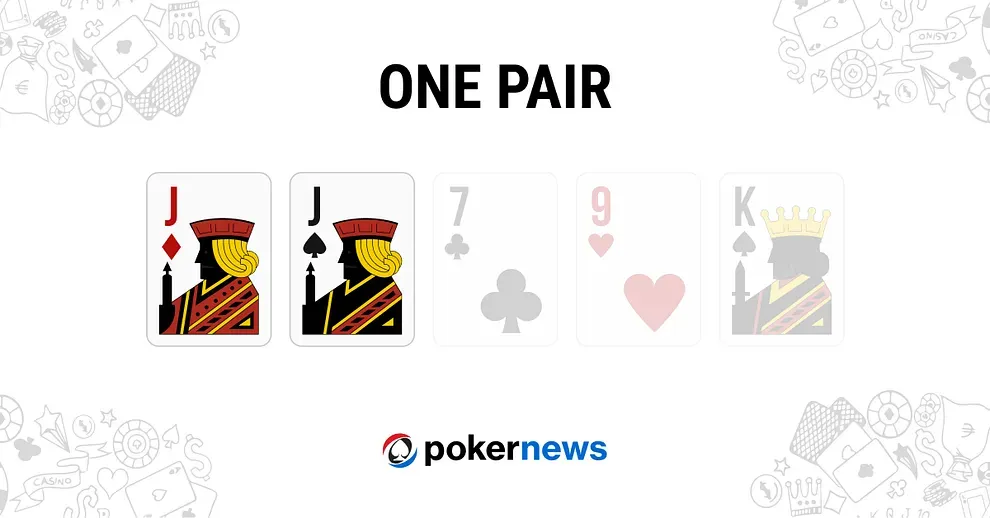
A pair (or 'one pair') in poker is a hand that contains two cards with the same value - E.g. J♦J♠7♣9♥K♠
It is one of the weaker hands in the poker hand rankings, only beating high cards. All other hands, including three of a kind, and two pair, beat one pair. That said, one pair can often be enough to win some hands in Texas Hold'em if the board doesn't play and there aren't multiple opponents in a pot. In Pot-Limit Omaha, it's a lot rarer to win with just a pair.
Skip to the relevant section on this page:
- What is a Pair in Poker?
- How One Pair Ranks in Poker Hands
- Pair vs Other Poker Hands
- How to Play One Pair
- One Pair FAQs
What is a Pair in Poker?
A pair is two cards of the same rank. For example, if you hold A♣K♥ and the flop is K♦J♠8♥, you have a pair of kings. In this example, you also hold what's known as 'top pair' - which is where you match the highest-ranked community card. This might seem a little counterintuitive, as if your opponent holds aces then they have a higher pair, but top pair generally only refers to what pairs can be made using the community cards.
Similarly, you can have bottom pair, which is where the lowest-ranked community card forms part of your pair.
It's important to note that a pair can make up part of several other stronger hands. A full house, for instance, consists of a pair and a separate three-of-a-kind. While two pair is made up of two different individual pairs. The distinguishing factor is that one pair means two cards have the same rank, while the other three in your five-card hand do not connect with any other card.
Pocket Pairs
A pocket pair is when a player's two hole cards are the same value, giving them a pair before the flop is even dealt. The strength of these varies drastically based on the ranking of the pair.
For instance, pocket aces is well-known for being the best starting hand in poker, however, pocket twos is far more commonly folded in most scenarios, given their exposure to overcards and weak postflop playability.
A lot of the middling pairs (7s - 10s) are considered tricky to play. If you don't improve on the flop, turn or river, they're unlikely to be strong enough by themselves to win a hand. However, if you do hit three-of-a-kind, your mediocre hand then becomes extremely strong.
The real value and perhaps greatest advantage of a pocket pair is that they're disguised. Players expect opponents to have strong holdings with high cards like aces and kings, and information can be drawn based on what community cards land. But pocket pairs are not only two cards of the same rank, but they're also not going to be seen by opponents - and this makes them powerful.
How One Pair Ranks in Poker Hands
One pair is the second worst poker hand in the rankings, beating only high cards. The other eight possible hands all beat pairs.
From strongest to weakest, the top of the poker hand hierarchy looks like this:
- Royal Flush: A-K-Q-J-10, all the same suit
- Straight Flush: Five consecutive cards of the same suit (not A-K-Q-J-10)
- Four of a Kind: Four cards of the same rank
- Full House: Three of a kind plus a pair
- Flush: Five cards of the same suit (not in sequence)
- Straight: Five consecutive cards, mixed suits
- Three-of-a-Kind: Three cards of the same rank
- Two Pair: Two sets of two cards the same rank
- Pair: Two cards the same rank
- High Card: Five cards where none of the hands above can be made
A common mistake amateurs make is misreading a two-pair hand as being just one pair. For instance, if you have pocket nines and the flop is K♦J♠J♥, you have two pair, not just one pair. Remember that in Hold'em poker, the best five cards from your hole cards and the community cards make up your hand, so in this example, every player will have at least a pair of jacks regardless of their other cards.
Pair vs Other Poker Hands
It's important to understand exactly where you stand in a hand with one pair, knowing how it compares with other holdings in poker. So here's a quick comparison between the strength and overall value of pairs compared to some of the other common hands it might be up against.
Pair vs Two Pair
A pair always loses when up against two pair in poker. They are next to one another in the full hand rankings, but two pair will always beat one pair, regardless of the strength of it. For instance, a pair of aces will lose to two pair (twos and threes). An ace has a significantly higher value than a two or a three, but if it only forms a pair, it loses to any two pair holding.
| Hand | Which Wins? | Example |
| One Pair | ❌ Loses | A♥ A♣ Q♠ J♠ 10♦ |
| Two Pair | ✅ Wins | 2♣ 2♥ 3♦ 3♠ 10♥ |
Pair vs High Card
A pair always beats a high card in poker. A high card is the lowest holding in the poker hand rankings and is a very weak hand. A pair only sits one position higher in the rankings, but is stronger than high cards.
| Hand | Which Wins? | Example |
| One Pair | ✅ Wins | K♥ K♣ 6♠ 5♠ 2♦ |
| High Card | ❌ Loses | A♣ 10♥ 8♦ 7♠ 5♥ |
One Pair vs One Pair
When two or more players have one pair, the player with the highest-value pair wins the hand. If players have pairs with the same value, the players with the highest kicker wins the pot. If those are equal, it goes to the second kicker, then the third kicker. If all five cards are equal, the pot is split.
| Hand | Which Wins? | Example |
| One Pair | ✅ Wins | Q♥ Q♣ 10♠ 8♠ 5♦ |
| One Pair | ❌ Loses | Q♦ Q♣ 8♦ 7♠ 5♥ |
How Common is One Pair?
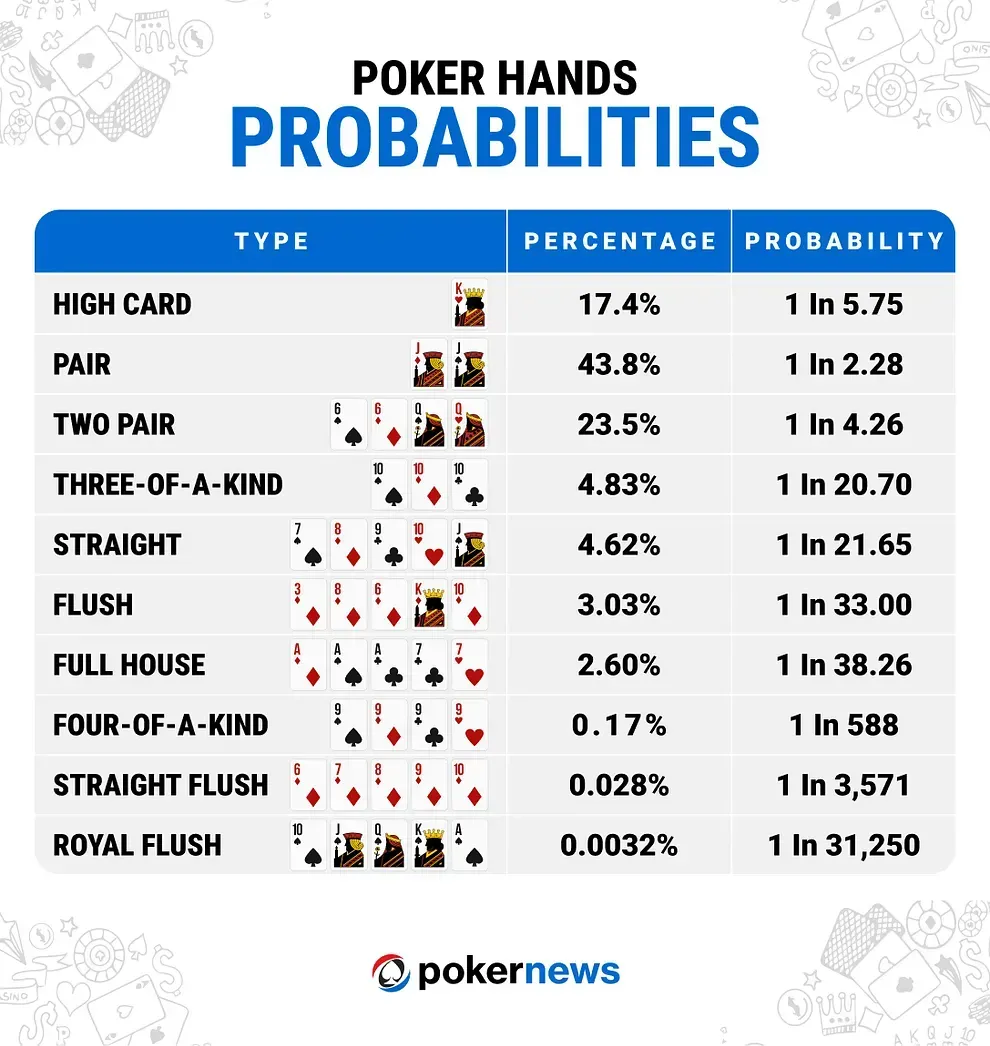
The probability of ending a hand (i.e. reaching the river) with just one pair is 43.8%, taking into account the five community cards plus the two hole cards. This makes it the most common holding to end a hand with in Texas Hold'em poker and you're expected to make one pair approximately once every 2.28 hands.
Looking at it more loosely, you can expect to finish with a pair or higher by the river 82.6% of the time.
Ironically, you're less likely to actually end with a one-pair hand in Omaha games like Pot-Limit Omaha and Big O. In these, you have four hole cards, making it more likely that you hit higher-ranking hands by the river. The percentage of ending the hand with just one pair is therefore considerably less than the 43.8% chance you have in Hold'em.
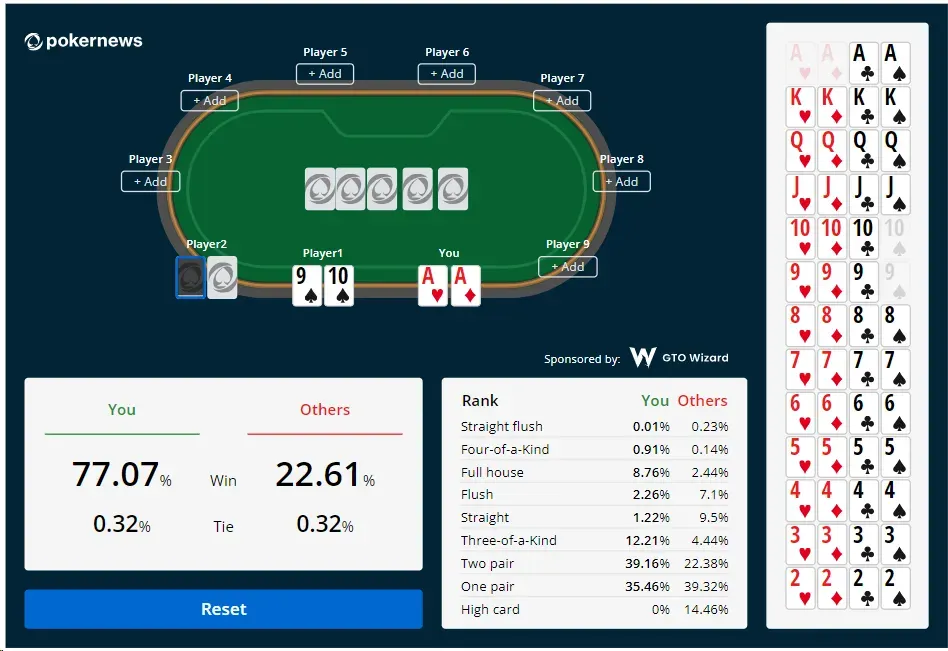
Check out our Poker Odds Calculator, where you can find the exact probabilities of winning a hand when you have high cards.
How to Play One Pair
One pair is a very difficult hand to play, and its strength varies significantly depending on the value of the pair you hold. It's important to understand that if your pair doesn't improve on the latter streets, its relative value decreases as each community card lands - as more cards give your opponents more opportunities to improve their hand to something that will beat your pair.
Here are some tips and strategies for playing pairs in poker.
Bet Big Preflop with Premiums
Pocket aces, kings, queens and, arguably, jacks are all premium starting hands, but aces stand out because they have no overcards to worry about. Kings, queens and jacks, meanwhile, can quickly become vulnerable if an ace lands on the board.
To maximize your chances of winning, raise aggressively before the flop. This builds the pot when you're ahead while reducing the number of opponents, making it less likely someone will improve to beat your pair. Some players choose to slow-play aces to trap opponents, but this comes with the added risk of giving opponents a chance to catch up.
Don't Commit to Set-Mining
Set-mining is where players with lower-value pocket pairs aim to see the flop as cheaply as possible, with the goal of making three-of-a-kind. The key takeaway here is that you will flop a set with a pocket pair around 11.8% of the time. If we base it purely on pot odds, set-mining is very rarely a profitable strategy, but the implied odds are what makes it occasionally worthwhile.
Therefore, don't make the same mistake a lot of new players make and commit too many chips with a low pocket pair in the hope of hitting a set. If you're facing large bets, don't have any strong flush draws or straight draws and are likely to lose unless you hit one of two outs, you should strongly consider folding your pair.
Consider Board Texture
Board texture is another crucial factor that can change the relative value of the pair you hold. Let's say the board is wet, and Q♦J♦10♦ lands on the flop, there are a ton of draws available. If you have a pair like 6♥6♠, there are several overcards to your pair and you have no drawing potential.
Alternatively, if the flop lands 3♦4♥5♠, you have an open-ended straight draw, your sixes are overcards to the flop and opponents can only have a backdoor flush draw at best. While you have the same hand in both scenarios, your sixes are significantly stronger in the second situation.
It's important to consider the board texture when holding pairs, and question how likely it is that your opponents' hands connect with the board.
Poker Hands Quiz
If you think you know which hands beat which in poker, let's put it to the test! Can you get 100% in our poker hands quiz?
Want to put your new-found knowledge to the test? Check out our list of the best online poker sites and play real-money online poker today!
One Pair in Poker FAQs
What is one pair in poker?
One pair is a hand consisting of two separate cards of the same rank.
How does one pair rank in poker hands?
One pair is the second weakest made hand in games like Texas Hold'em, and only beats high-card hands.
What beats one pair?
Every hand apart from high cards beat one pair, including two pair, three-of-a-kind and straights.
How do you compare two separate pairs?
Two separate pairs are compared by the rank of the pair, so a pair of queens will beat a pair of jacks.
Is one pair ranked the same in all poker variants?
Yes, aside from lowball games, a pair is ranked the same across different poker variants, including Stud, Omaha and Short Deck.