
 button in Safari
What is a Full House in Poker? Definition & Examples

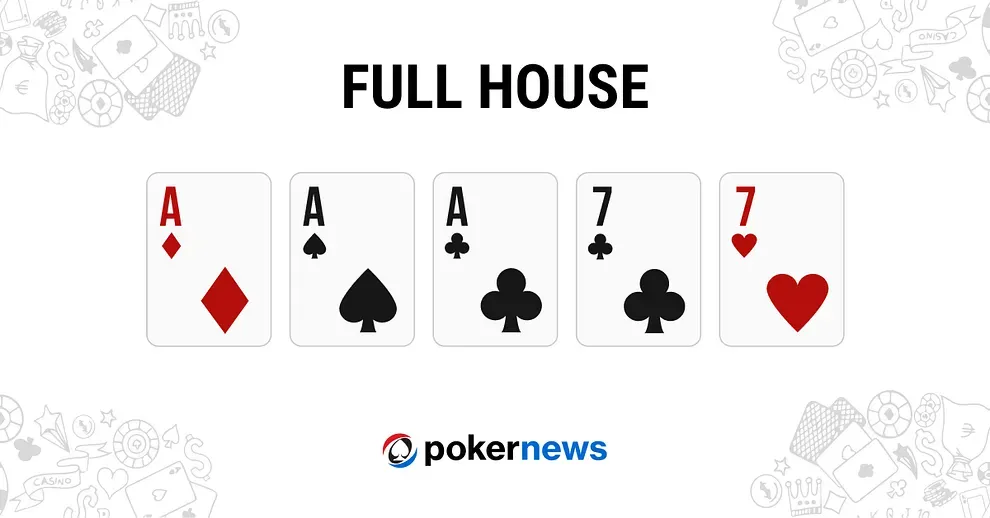
A full house in poker is a very strong hand made up of three-of-a-kind and a pair, for example: A♦A♠A♣7♣7♥.
It's only beaten by the top hands on the poker hand rankings list. If you have a full house, it's very likely you'll win the hand. However, there is a small possibility of opponents having stronger full houses or even quads - though the latter is very rare.
Find out more about full houses below, including examples, who wins when two players have full houses and how to play it when you hit this hand.
Quickly navigate to the relevant section on this page
- What is a Full House in Poker?
- How a Full House Ranks in Poker Hands
- Full House vs. Other Poker Hands
- How Common are Full Houses in Poker?
- Playing and Maximizing Value With Full Houses
- Full House FAQs
What is a Full House in Poker?
A full house is a powerful poker hand made up of
three-of-a-kind and a pair. It is the fourth strongest hand you can make in
Texas Hold'em, beaten only by four-of-a-kind, a straight flush, or poker's Holy
Grail, a royal flush.
The most common way to make a full house is by having a
pocket pair as your hole cards, improving to a set, then the board pairing. For
example, holding K♦K♠ and the five community cards falling K♥3♠Q♣3♥7♦.
Another way would be to have a pocket pair as your hole
cards and the five community cards showing three-of-a-kind by the river.
Full houses are ranked by the three-of-a-kind component.
For example, A♠A♣8♠8♦8♥ is a
lesser full houses than Q♠Q♦Q♣9♠9♥. The first example would be called eights full of aces, while the second would be called queens full of nines.
Although a full house is not unbeatable – it's not the
nuts – improving to one in a Texas Hold'em cash game or tournament means you
are very likely to win the pot.
Summary - A Full House is...
• The fourth strongest hand in Texas Hold'em
• Made up of three-of-a-kind and a pair
• Very strong but not unbeatable
How a Full House Ranks in Poker Hands
You should be delighted if you make a full house at the poker tables because, while not unbeatable, it is quite unlikely that someone has you beat. Only stronger full houses, four-of-a-kind, straight flushes, and royal flushes can beat a full house.
One thing to note is that full houses are weaker than flushes in the Short Deck rankings - which is a popular variant of Hold'em poker that's also known as 6+. In Pot-Limit Omaha, the rankings are the same as Texas Hold'em, but full houses are more common due to players having four hole cards - and are relatively weaker as a result.
Below shows where full houses sit in the rankings for most poker games, though, including Texas Hold'em and Omaha.
- Royal Flush: A-K-Q-J-T all of the same suit
- Straight Flush: Five consecutive cards of the same suit (not A-K-Q-J-T)
- Four of a Kind: Four cards of the same rank
- Full House: Three-of-a-kind plus a pair
- Flush: Five cards of the same suit (not in sequence)
- Straight: Five consecutive cards, mixed suits
- Three-of-a-Kind: Three cards of the same rank
- Two Pair: Two sets of two cards of the same rank
- Pair: Two cards of the same rank
- High Card: Five cards where none of the above hands can be made
Full House vs Other Poker Hands
A full house may be an extremely strong hand, beating all but three other possible poker hands, but it is not unbeatable. Four-of-a-kind, straight flushes, and royal flushes beat a full house, but a full house trumps everything else. Let's see how a full house compares to other poker hands.
Full House vs Flushes
A full house beats all flushes in Texas Hold'em and Omaha with the exception of straight flushes and royal flushes. Unless there is three-of-a-kind on the board, it will be difficult for an opponent to get away from a strong flush, which means you are likely to get paid off.
| Hand | Which Wins? | Example |
| Full House | ✅ Wins | A♠A♦A♥9♠9♣ |
| Flush | ❌ Loses | Q♦J♦9♦6♦3♦ |
Full House vs Straight Flushes
A straight flush is one of three possible hands that beat a full house. For example, if you held K♠K♦, your opponent held 10♣8♣, and the five community cards were K♣J♣J♥Q♣9♣, you'd have a full house (kings full of jacks), but your opponent would have a king-high straight flush and would beat you.
Thankfully, it is extremely rare for someone to have a straight flush when you have made a full house. The actual figure is less than 0.003% of the time, or once in every 34,965 times you hold a full house.
| Hand | Which Wins? | Example |
| Full House | ❌ Loses | K♠K♦K♣J♣J♥ |
| Straight Flush | ✅ Wins | K♣Q♣J♣10♣9♣ |
Full House vs Four-of-a-Kind
If you lose while holding a full house, it will almost certainly be against four-of-a-kind. Although it is very rare for someone to have four-of-a-kind when you have a full house, it is more common if the three-of-a-kind is on the board.
For example, you have a greater chance of running into four-of-a-kind on a 10♠10♣10♦7♠3♣ board than you are when you have made a full house on a board reading 10♠10♣7♠6♥3♣. In the first example, your opponent could have any 10♥Xx combination, while they would need 10♥10♦ in the second example to beat you.
| Hand | Which Wins? | Example |
| Full House | ❌ Loses | 7♣7♦10♠10♣10♦ |
| Four-of-a-kind | ✅ Wins | 10♥10♦10♠10♣7♠ |
Full House vs Straights
Anyone with a full house beats a straight every day of the week in Texas Hold'em, Omaha, and even in Seven-Card Stud. Most recreational players hate folding straights, so the chance of a substantial payoff is very real if you have a full house when they have improved to a straight.
| Hand | Which Wins? | Example |
| Full House | ✅ Wins | J♦J♥10♠10♣10♥ |
| Straight | ❌ Loses | Q♦J♥10♠9♣8♦ |
How Common are Full Houses in Poker?
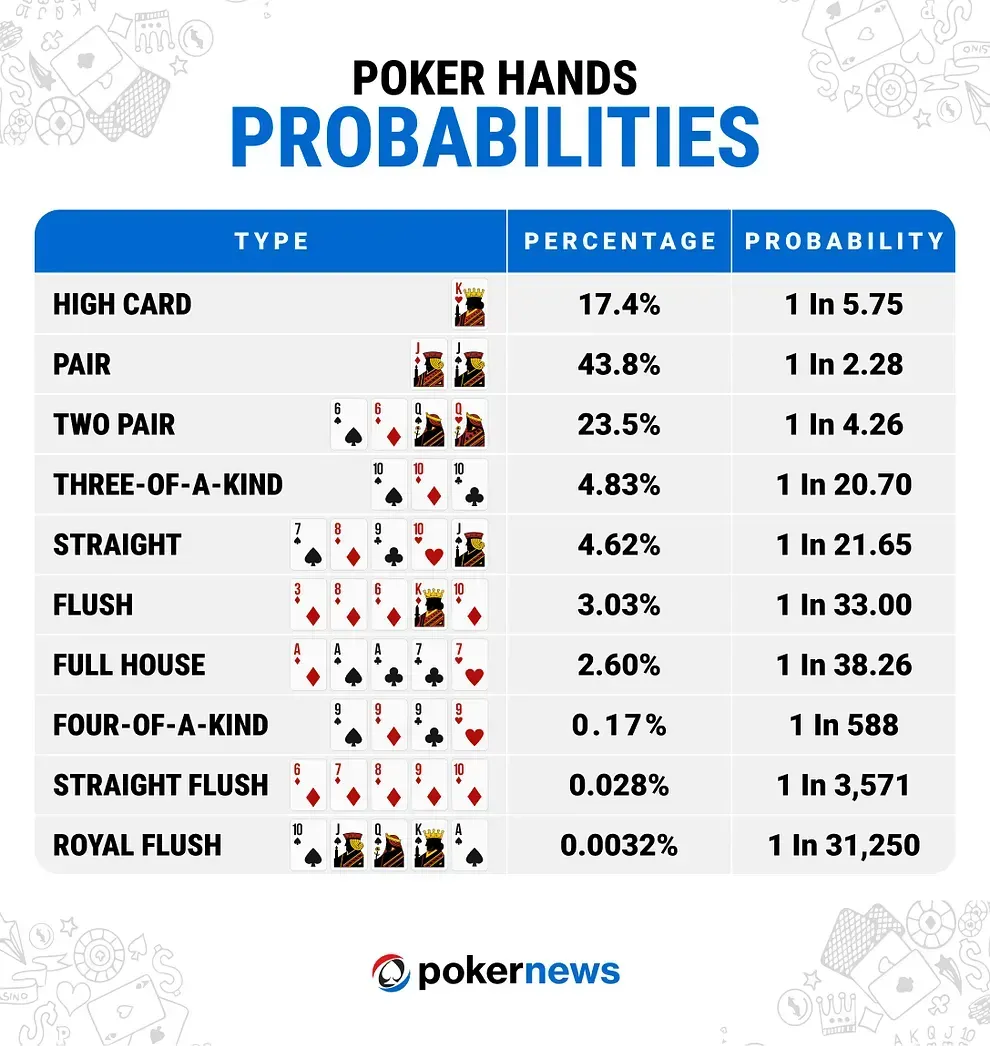
The reason a full house is so strong is that it is very difficult to make. If you have a pocket pair, the chances of flopping a full house are a mere 0.98% or once in every 102 hands. If you do not have a pocket pair, the probability of flopping a full house reduces to only 0.09% or once in every 1,110 hands.
Regardless of your starting hand, you will, on average, improve to a full house a mere 2.6% of the time, or once in every 38.26 hands.
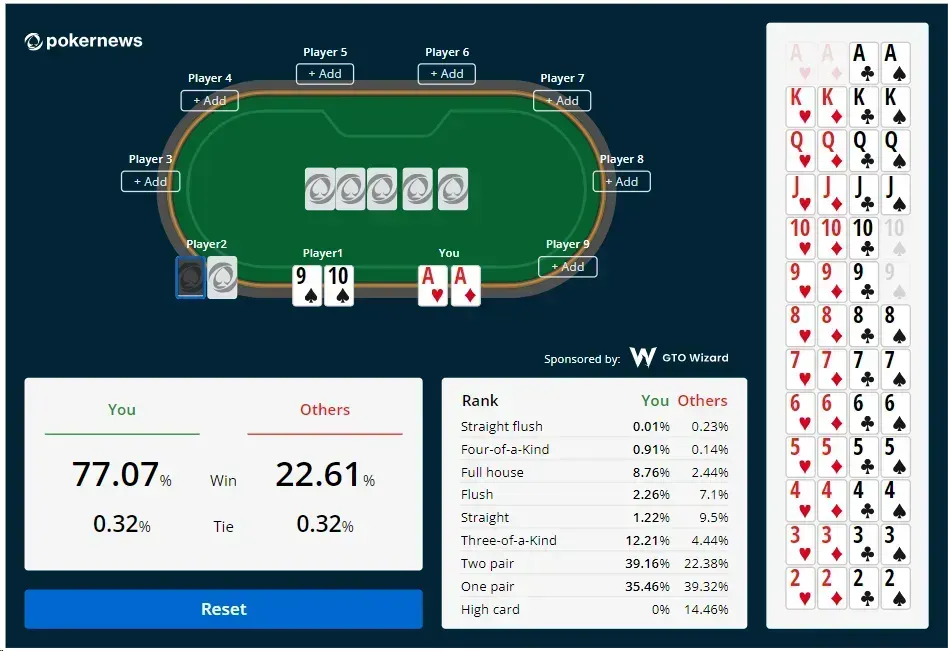
Want to see the odds for yourself? Give our FREE Poker Odds Calculator a try!
Playing and Maximizing Value With Full Houses
As you have learned, full houses don't come around all that much, so making the most of them is important. You want to extract maximum value from these powerhouse hands. Here are three tips to help you do that.
- Worry More About Building the Pot
- Size Your Bets According to Your Opponents and Their Ranges
- Assess Board Texture and Relative Strength
Worry More About Building the Pot
With a hand as strong as a full house, your primary concern should be how to build the pot so that you can win more money or chips. Unless your opponent is very aggressive and has shown a tendency to bet and bluff into you, you probably shouldn't slow-play your full house.
Feel free to liberally value bet because many opponents will call you down with hands such as top pair or trips, as long as you keep your bet sizes reasonable.
Size Your Bets According to Your Opponents and Their Ranges
A common mistake players make, particularly those at lower stakes, is not adjusting their bet sizes to their opponents and their hand ranges. As mentioned above, your prime focus will be a full house is to make as much money as possible.
Against a player you have marked as a calling station (someone who calls most bet sizes with any holding), you should consider betting larger than you ordinarily would against a more thinking player. If they'll call a half-pot bet, they'll likely call a two-thirds-pot bet.
Consider what your opponent may have or the range of hands they are playing. Could they have an overpair and have now improved to two pair? If so, they may call a larger bet. Is it more likely that they are drawing to a straight or flush? If so, bet enough that they are tempted to continue drawing.
Assess Board Texture and Relative Strength
As explained earlier in this full house guide, all full houses are fourth in the poker hand rankings chart, but not all full houses are of the same strength. Making a full house on a double-paired board opens up the possibility of someone having a stronger full house or even four-of-a-kind.
Similarly, it is well-known that recreational players, in particular, love to play any ace. So, if you have Q♠Q♦ and the board is A♠A♣Q♥7♦2♠, you will almost always get paid by someone holding an ace. However, an A♠A♣A♥Q♥7♦ board could see you up against quad aces, so you should proceed with more caution.
Poker Hands Quiz
Want to test your knowledge of which hands beat which in poker? Prove your skills and try get 100% in our poker hands quiz.
Real money poker is a great way to put your knowledge of the poker hand rankings into practice. Have a look at the best poker bonuses, which can give you some bonus funds to start off your sessions.
Full House FAQs
What is a full house in poker?
A full house is a strong poker hand that consists of three-of-a-kind plus a pair.
How does a full house rank in poker hands?
Full house are very powerful poker hands, ranked fourth from a possible 10 holdings in the poker hand rankings.
What beats a full house in poker?
Only three poker hands beat a full house in poker. They are four-of-a-kind (or quads), a straight flush, and a royal flush.
How do you compare two full houses?
All full houses are made up of three-of-a-kind plus a pair. The strongest full house is the one with the better three-of-a-kind element. For example A-A-Q-Q-Q loses to Q-Q-A-A-A. The former would be queens full of aces, while the latter would be aces full of queens and the winner.
How common is a full house?
The reason a full house is a powerful hand is because of how rare it is. You will only make one by the river 2.6% of the time, or once in every 38.26 hands.