
 button in Safari
The Nuts in Poker: Definition and Examples of Nutted Hands

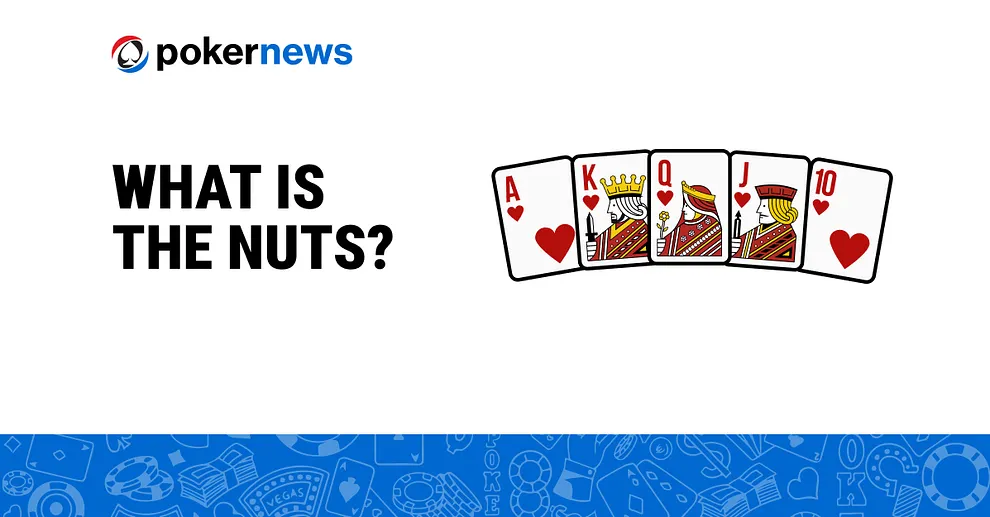
The 'nuts' in poker is a concept you should be aware of, and also know how to play to get maximum value in a hand. This guide will go through it all, providing a straightforward definition of the nuts, a detailed explanation of what it is and also teach you how best to play a hand when you hold the nuts.
Read on to find out more about the nuts, regardless of what poker hand you hold.
You'll learn:
What is the ‘Nuts’ in Poker?
The nuts in poker is the best possible holding at the current stage of any hand.
It's worth noting that 'the nuts' can change over the course of a hand. For instance, on a rainbow flop you might have a made straight where at the time it's not possible to be beaten by any other hand. This is the nuts.
However, if suited cards come on the turn and river, a flush might be possible, therefore leaving you with a strong hand that is not the nuts.
Another key aspect is that multiple players could technically hold the nuts. This is especially plausible when the board plays, meaning the best possible five-card combination is made from the five community cards.
Key Aspects of the Nuts
• The nuts can change over the course of a hand
• The nuts can be shared by multiple players
• Holding the nuts by the river means you cannot be beaten
What is the ‘Effective Nuts?’
The 'effective nuts' is where your holding is realistically the strongest in the hand, but it is possible that another player could have a better hand.
You might hear this term a lot. Effective nuts is used to describe a hand that is highly likely to win at showdown, based on hand probabilities, information inferred from opponents' actions and the strength of the made hand. It's slightly deceptive, because there is always a possibility that your hand (the effective nuts) can be beaten, but it's highly unlikely.
There are no strict parameters or defined situation where the term can be used. In general, it's just used to refer to a player's hand that is likely to take down the pot.
- Technically, stronger hands might exist
- But based on the board, it's likely you have the best hand
- The effective nuts can also change during the course of a hand
Common Types of Nutted Hands in Poker
So, what kind of hands can be nutted? Given their relatively low strength in the overall rankings and that many other hands beat them, nutted is not a term that is used when holding hands like pairs or three-of-a-kind. Two aces are the highest possible single pair that can be made, but you'd never say you have a nutted pair - as there are eight other made-hand combinations that outrank them.
Below is a quick overview of the common types of nutted hands, where the term is widely used to describe them:
What is a Nut Straight?
A nut straight is the best possible straight that can be made, given the composition of the community cards on the board and a player's hole cards.
For instance, if the board at the river shows 10♥9♠7♦K♠A♣, there are no possibilities for flushes, full houses, or anything better than a straight. If a player holds a Q and a J of any suit, they will have a straight. In this instance, no higher straight can be made - a broadway is the best possible straight. This makes it a nut straight.
What is a Nut Flush?
A nut flush is the best possible flush that can be made from the five community cards on the board and a player's two hole cards.
For instance, if the board at the river shows 3♥5♠7♦K♠J♠, a player would need two more spades to have a flush. If one of the two other spades in a player's hole cards is the A♠, they have the nut flush, because no higher flush can be made. Even if their second card is the 2♠, the lowest-valued card of the suit, the A♠ means no other player holds that card, so they hold the nut flush.
What is a Nut Full House?
A nut full house is the best possible full house that can be made from the community cards on the board and a player's hole cards.
For instance, if the board at the river shows A♥3♠5♦A♣K♠, there are several different full house combinations that can be made, depending on a player's hole cards. The best possible full house is aces over kings (i.e., three aces and two kings). Therefore, if any player holds one ace and one king among their hole cards, they will have the nut full house. In this instance, this would be the overall nuts. When full houses are made, there is always at least a pair on the board, which means the nuts (best possible hand) will be four-of-a-kind. But in this case, the full house is nutted as there are already three aces in play, so no other player can hold the two aces in their hole cards to make quads.
Other hands, like a straight flush and four-of-a-kind can technically be nutted, but the term is not generally used given the strength and rarity of these hands. Similarly, a royal flush is well known for always the absolute nuts in any hand and as such, you'd never use the term 'nutted royal flush.'
Example of the Nuts
We've already given you some examples, but let's dive deeper into it and run through an entire hand where the nuts comes into play.
Preflop
Your Cards: 10♥ 9♥
Opponent's Cards: A♠ 2♣
You have 10♥9♥ preflop, which is a very playable starting hand despite the high potential of overcards landing on the flop. Your opponent has A♠2♣.
According to the PokerNews Odds Calculator, you are a slight underdog right now, but it's basically a coinflip. They bet from the small blind and you opt to just call.

Flop
Your Cards: 10♥ 9♥
Opponent's Cards: A♠ 2♣
Community Cards (Flop): A♥ 8♦ 7♥
No player currently holds the nuts at this stage in the hand.
You both hit the flop. Your opponent has top pair (aces) and although you only technically have ace-high with a 10 kicker, you also hit an open-ended straight draw and a flush draw, so you should almost always be sticking around in the hand.
Turn
Your Cards: 10♥ 9♥
Opponent's Cards: A♠ 2♣
Community Cards (Turn): A♥ 8♦ 7♥ 6♣
You currently hold the nuts at this stage in the hand.
The turn is your jackpot card as you make a straight! No other possible five-card combination can beat it at this moment, so you know you have the best hand. Getting value from it is the tricky bit.
Your opponent opts to check. You want to get value, so bet big and your opponent just calls - still holding a decent top-pair hand.
The River
Your Cards: 10♥ 9♥
Opponent's Cards: A♠ 2♣
Community Cards (River): A♥ 8♦ 7♥ 6♣ 2♥
No player currently holds the nuts in the hand.
The river is very interesting. Your opponent makes two pair, but you also improve to a flush.
Your opponent leads out with a big bet. You now have a tough decision as you beat all two pairs, three-of-a-kinds and even weaker straights, but there is a chance your opponent has a higher flush. However, given that you already hold blockers to the flush (your two hearts), it reduces the chances of your opponent having that higher flush.
As a result, you raise big and your opponent folds, meaning you win a sizeable pot.
QUIZ: Can You Read the Board?
Knowing the poker hand rankings is essential if you want to identify the nuts. Test your hand-reading skills below: compare Hero with the Opponent and work out who has the winning hand, or if neither player can be separated.
How to Play the Nuts in Poker
Like any hand in poker, there is no 'set' way on how to play the nuts. The optimal play with the nuts is dependent on various factors, such as your opponents' likely cards, previous action in the hand and table image.
Making a royal flush is not as profitable as it seems if nobody else has a hand they're willing to commit chips with!
In general, though, you should aim to get value with every action at the table when you have the nuts. Avoid the common beginner mistake of 'setting traps,' like you might see on high-stakes game highlights. Most lower-stakes poker games have very different dynamics, meaning this play isn't optimal.
Instead, you should mostly be betting relentlessly when you have the nuts, and only betting small if you believe opponents' hands are weak or if you're heads-up in a hand against a 'nitty' opponent.
Read on to find out how to play the nuts in more specific situations.
How to Play the Nuts on the Flop
The crucial thing to take into account about having the nuts on the flop is that there are still two cards to come - which means you might be less likely to have the nuts by showdown than if you have it on later streets. So the first thing to do, is evaluate the chances of you still having the nuts (or at least the likely best hand) by the river.
If, for instance, you flop an ace-high flush and the value of the cards aren't connected (meaning straight flushes are unlikely), you can assume you'll likely have the best hand by showdown. However, if you have a weaker hand like a set of eights, you're more susceptible to not having the nuts by the river.
So, you have two options.
- Play Passive: Check or just call and hope an opponent either raises in later position, or you get more value on the latter streets.
- Play Aggressive: Bet or raise to build the pot and hope that an opponent has a good enough hand to call.
Optimal Play
Playing aggressively is usually the way to go. If opponents are weak, you will likely not get any more value from them anyway, so checking only allows them to catch up in the hand. If you bet, you not only charge potential drawing hands that might have checked back, but you also build the pot.
The early stages of a hand are crucial as it can impact how much you're going to win.
Building the pot early can help you win more later, as opponents are more likely to call bigger river bets after already investing chips. Playing passively can still work well against aggressive players, multiple opponents or when you expect someone else to bet.
How to Play the Nuts on the River
Playing the nuts on the river is a completely different kettle of fish. Here, all the cards are out and drawing hands have either hit or missed. In that sense, there's less ambiguity and you know for certain if you have the nuts.
If you do, then you need to go back over the hand and analyze all the action that's happened to gain information on your opponents' potential hand, and then use that to get maximum value.
Again, you have two options:
- Play Passive: Check and hope your opponent bets.
- Play Aggressive: Bet or raise and try to extract maximum value.
Optimal Play
Playing aggressively is recommended, as it significantly narrows down your range. Have you heard the phrase 'There's no such thing as a semi-bluff'? This is relevant here. If you've bet big on every street and the river completes potential draws, opponents are more likely to think you either have a monster hand or are bluffing. If you hold the nuts and believe your opponent is strong, you should usually bet big to extract maximum value.
Playing passively can occasionally work well too. If you act first, checking can make it look like you missed a draw or were bluffing, encouraging opponents to bet into you. However, raising after checking often looks extremely strong and may scare opponents away.
Want to learn more about poker hands? Check out our other content:
- Poker Hand Rankings
- Tied Poker Hands
- What Beats What in Poker?
- Poker Probabilities
- Kickers in Poker
- Best Starting Hands
- Short Deck Hand Rankings
Nuts in Poker FAQs
How does the nuts work in poker?
The nuts in poker is the best possible hand at any given moment. Therefore, the nuts works by changing based on whatever cards get dealt out at each stage of a hand. A royal flush is the best hand in poker, but the nuts in a hand is the best possible five-card hand at the time.
Is a royal flush always the nuts in poker?
If someone holds a royal flush in poker, that will always be the nuts as it cannot be beaten. However, if a royal flush cannot possibly be made with the player's two hole cards and the five community cards, the 'nuts' is the best five-card hand that can be made.
Can the nuts be beaten in poker?
Yes, the nuts can technically be beaten in poker, if certain cards land on future streets. If someone holds the nuts, it's the best possible hand in that moment, but that's not to say it will still be the best hand by showdown.
How can I get maximum value with the nuts in poker?
To get maximum value with the nuts, you should generally play it aggressively and look to build a pot. How much you bet (E.g. big or small) should depend on your opponents' play style, the texture of the board and how many players are in the hand.
Can the nuts change in a poker hand?
Yes, the nuts can change in poker during a hand, given it's the best possible five-card combination at any given time. The best possible hand on the flop is rarely the best possible hand at showdown, as the two extra cards will drastically change the dynamic of a hand.