button in Safari
Would You Make This Queen-High River Bluff Playing for $10,000,000?


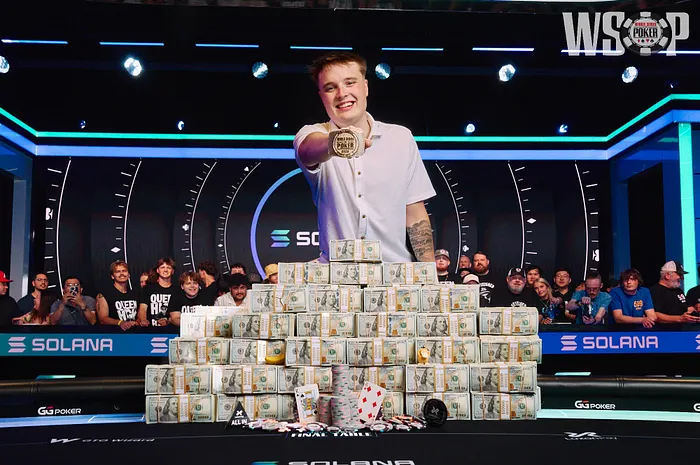
The stakes don't get much higher than heads-up in the World Series of Poker Main Event, with a $4,000,000 pay jump on the line, and an eight-figure score of $10,000,000 going to the winner.
In the 2026 edition of the event, an extremely interesting hand played out between eventual runner-up Lauri Saaskilahti and and champion Lucas Jumalon, which saw the former attempt to pull off a queen-high river bluff. Let's go over the hand itself, before analysing the player's decisions with GTO Wizard.
The Hand
Pre-Flop
Lauri Saaskilahti (SB/BTN): 204,000,000 (51bb)
Lucas Jumalon (BB): 349,000,000 (87.3bb)
With blinds at 2,000,000/4,000,000/4,000,000, Saaskilahti limped in holding Q♠9♦, and Jumalon checked his option with 10♠5♦ in the big.
Flop
A♠10♣7♥ (12,000,000 Pot)
Jumalon check-calls a bet of 6,000,000 from Saaskilahti.
Turn
K♠ (24,000,000 Pot)
Jumalon checks, Saaskilahti bets 22,000,000, and Jumalon calls.
River
A♣ (68,000,000 Pot)
Jumalon checks, Saaskilahti fires a third barrel, this time for 37,000,000. Jumalon calls relatively quickly.
"You have it," announced Saaskilahti, before mucking his cards. Jumalon scooped the 142,000,000 pot without havng to table his hand, and further increased his chip lead.
Let's see what the GTO Wizard solver thinks of their plays.
Pre-Flop Analysis
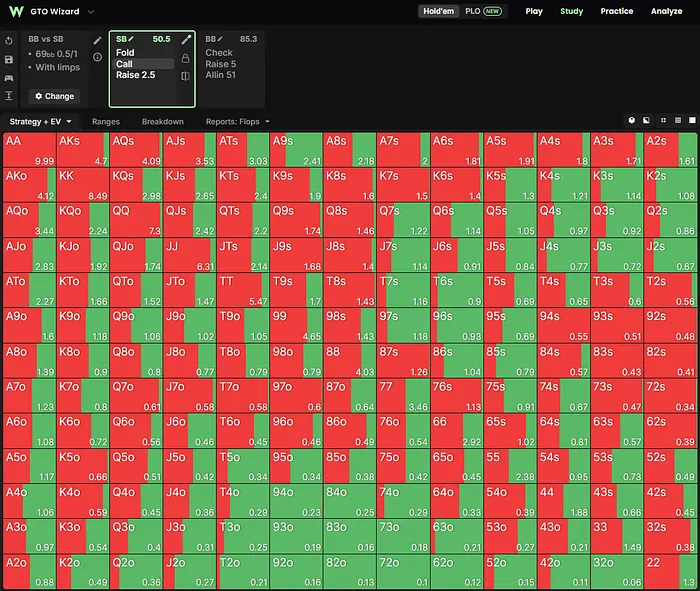
Saaskilahti's pre-flop call with Q♠9♦ is GTO approved. Due to the additional value created by the BB ante, the solver either calls or raises to 2.5bb with the entire SB range.
Q9o can either limp or raise, with limping slightly preferred.
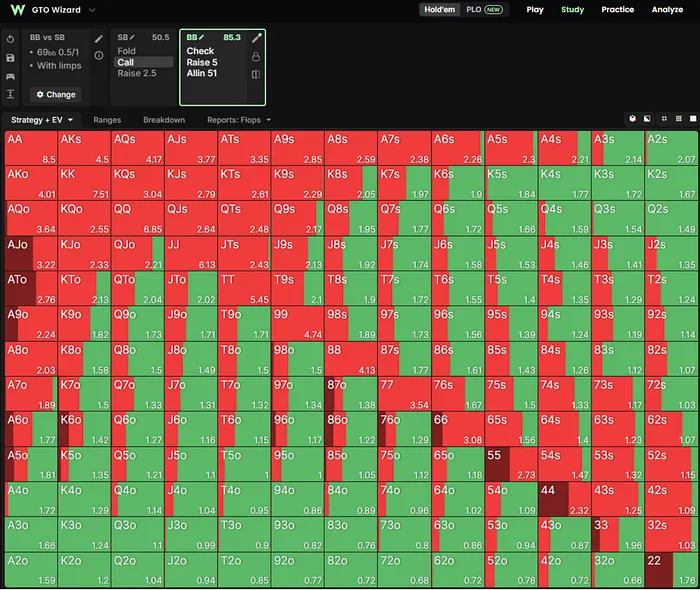
Jumalon's check back with 10♠5♦ is also GTO approved. Again, due to the existence of the BB ante, the BB plays an aggressive iso-raising strategy against the limp, with over 40% of its range opting to raise, and the rest checking.
Interestingly, at 51bb effective, the BB can use a large raise size of 5bb, or even some shoves due to the additional dead money created by the ante.
Flop Analysis
A♠10♣7♥ (12,000,000 Pot)
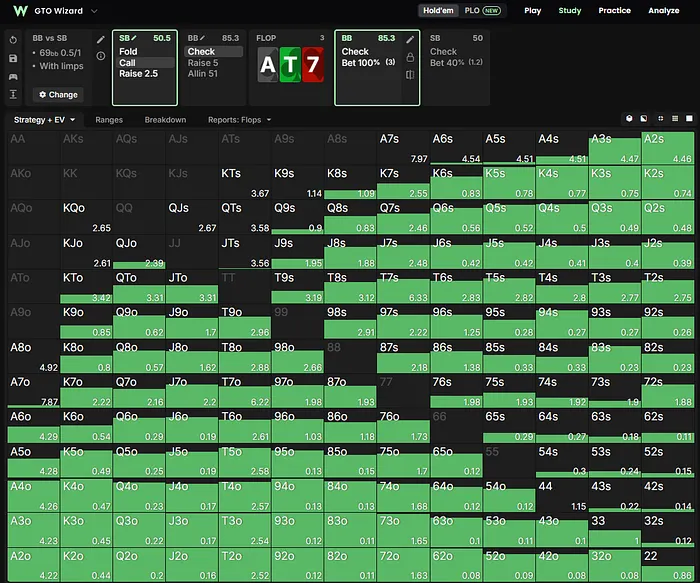
Jumalon's flop check is GTO approved. The solver doesn't recommend any leads from the BB on this flop. Let's compare both ranges to understand why this is.
BB vs SB Flop Range Comparison
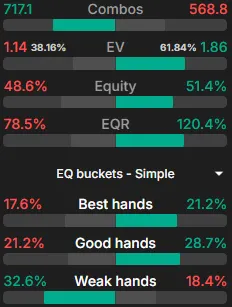
The SB holds the advantage across almost every category, whereas the BB range contains a much higher proportion of weaker hands. This significant range advantage is why the solver doesn't recommend any BB leads.
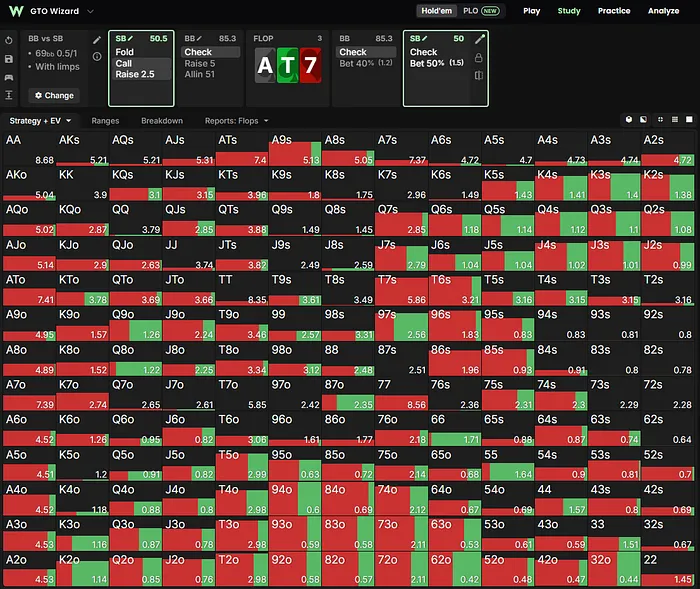
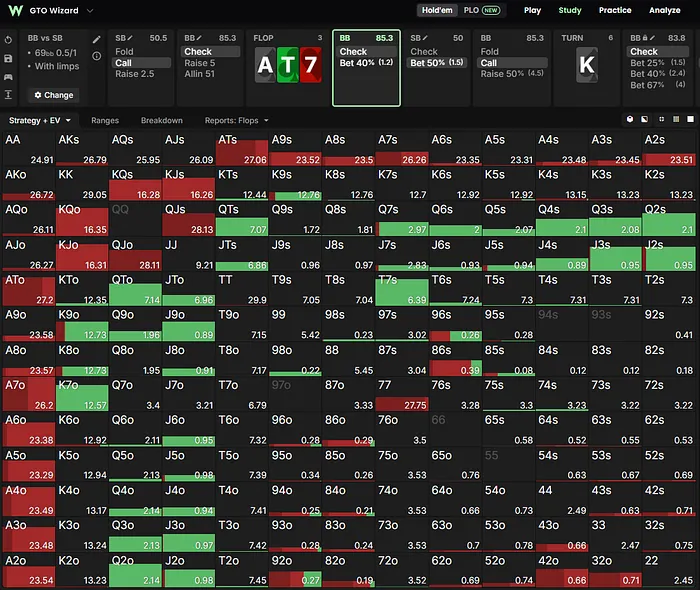
Saaskilahti's bet of 6,000,000 on the flop is approved by the solver. Due to the significant range advantage that the SB holds, it can c-bet around 70% of its range on this flop.
Q9o mixes between checking and betting, with both options generating the same EV.
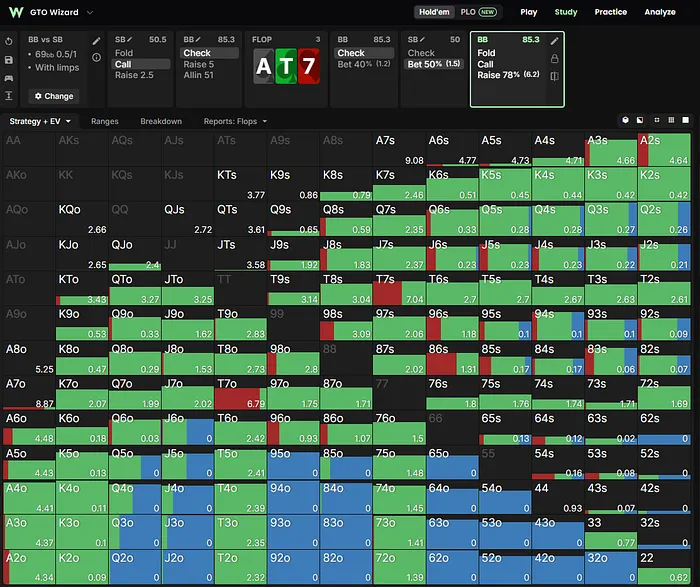
Jumalon's call on the flop is GTO approved, as no pairs fold to a bet of half-pot on this flop.
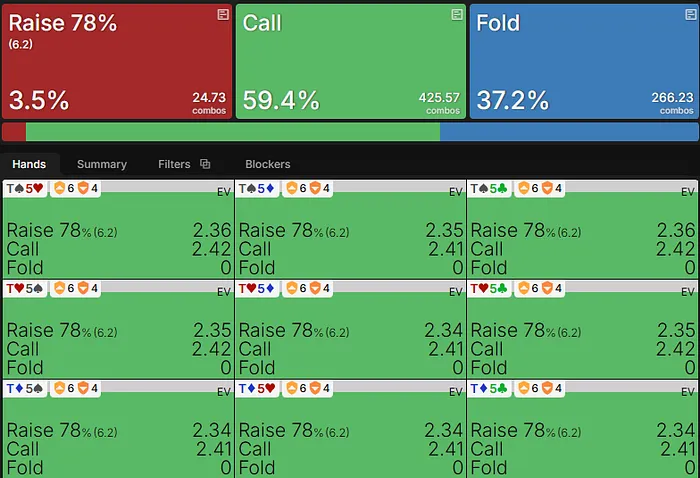
All combos of T5o are pure calls against this bet size, along with every other Tx one-pair holding. The only Tx combos that want to raise are two-pair combos.
Turn Analysis
A♠10♣7♥K♠ (24,000,000 Pot)
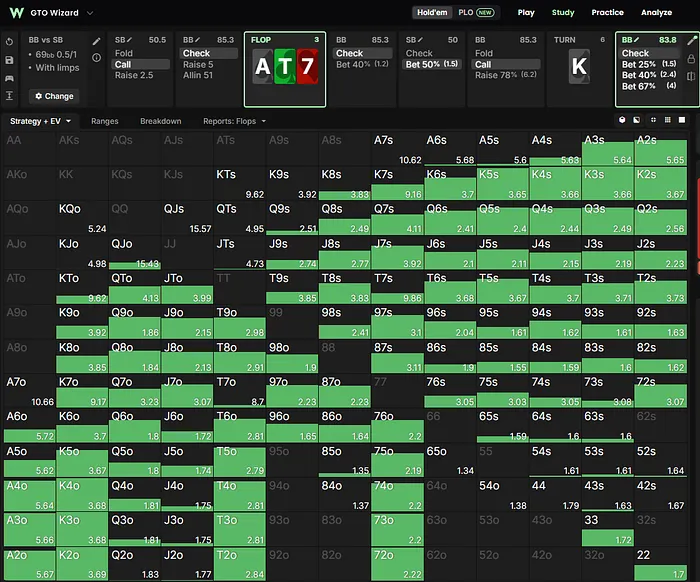
The solver approves of Jumalons's turn check, as once again it recommends no leads from the BB. Let's compare both ranges again to see why the solver still wants to check the entire range.
BB vs SB Turn Range Comparison
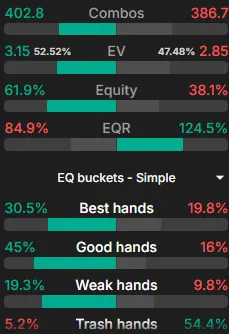
Despite the turn K♠ shifting both the equity and EV advantages towards the BB, the solver still recommends checking its entire range.
The BB also now holds the advantage in best hands and good hands, whilst containing significantly fewer trash hands. However, the SB has a substantial EQR advantage, due to being in position.
A range advantage alone isn't enough to generate a leading strategy The BB can still maximise the EV of its range by checking, allowing the SB to continue betting its weaker hands as well as bluffs, all whilst retaining the option to check-raise its strongest hands.
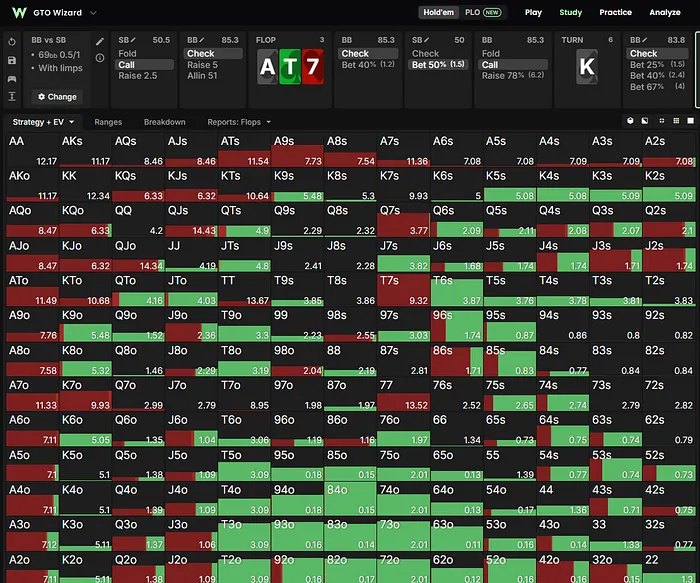
Saaskilahti's turn bet is the first action so far this hand that is GTO disapproved.
The solver prefers a geometric sizing of 157% to Saaskilahti's 92% pot bet. A geometric sizing is used to build the pot so that the SB can get all in by the river using similar sizings on both streets.
Q9o prefers checking on this turn, with the solver opting to use more Jx hands as bluffs, given that they block some of the BB's strongest hands, while still allowing Qx hands to fold. It avoids bluffing its weakest hands, too, as they have very little equity when called.
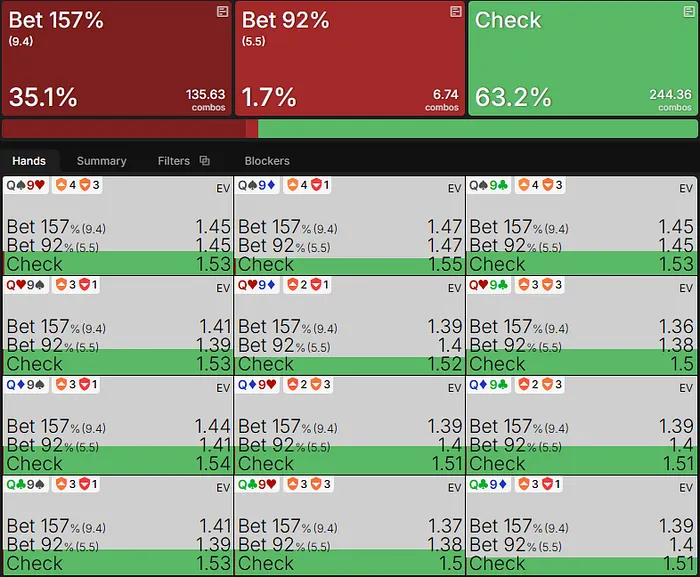
The key takeaway is as follow: the best bluffs aren’t always the worst hands. The solver prefers bluffs with useful blockers, as well as some equity when called.
To best analyse Jumalon's turn action, let's use the nodelock feature to adjust the SB’s range to include the 92% pot sizing and bets with hands such as Q9o, which more accurately reflects the strategy Saaskilahti used in game.
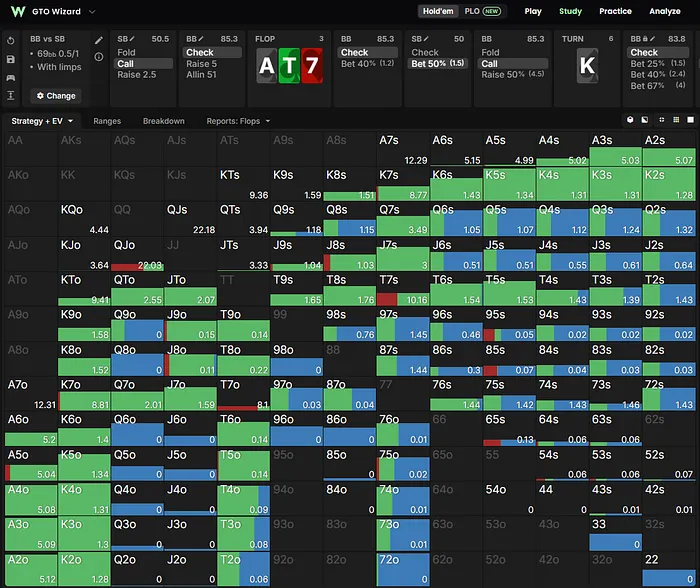
The solver approves Jumalon's turn call. Facing this large turn sizing, however, a number of 7x hands as well as the very weakest Tx combos begin to fold.
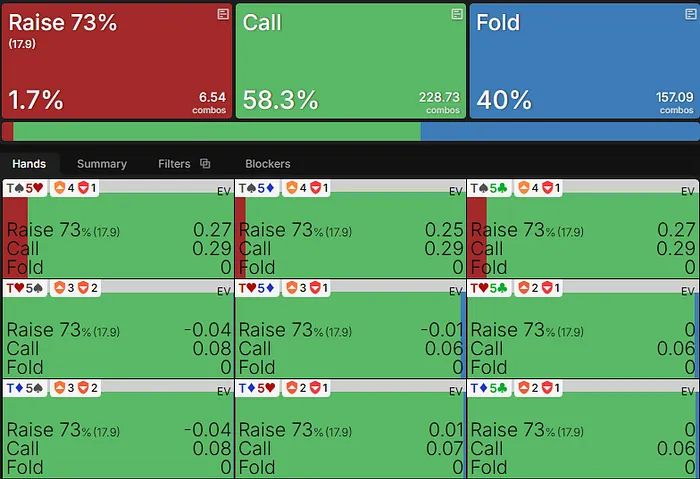
Despite this, all combos of T5o remain pure calls, meaning that once again Jumalon is perfectly in line with the solver.
River Analysis
A♠10♣7♥K♠A♣ (68,000,000 Pot)
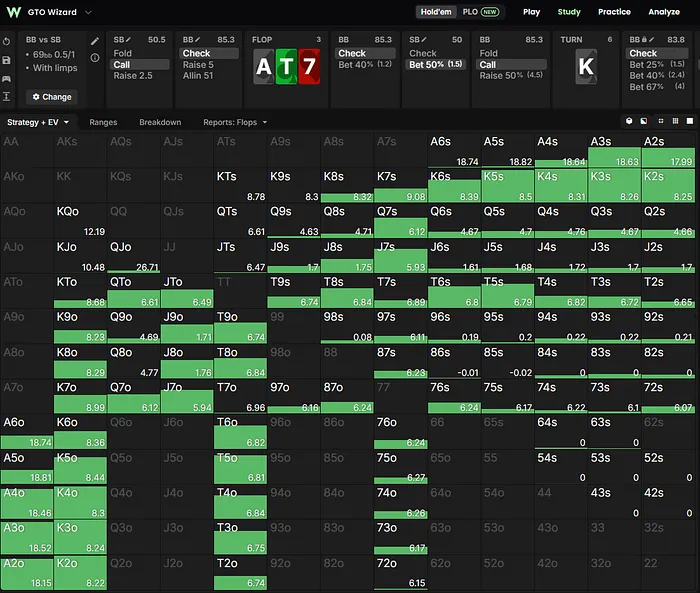
Yet again, the solver recommends no leading from the BB on this river, meaning Jumalon's decision is GTO approved. Let's compare both ranges for a final time to see why checking the entire range is still the preferred strategy.
BB vs SB River Range Comparison
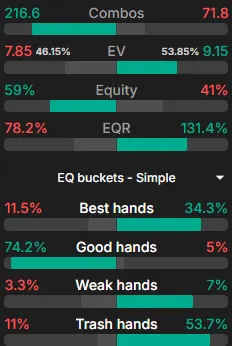
The BB still holds the equity advantage, but the SB now has both the EV and EQR advantage, as well as a much higher percentage of the strongest hands in its range. This means that the SB can apply significant pressure when checked to on the river.
For a second successive street, Saaskilahti's choice is GTO disapproved. The solver does not recommend the 54% sizing chosen by Saaskilahti, preferring either a check, a bet of 100% pot, or moving all in for 253% pot.
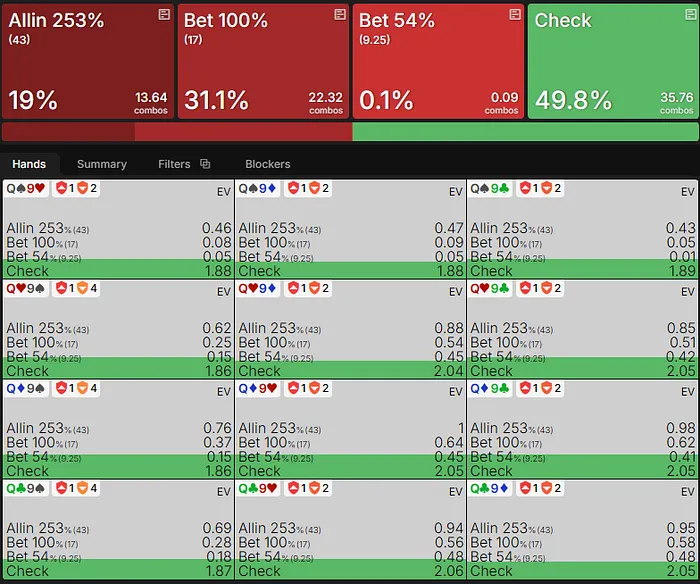
The Q♠9♦ combo in particular is a pure check, given that it is not an effective bluff candidate. A large portion of the BB’s turn calling range contains spade draws that miss on the river, which are exactly the hands the SB wants to fold out.
The Q♠ held by Saaskilahti blocks some of these missed draws, meaning that the solver prefers bluffing with hands that don't contain a spade, given that they unblock more of the BB's missed flush draws that can fold to a river bet.
Overall, the solver uses a polarised river strategy, betting big with its strongest value hands and best bluffs, while checking hands such as Q♠9♦.
Let's once again use the nodelock feature to include a 54% sizing, as well as more bluffs with hands such as Q9o to the SB's range.
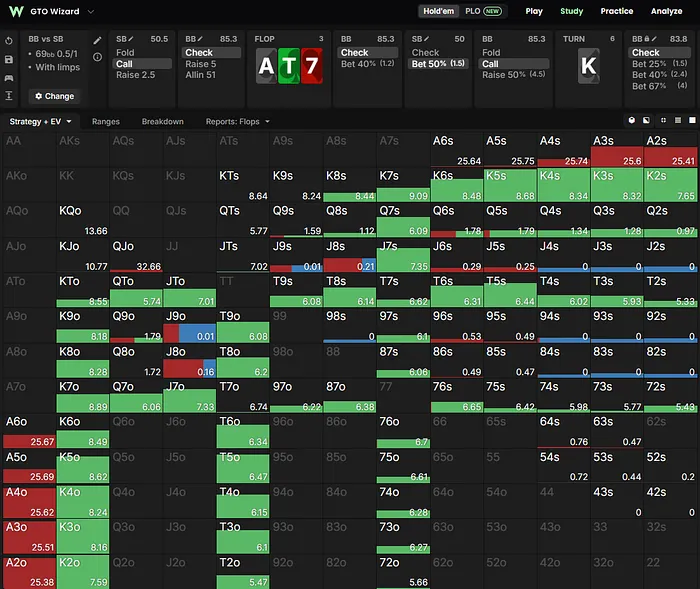
Similarly to the flop, the solver doesn't fold any pairs against this bet sizing on the river.
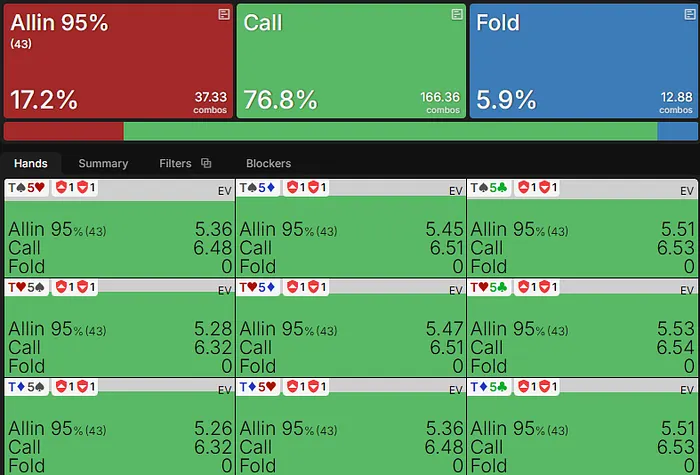
All T5o combos are highly profitable calls against the nodelocked betting range, making Jumalon’s call, as well as the entirety of his action during the hand, comfortably GTO approved.
Key Takeaways
- Preflop: Both players played perfectly according to GTO.
- Flop: Both Saaskilahti's continuation-bet and Jumalon's check-call were GTO approved.
- Turn: Saaskilahti made a first major mistake. The solver prefers checking Q9o, or using a geometric 157% pot sizing, rather than the 92% used in game.
- Selecting Bluffs: The best bluffs according to the solver are hands with useful blockers and some equity when called, rather than the weakest hands.
- River: Saaskilahti made a second major mistake. The solver opts for a pure check, particularly due to the Q♠ blocking missed flush draws.
- River Sizing: The solver refers a polarised strategy of either 100% pot or 253% pot, rather than Saaskilahti's 54%, as it allows to maximise value with its strongest hands, while applying maximum pressure with its best bluffs.
- Jumalon's Call: 10♠5♦ is a highly profitable call against Saaskilahti's nodelocked betting range.
- Overall: Jumalon successfully navigated all three streets with a relatively weak Tx holding, while Saaskilahti’s turn and river bluffs show just how important bet sizing, blockers and bluff selection are when applying pressure.
Want to find the leaks in your own game? Use GTO Wizard to analyse and study your hands, and download it online today.
*Note: Hand Begins at 05:46