button in Safari
How Should You Respond to a 2x Open Blind-On-Blind?

Table Of Contents
When action folds to the small blind, the GTOWizard preflop solver is not a massive fan of the 2x open that is still so often seen at the table. That being said, its new AI-powered solver is a big fan of explaining the Game Theory Optimal (GTO) move when facing a bet of this size.
The recently rolled-out solver, that can be used to simulate a whole host of preflop spots with up to nine players at the table, is ideal for both live and online players to improve their preflop game.
This article will use the new solver to explain how GTOWizard both plays when folded to in the small blind, and how it responds to a 2x open from the small blind at different stack levels.
100bb Strategy
100bb SB GTO Strategy
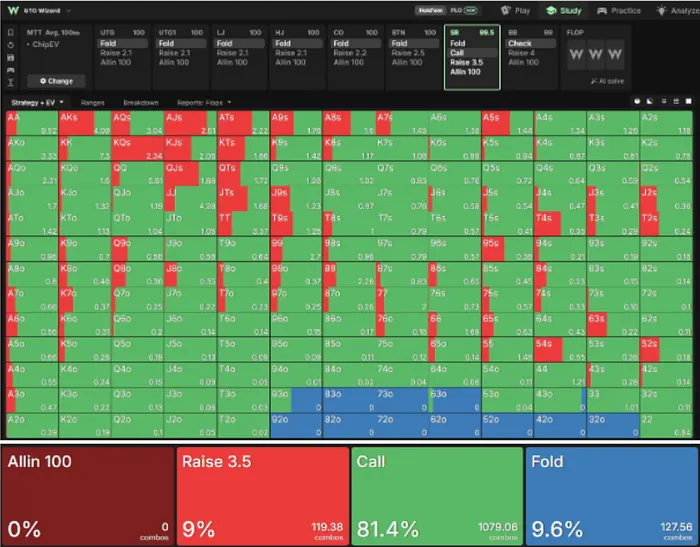
As mentioned before, the solver doesn't approve of the 2bb open sizing, rather opting for 3.5bb, albeit only 9% of the time. At 100bb deep, the solver prefers a tighter strategy given the disadvantage of playing the full hand out of position.
100bb BB Response vs 3.5bb SB Raise
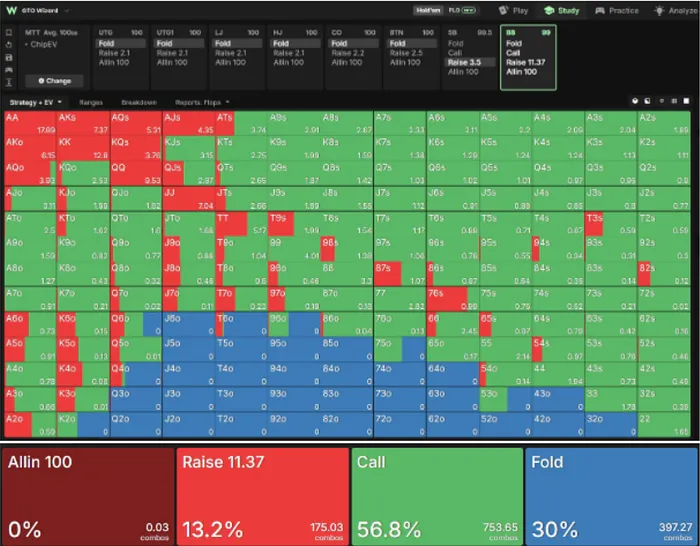
When facing this larger open, the big blind adopts an extremely polarised three-betting range, doing so with the strongest value hands, as well as a selection of weaker bluffing hands.
The majority of hands prefer to call, however, with 56.8% of them choosing this option. This includes every single suited hand, due to their playability and ability to realise equity when in position. But how does the solver react when forced to 2x open?
100bb SB 2bb Raise Strategy
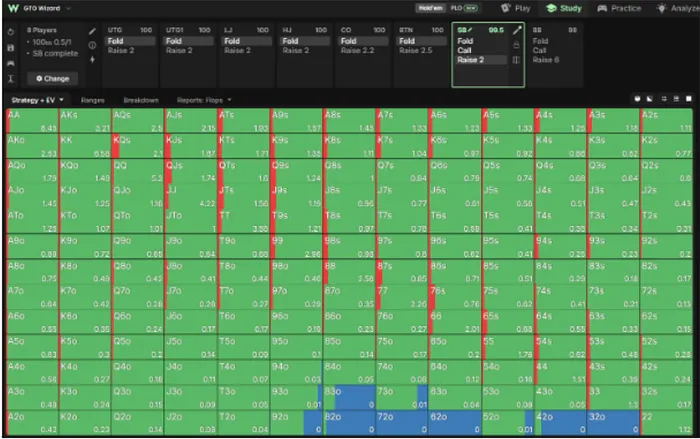
When forced to open to 2bb, the solver opens a much tighter range of hands, with only 3.1% of them falling into that category, with most hands being limped.
In practice, many players approach the spot differently, using a 2x open size a lot wider than is recommended. Before adjusting for these tendencies from the small blind in real life, let's examine the big blind's response to this open.
100bb BB Response vs GTO 2bb SB Raise
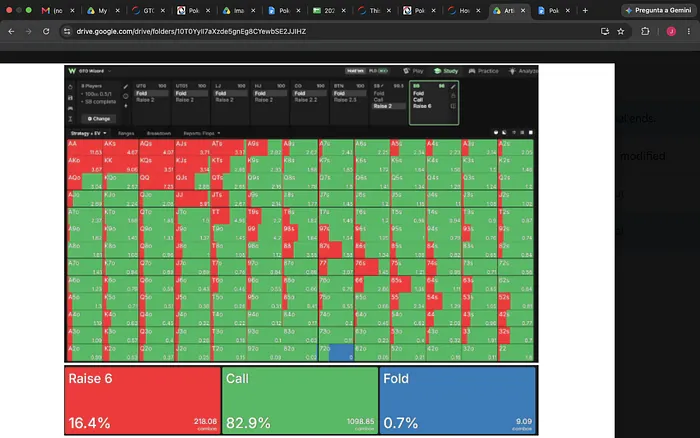
The BB of course folds a lot less frequently, with only 0.7% of hands hitting the muck, and any offsuit combination of 7♥2♣ the only hand that folds most of the time. The three-betting frequency increases by 3% compared to a 3.5bb open.
Now let's explore how to adjust, with the 2bb opening size nodelocked to 3.5bb, allowing for optimal strategy against a player who uses the smaller sizing without adjusting their own range.
100bb BB Response vs Nodelocked 2bb SB Raise
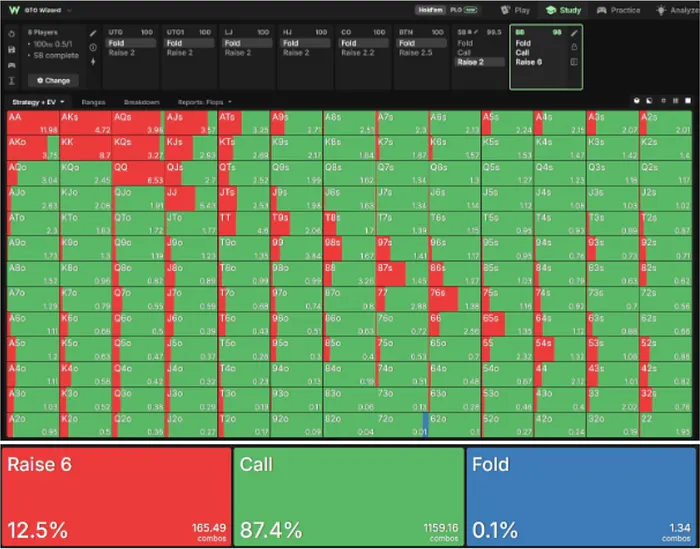
We can no see that the big blind has almost no folds, with even 7♥2♣ combos inclined to call most of the time. Overall, there is more calling and less three-betting, which makes sense as the nodelocked SB range has a higher concentration of stronger hands.
50bb Strategy
50bb SB GTO Strategy
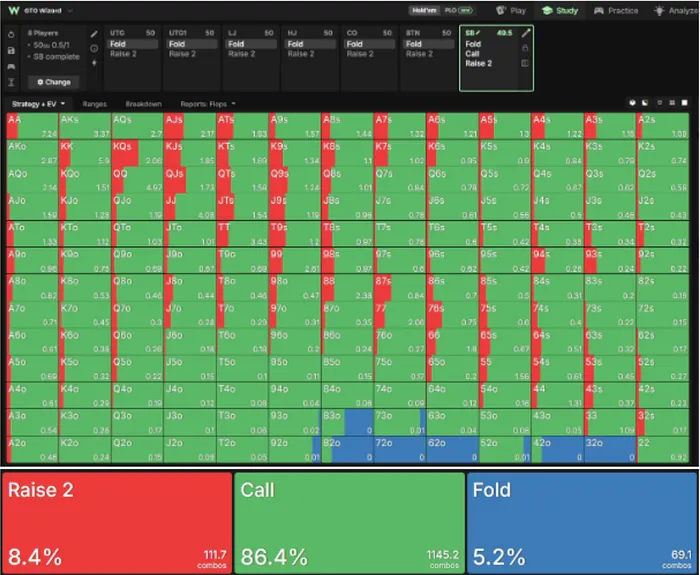
At a stack depth of 50bb, the solver recommends a 2x opening size more often than it did at 100bb, however limping is still preferred by the majority of hands.
50bb BB Response vs GTO 2bb SB Raise
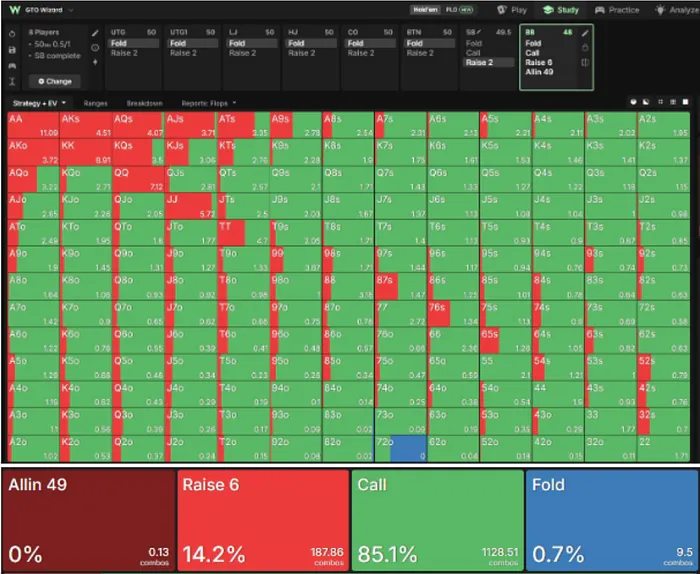
At this stack depth, the BB's response is very similar to the 100bb strategy. It still defends extremely wide, with
a high-frequency calling strategy, little folding, and a polarised 3-betting range.
50bb BB Response vs Nodelocked 2bb SB Raise
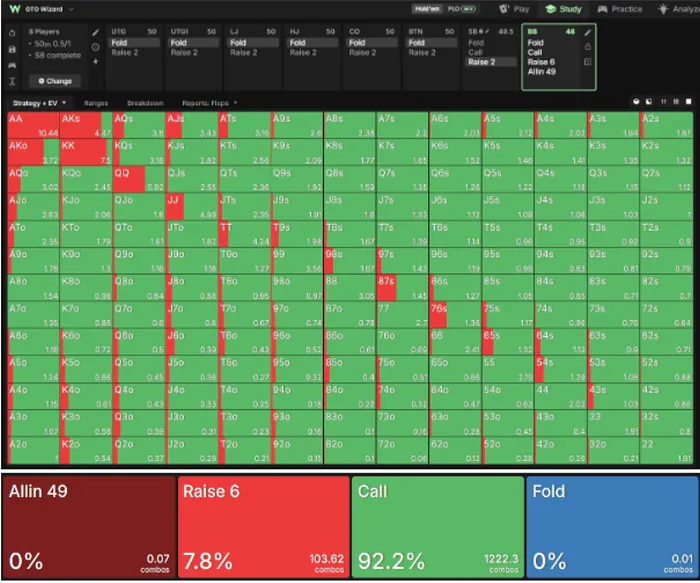
Interestingly, here the solver recommends zero folding at all, opting to either call or 3-bet every single hand when facing a 2bb open.
The 3-bets are less frequent, only coming 7.8% of the time, as the small blind can respond with an all-in 4-bet. Therefore, less 3-bets means less all-in pressure from the small blind.
25bb Strategy
25bb SB GTO Strategy
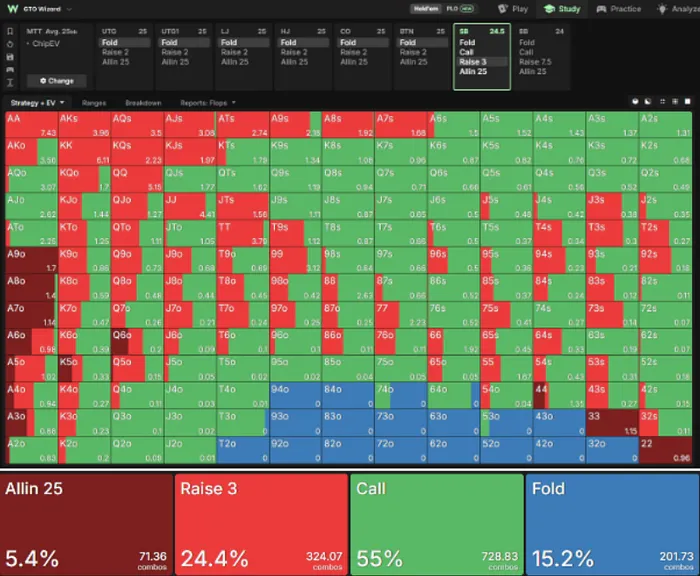
At 25bb, the solver prefers using 3bb as its open size. It also begins to incorporate some open-shoves into its strategy, unlike at deeper stack depths, which allows the SB to apply pressure with specific hands that perform best by jamming.
25bb BB Response vs 3bb SB Raise
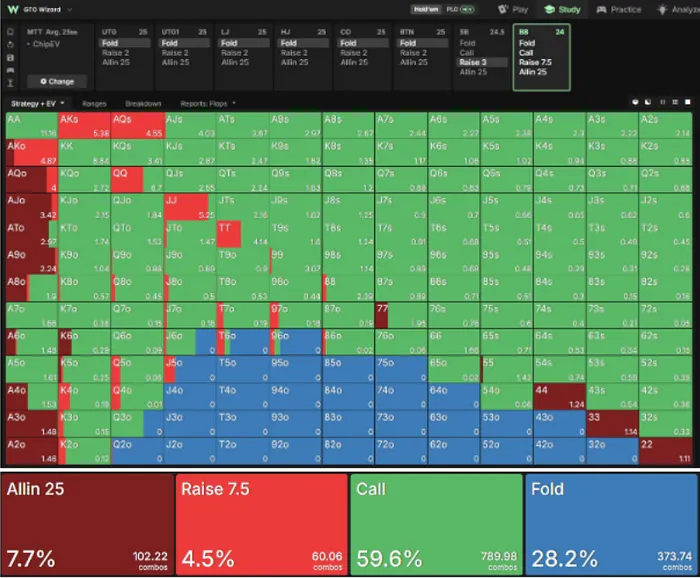
Here, the BB incorporates 3-bet shoves into its strategy over the 3bb open. Given the shallow stack depth, this becomes a very effective strategy, as it maximises fold equity whilst denying the SB the chance to realise equity postflop.
25bb SB 2bb Raise Strategy
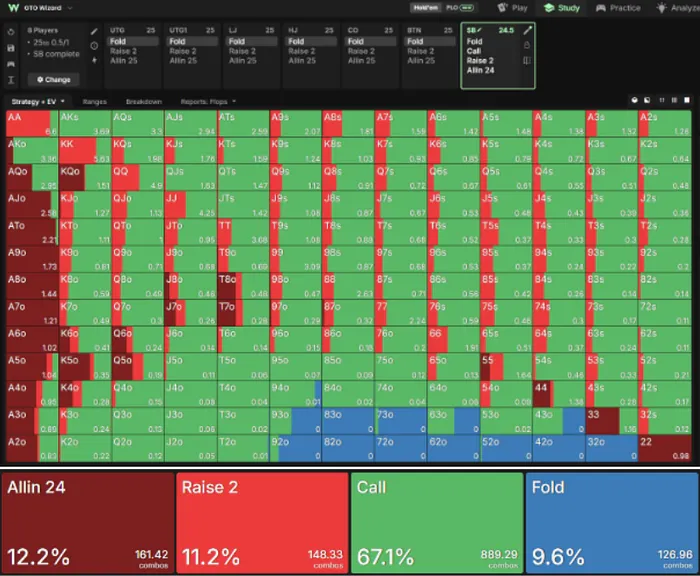
At this stack depth, the solver has a lot more 2x opens than it does when deeper, opting for this more than 10% of the time. Limping is still preferred, and less than 1 in 10 hands are folded.
25bb BB Response vs GTO 2bb SB Raise
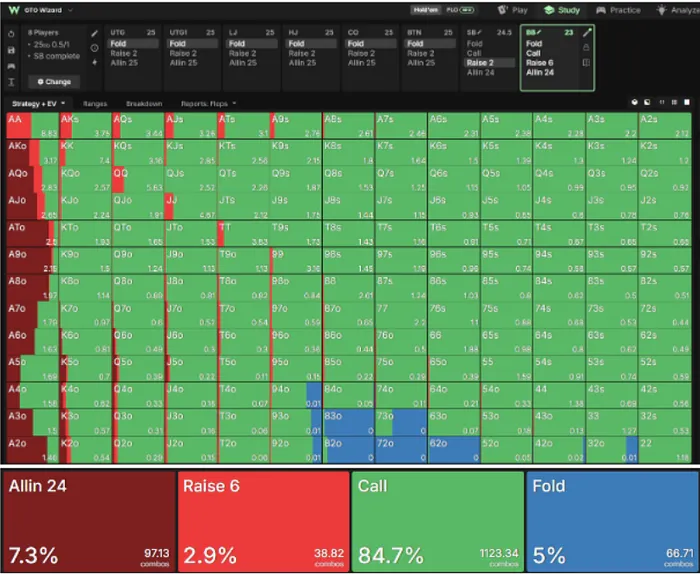
Interestingly, in this spot the solver much prefers calling from the BB, even with premium hands such as combos of A♠A♣ and K♥K♦.
The reason for this is lower SPR. By flatting, the SB's weaker range is kept in tact, rather than being forced to fold by a preflop 3-bet. Hence, at 25bb the solver opts to trap its strongest hands, rather than building the pot preflop.
25bb BB Response vs Nodelocked 2bb SB Raise
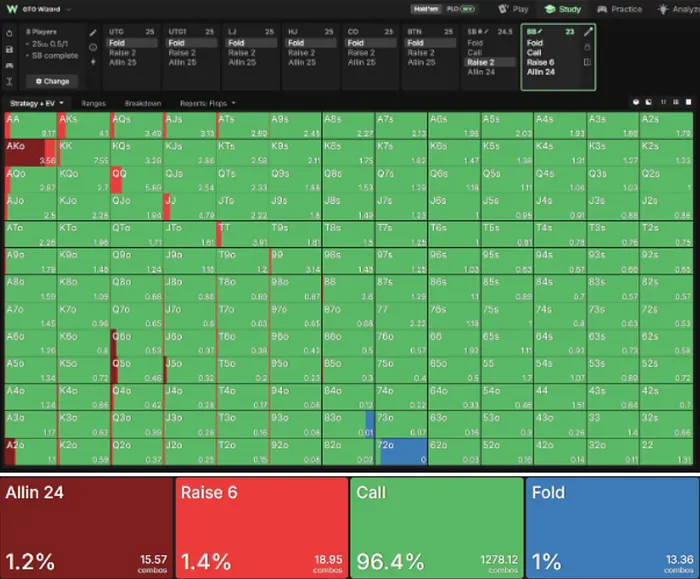
For this same reason, the big blind calls almost its entire range against the SB's nodelocked 2bb opening range. Due to the low SPR and an in position advantage post flop, the only hands that are folded at any real frequency are offsuit combos of 7♥2♣ and 8♦3♠.
Key Takeaways
Playing vs a SB 2bb Open
- 100bb: Defend extremely wide, almost no folding. BB mostly calls, uses a polarised 3-betting strategy. Playing deep makes position and hand playability very valuable.
- 50bb: Strategy remains similar to 100bb, but SB opens more frequently because positional disadvantage is reduced. BB still defends almost everything, but becomes more cautious with its 3-bets due to threat of a 4-bet jam.
- 25bb: BB calls even more often, including with premium hands. At lower SPR, trapping becomes more profitable, as it allows BB to extract more value postflop.
Biggest Differences by Stack Depth
- 100bb: Position is most valuable, so BB calls with a huge range to realise equity postflop.
- 50bb: Similar overall strategy, but SB can profitably open much wider than at 100bb, as playing out of position is less punishing.
- 25bb: Lower SPR dramatically changes strategy. BB is happy to trap with premiums, all-in 3-bets become part of strategy, and folding almost disappears.
Overall Conclusion
If your opponent is opting on a wide 2bb opening range from the SB, you should be defending very aggressively from the BB across all stack depths. The main adjustment isn't either folding or 3-betting more, but understanding how your play changes as stacks get shallower. Deep stacked, you
leverage position by calling frequently. At medium stacks, the strategy remains largely the same. By 25bb, the low SPR encourages even more calling with strong hands, while all-in 3-bets become an important part of the overall strategy.