button in Safari
Three Preflop Leaks and the Charts That Fix Them



Jordan "BBZ" Drummond is the founder of BBZ Poker. This article is part of a content partnership with PokerNews.
Preflop mistakes can be costly in poker, so it is important to have a solid strategy and to be able to identify preflop leaks and avoid them.
Run enough tournament databases through the BBZ Leak Finder and three preflop stats come back flagged low in almost every report. In each one the player stays passive in a spot that calls for aggression, and the right strategy shifts with stack depth.
Isolating Small Blind Limps from the Big Blind
The small blind limps, you are in the big blind, and a free flop is on offer. Most players take it.
A small blind limp tells you several things. At most stack depths, a player who declines to raise is holding a weaker range for it. That range is also very wide, because the limp gets an attractive price, so expect hands like 7-2 suited and 8-5 offsuit in it. And you will have position for every street that follows, which is as good a setup as tournament poker gives you.
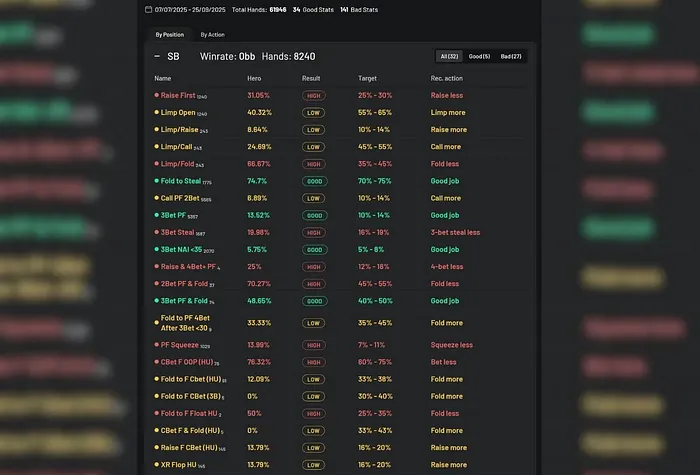
Raise more often, and raise bigger than feels comfortable: 3 to 3.5 big blinds works at most stack depths. Your opponent is out of position with a weak, mostly capped range, and even when they limp-call, which is their main defence, they still face a difficult spot on every street after the flop.
Which hands belong in the isolation raise depends on stack depth. The hands you isolate with at 45 big blinds differ from the ones you isolate with at 16, because at shorter stacks you have to play around the small blind limping and then shoving over your raise, and that changes which hands perform best. Guessing at the edges of that range costs money over a year of play, so take the list for each depth from the big blind isolation chart.
Three-Betting from the Blinds Against Steals
A late-position player opens, you are in either blind, and you call. Do that too often and you pass up the chance to attack one of the weaker opening ranges at the table.
The small blind is a difficult seat to flat from, because you play the hand out of position with the big blind still to act behind you. Most players miss a large share of their three-bet opportunities from the blinds by flatting or folding hands they should be three-betting, which leaves their blind defence both too tight and too weak.
From the big blind you close the action at a good price, so flatting is a strong option there. The trouble starts when flatting becomes the whole strategy. A three-betting range mixes hands you are happy to get called with, hands that block the opener's continuing range, and hands that give you coverage on boards your range would otherwise rarely hit. Stack depth and the opener's position both change which hands go in, which is why the blind three-betting chart is worth keeping open as a reference.
Opening the Button and Cutoff
The button plays every street in position and has only two players left to get through. The cutoff is a close second, with position on everyone except the button. Getting the most out of these two seats is critical to a sustainable win rate, yet most players open them too tight and leave money on the table.
Two reasons usually sit behind the tight ranges: fear of a three-bet from the blinds, and not realising how wide these ranges can get. Players who underrate the detail in their opening ranges make the same small mistakes hand after hand. Leak 2 showed that much of the field three-bets from the blinds too rarely, so most players are folding very profitable button opens to dodge a three-bet the population often never makes.
Open wider. The mistake costs more than most people expect, and the button and cutoff opening charts make it an easy one to fix.
Why Playing By Feel Falls Short
All three leaks have answers. A button opening range at 30 big blinds is a fixed list of hands, and so are the big blind's response to a small blind limp at 16 big blinds and the small blind's three-betting range against a cutoff open at 50.
Corrections made by intuition fall well short of fixing the underlying problem. A player learns they open the button too tight, widens by feel for a week or two, and then drifts back to the old ranges as habit takes over.
Ranges built for the wrong format make it worse. Cash stacks often sit at 100 big blinds for the whole session, with no antes and a different rake structure, while tournament stacks pass through 12, 25, 40 and 80 big blinds in a single event.
Antes, ICM and hands played without rake put the two formats far apart, and deliberately playing cash ranges in a tournament can do more damage than playing by feel.
Why Tournament Players Fold These Spots
Busting ends your day, so avoiding confrontations and playing tighter feels correct in a tournament in a way it never does in a cash game. Pay jumps and ICM make that at least partly true, since chips you win are worth less than chips you lose, and there is a real incentive to avoid stack-committing spots on a bubble.
At most stack depths, though, isolating a small blind limp or opening the button does not put your stack at risk. Each is a small risk for a chance at the blinds and antes already in the pot, and bubble-level caution applied to a button open early in a tournament gives up real opportunity while protecting nothing.
The Charts
BBZ preflop charts cover 3 to 100 big blinds across all eight seats for opens, facing raises and facing three-bets, in more than 900 scenarios, so each of the three spots above has a chart at every depth you will play it.
MTT charts cost $12.50 a month on the annual plan or $15 monthly. The package covering MTT, cash, ICM, PKO and Spin and Go costs $20.80 a month annually or $25 monthly. The seven-day free trial gives you time to pull the exact ranges for all three leaks without paying anything.
BBZ preflop charts cover 3 to 100 big blinds across every seat in MTT, cash, ICM, PKO and Spin and Go formats, from $12.50 a month, with a seven-day free trial. The leak data in this article comes from the BBZ Leak Finder, which grades 175 tournament stats by position.