button in Safari
The One PKO Adjustment Most MTT Players Still Get Wrong


Table Of Contents
Progressive Knockout Tournaments (PKOs) have quietly become the backbone of online poker's tournament schedules.
Open the lobby on PokerStars, GGPoker, 888poker, or more, and you'll see PKOs dominating the slate. They are action-heavy, fast-paced, and, for players who understand them, highly profitable. However, many regular grinders still approach PKOs like standard MTTs.
Jordan “BBZ” Drummond from coaching site BBZ Poker has spent years studying bounty dynamics with solvers and students alike, and has identified one pattern that keeps showing up time and time again. Players obsess over complicated bounty math but miss a far simpler adjustment that carries enormous weight.
It’s called Double Cover, and after checking out BBZ's work, it's clear it might just be the most practical edge in PKO poker.
How & Why PKOs Play By Different Rules
To state the obvious first up, in a PKO a part of every buy-in funds a bounty. Knock someone out and you collect cash immediately, while also increasing your own bounty for future hands. It's a small tweak that should cause a fundamental change in your approach to the table.
Covering stacks benefits the most. If you have more chips than your opponent and can bust them, the bounty effectively reduces the equity you need to continue in all-in spots.
Meanwhile, covered stacks face the opposite reality. When you are the shorter stack, opponents have extra incentive to bet against you.
In practice, that means bigger stacks get to play wider, while shorter stacks must be more careful. The mistake most players make is failing to apply that logic before the hand even begins.
That’s where Double Cover comes in.
What is Double Cover?
Double Cover is pretty much as easy as it sounds; your range simply tightens or expands depending on whether you cover both players left to act behind you.
On the button, this means having a stack larger than both the small blind and the big blind. In that scenario, if either player shoves and you call, you can collect their full bounty, putting you in the role of the hunter rather than the hunted.
Equally, flip the situation where if both blinds cover you, they can win your bounty and become the one in the crosshairs.
BBZ Poker emphasizes it's a very simple concept, requiring no calculator or solver, but it can have massive strategic consequences in PKO tournaments.
Before you open the pot, glance at the stacks behind you. Do you cover both players or not? That answer should directly influence how wide you raise.
How Double Cover Changes Your Opening Ranges
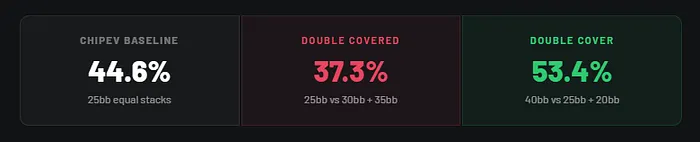
In a standard chip EV environment at 25 big blinds, a button might open somewhere around 45% of hands.
Now change nothing except the stacks.
If both blinds cover the button, that opening range contracts significantly. Marginal hands that relied on fold equity become far less attractive because the blinds are incentivised to defend wider and apply pressure.
Reverse the dynamic. Give the button a healthy stack that covers both blinds. Suddenly, the opening range expands dramatically. Hands that would be clear folds in a regular MTT become profitable opens because every confrontation carries additional bounty upside.
In solver work highlighted by BBZ Poker, the swing between being double covered and double covering can exceed 15% in opening frequency. That's not a small tweak, that's a structural shift.
Why Most Players Miss This Adjustment
Part of the reason Double Cover is overlooked is that PKO strategy has developed a reputation for being heavily mathematical. Discussions about bounty-to-chip conversions, equity reductions and late-stage pressure can quickly become dense, and for many players the theory feels abstract.
Double Cover, by contrast, is immediate and practical. It does not require a calculator or memorizing formulas mid-hand. Yet many regulars still rely on static preflop ranges, opening the same hands from the button whether they cover the blinds or are covered by them.
In a format where stack coverage directly alters incentives, that rigidity becomes a leak. Over the course of a long session, failing to widen as the covering stack and tighten as the covered stack quietly bleeds EV in both directions. The adjustment is simple, but the cumulative effect is significant.
Three Practical PKO Adjustments You Can Apply Immediately
Start From the Beginning
Late registration in regular MTTs can make sense. In PKOs, it often means missing untouched bounties. The earlier you enter, the more raw bounty value is available in the ecosystem. Those early knockouts compound.
Chase Coverage, Not Just Chips
It is not just about accumulating blinds. It is about who you cover. Becoming the covering stack unlocks negative risk premiums and wider profitable ranges. Double Cover is the clearest expression of this dynamic, but the same logic extends across the table.
Lean Into Profitable Aggression
PKOs reward calculated risk-taking, especially in the early and middle stages. When you cover opponents, thinner calls and lighter stack-offs can be correct because the bounty reduces the equity threshold required. Playing scared in these spots leaves money behind.
Where the Real Edge Comes From
Double Cover is a gateway concept.
It is easy to grasp, easy to apply and immediately impactful, which makes it an ideal starting point for players looking to sharpen their PKO game. But it sits within a larger strategic framework that includes converting bounties into chip value, adjusting calling thresholds across stack depths and recognizing how incentives evolve as the field shrinks.
That deeper layer is where structured study pays off. BBZ Poker's PKO-focused training breaks down these dynamics with solved ranges, scenario work and drills designed to make adjustments automatic rather than theoretical.
PKOs are not a niche format anymore. They are a staple of the online ecosystem and, for prepared players, one of its most profitable arenas. If you begin by consistently checking who covers whom and adjusting accordingly, you are already ahead of a large portion of the field. From there, the edge only compounds.