button in Safari
Is This Sick Hero Call by Alex Foxen in $250K Tournament Solver Approved?


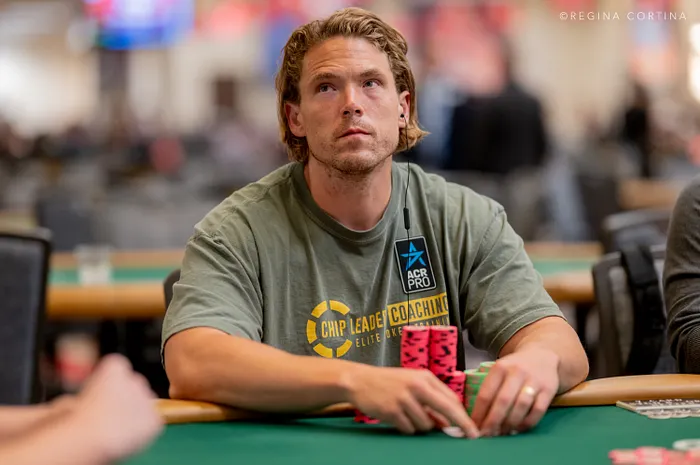
There aren't many players you'd want to face in a massive river spot less than Stephen Chidwick.
Alex Foxen found himself in exactly that position during Day 1 of the $250,000 Super High Roller at the 2026 World Series of Poker, facing a 1.5x pot river overbet with little more than bottom pair.
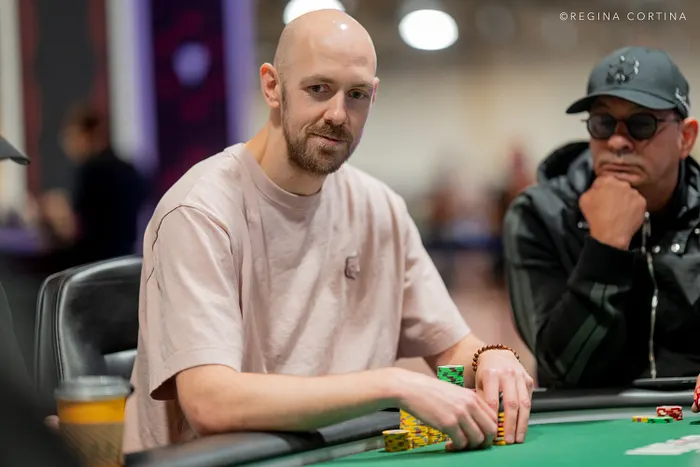
Chidwick had fired 525,000 into a pot of 344,000. Foxen went deep into the tank before eventually finding the call with ace-five suited. Chidwick turned over a stone-cold bluff, while Foxen's pair of fives was enough to drag a pot worth almost 1.4 million.
It looked like a world-class read from one of poker's best players. But was it actually the right call?
The folks at GTO Wizard wanted to find out, and the solver had plenty to say about how both players navigated one of the more fascinating hands from the $250K.
Chidwick and Foxen Get Busy Preflop
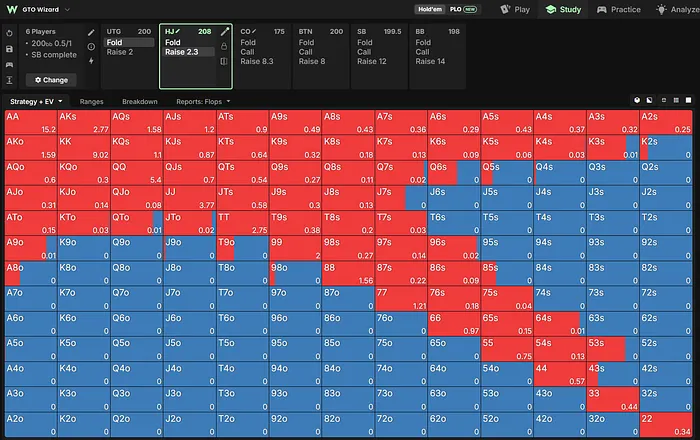
With the blinds at 6,000/12,000 with a 12,000 big blind ante, Chidwick started the hand with around 2.5 million and opened A♣10♣ to 28,000 from the hijack. Nothing controversial there. GTO Wizard opens all suited aces from this position.
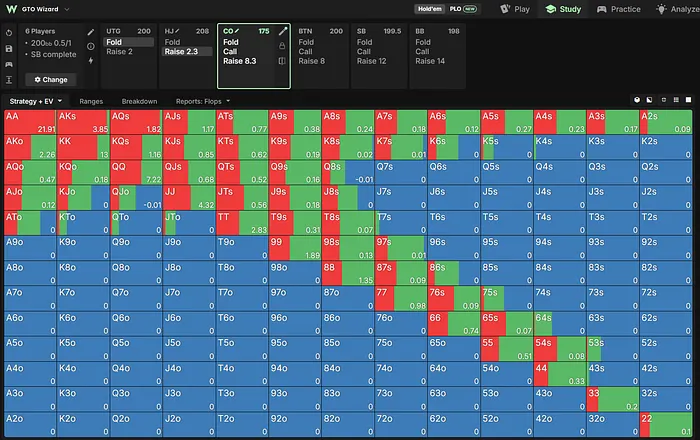
Foxen, sitting on 2.1 million in the cutoff, looked down at A♥5♥ and bumped it up to 100,000. Again, solver approved.
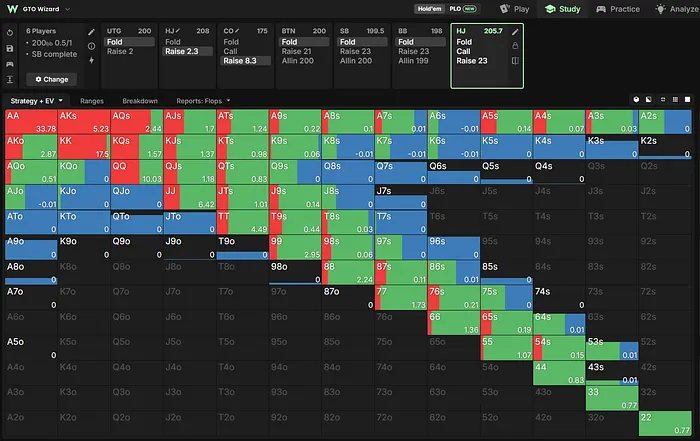
Ace-five suited mixes between calling and three-betting here, making Foxen's decision to apply some preflop pressure perfectly reasonable. Chidwick's response was equally standard, with ace-ten suited mostly calling against the three-bet while occasionally mixing in a four-bet.
Foxen Takes the Initiative
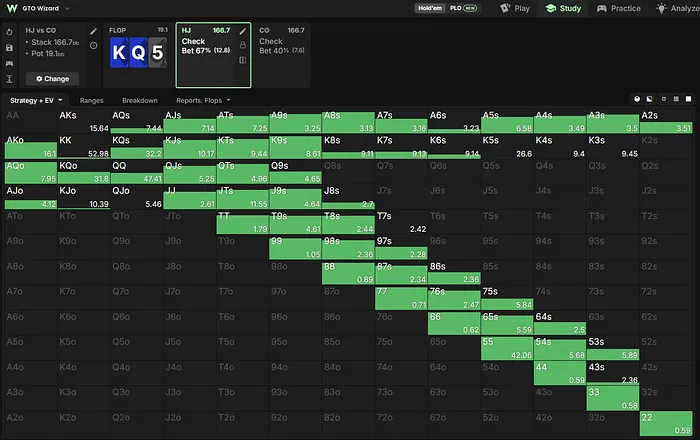
The K♦Q♦5♠ flop gave Foxen bottom pair. Chidwick checked and Foxen continued for 57,000 into a pot of 230,000, around quarter pot.
The cutoff retains the overall range advantage on this board, which allows Foxen to continuation bet at a high frequency.
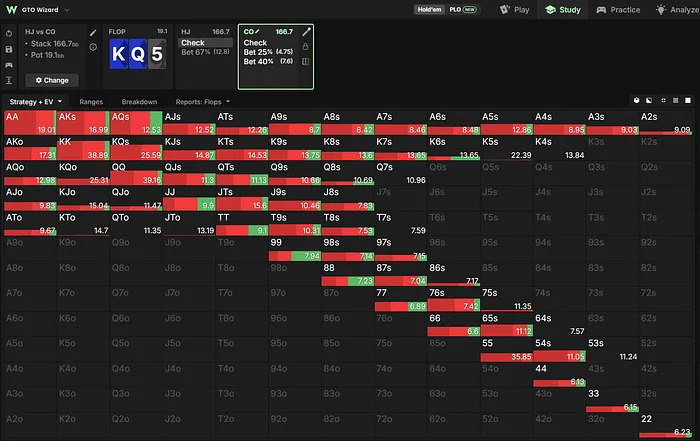
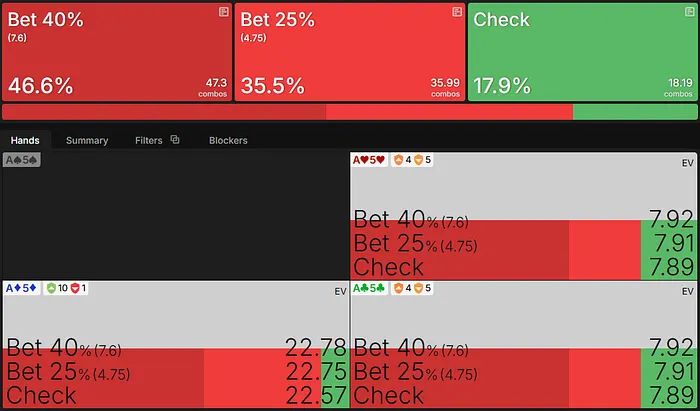
GTO Wizard does prefer a larger 40% sizing when using a single-size strategy, but the 25% sizing Foxen chose is still used with plenty of hands and sacrifices very little EV with A♥5♥.
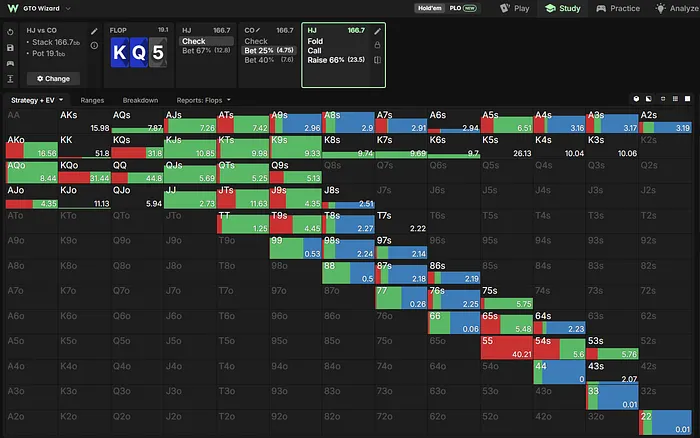
Chidwick wasn't going anywhere with A♣10♣. GTO Wizard prefers calling with the ace-ten suited combinations that lack a backdoor flush draw, while the versions with additional backdoor equity are more attractive candidates to raise. Chidwick called and the pot grew to 344,000.
The Queen Slows Everyone Down
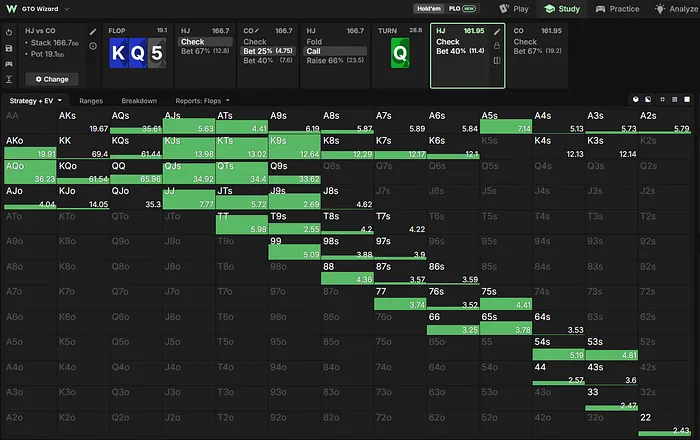
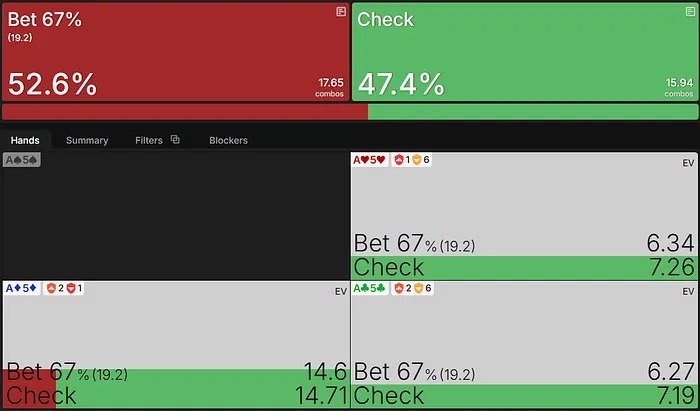
The Q♣ paired the board on the turn and Chidwick checked for a second time.
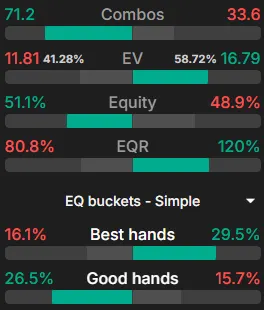
Despite the queen improving the hijack's overall equity, it doesn't shift the balance far enough for Chidwick to start leading. Foxen still retains important advantages in EV, equity realization and the strongest parts of his range. Foxen checked behind.
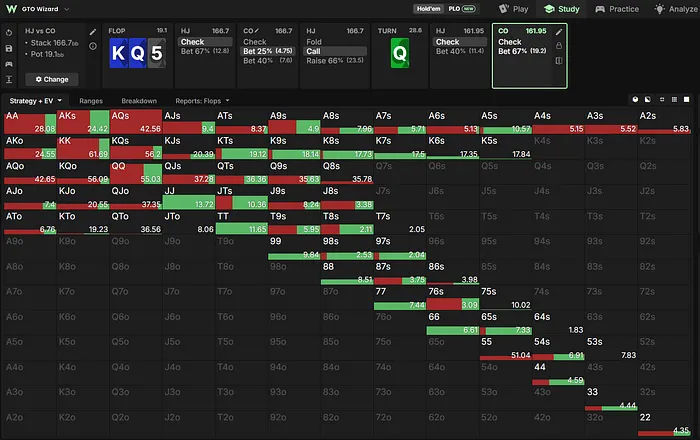
That's also the solver's preferred route with A♥5♥. Bottom pair isn't strong enough to comfortably extract another street of value, and the paired board means Foxen can no longer bet his range anywhere near as aggressively as he could on the flop.
Chidwick Pulls the Trigger
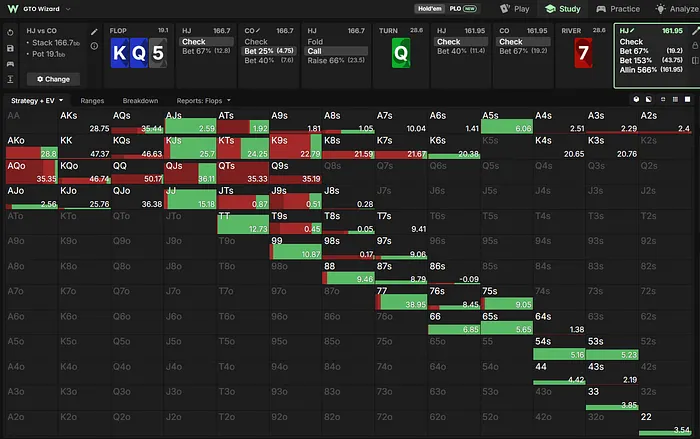
The 7♥ completed the board, leaving Chidwick with ace-high. After the turn checked through, he fired 525,000 into 344,000, an overbet of roughly 153% pot.
It is an intimidating bet to face, but it wasn't simply a case of Chidwick deciding he couldn't win at showdown and reaching for a huge stack of chips.
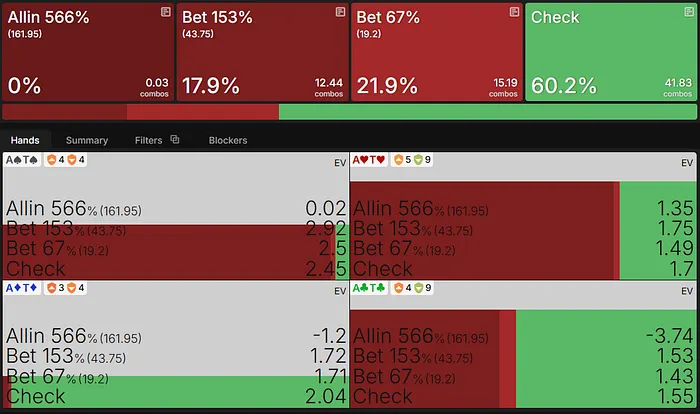
The solver actually likes ace-ten suited as a bluff candidate here, but there is a small wrinkle. With Chidwick's exact A♣10♣ combination, checking produces slightly more EV than betting. But once Chidwick decides to bluff, the massive sizing he chose is the solver's preferred option.
More importantly, the hand shows how a balanced river strategy isn't just about finding the right number of bluffs. Those bluffs also need to be allocated correctly across different bet sizes.
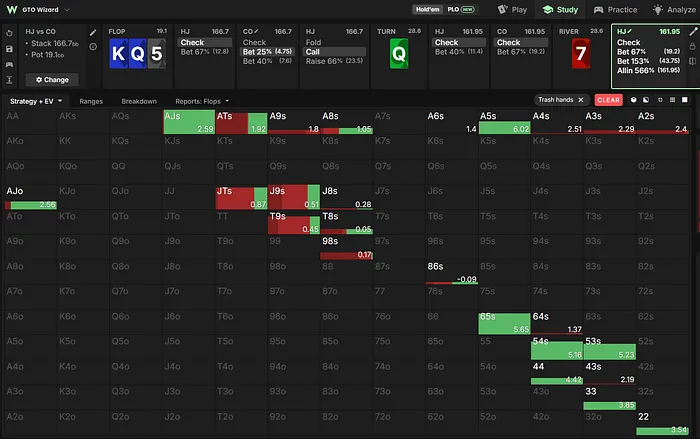
GTO Wizard splits Chidwick's river value range between two main sizing buckets. His strongest hands, including boats, straights and queens, gravitate towards the 153% overbet. Thinner value, such as kings, is more commonly bet for around 67% pot.
Weaker suited aces such as A2s, A3s and A4s are natural candidates for the huge overbet, while hands including JTs, J9s and T9s bluff more frequently with the smaller sizing.
Chidwick's A♣10♣ isn't quite a pure overbet, but the logic behind putting it into the bluffing range is very much solver approved.
Foxen Finds the Call, But GTO Wizard Says Fold
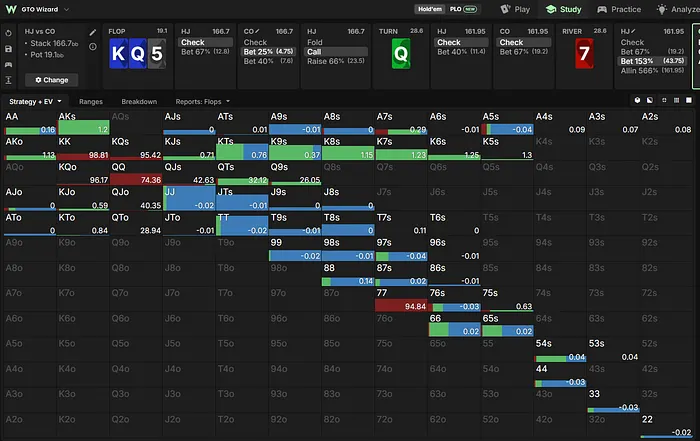
Foxen had queens and fives and he thought it over before calleing. Chidwick tabled his bluff and Foxen collected the 1,394,000 pot.
Great call, right? In practice, absolutely. In theory, not quite.
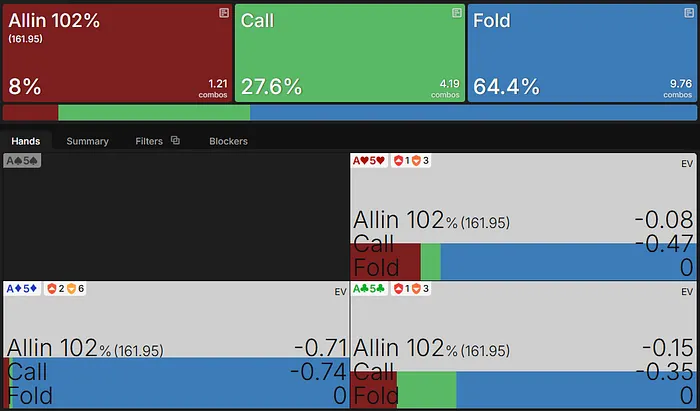
Against a perfectly balanced 153% pot river bet, Foxen needs to defend around 40% of his range to prevent Chidwick from automatically profiting with his bluffs.
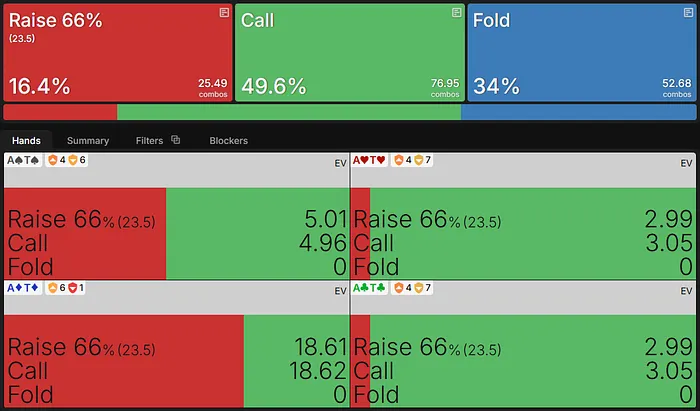
GTO Wizard folds 64.4% of Foxen's range in this spot, slightly more than the figure suggested by minimum defence frequency, and A♥5♥ overwhelmingly belongs in the muck.
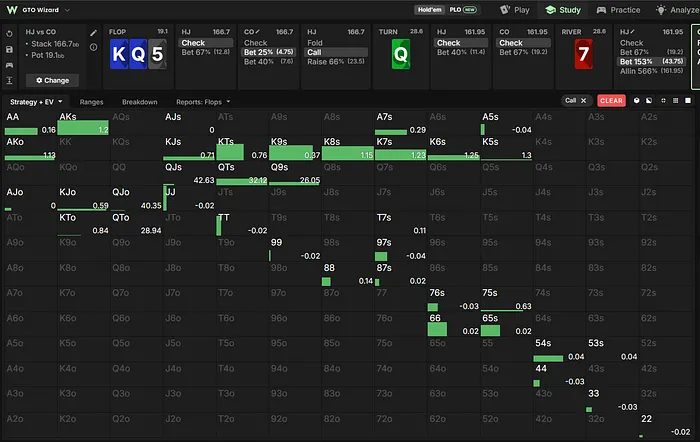
The solver does call at a tiny frequency, but overall calling loses considerably more EV than folding.
That creates one of the most interesting lessons from the entire hand: the strength of your cards isn't the only thing that matters when choosing a bluff-catcher.
Why Weaker Fives Can Make Better Calls
It might seem strange that Foxen should fold A♥5♥ when some weaker five-x hands are allowed to call. The answer comes down to blockers.
Hands such as 5♠4♠ and 6♠5♠ may be weaker in absolute terms, but they don't contain an ace. That matters because they leave more of Chidwick's natural ace-high bluffs available.
Foxen's hand removes one of those potential bluff combinations from Chidwick's range.
When you're facing an enormous polarized river bet, that can matter more than the small difference in showdown value between two bluff-catchers.
It's a useful reminder that a hero call isn't only about asking, "How strong is my hand?" You also need to ask what your cards remove from your opponent's range.
Right at the Table, Wrong in Theory
Foxen ultimately made the decision that mattered. He called, Chidwick was bluffing and the chips went his way.
Almost everything leading up to the river followed a theoretically sound path. Chidwick's preflop call, Foxen's flop bet, Chidwick's float and the turn check-back all fit comfortably within the solver's strategy.
Even Chidwick's huge river bluff makes sense. Checking carries slightly more EV, but if the hand is going to bluff, the 153% overbet is exactly the sizing the solver wants.
It's Foxen's spectacular hero call that finally breaks away from theory, which makes the hand so interesting.
Against a perfectly constructed range, A♥5♥ should mostly fold. Against Stephen Chidwick, in this particular hand, Foxen found a reason to do something else.