button in Safari
GTO Wizard: Phil Hellmuth Actually Plays GTO Poker After All?


Table Of Contents
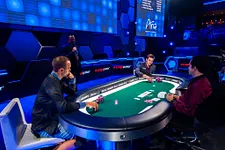
Phil Hellmuth analyzed an interesting hand on Day 3 of the 2013 World Series of Poker (WSOP) Main Event, one that you might think is game theory optimal (GTO) approved. But does GTO Wizard agree with his assessment. Let's dive into the memorable ESPN televised poker hand.
Hellmuth, as you probably know, doesn't exactly play a GTO style of poker. He relies more on natural feel, or what he refers to as "white magic." The breakdown he gave during the ESPN broadcast on the hand you're about to read about, however, wasn't as anti-GTO as you might have expected from the Poker Hall of Famer.
The basic info of the hand you need to know before we dive deeper into the action was that Olaoluwa Okelola had A♣5♣ and a stack size of 70,000 with the blinds at 1,500/3,000. There was a 500-chip ante in play for all players at the table, as this was prior to the big blind ante era. Tony Gregg, who was also in the hand, had 91,000 chips and A♠Q♦. Yuri Dzivielevski was also in the pot with K♠K♦ and a monster stack of 285,000 chips.
There were 756 of the 6,352 players remaining in the World Championship event, and 648 of them were to be paid, with the winner taking home $8,361,570.
Preflop Action
Okelola opened to 8,000 from under the gun before Gregg, the hijack, moved all in. Dzivielevski then called from the cutoff, prompting Okelola to fold. The board ran out 4♦3♦8♠8♥J♦, giving Dzivielevski two pair to scoop the pot and eliminate Gregg
from the tournament.
What makes this hand particularly interesting is that the coverage featured a segment titled ‘White Magic with Phil Hellmuth’, where Hellmuth shared his thoughts on the optimal play from Tony Gregg’s perspective. Phil suggested that with 30 big blinds, shoving all-in was excessive, instead recommending a 3-bet to around five or six big blinds, with the intention of folding if faced with a4-bet.
In practice, however, Gregg opted to move all-in. Let’s analyse the hand using the solver to determine which approach was closer to optimal, Phil Hellmuth’s or Tony Gregg’s.
Preflop Analysis
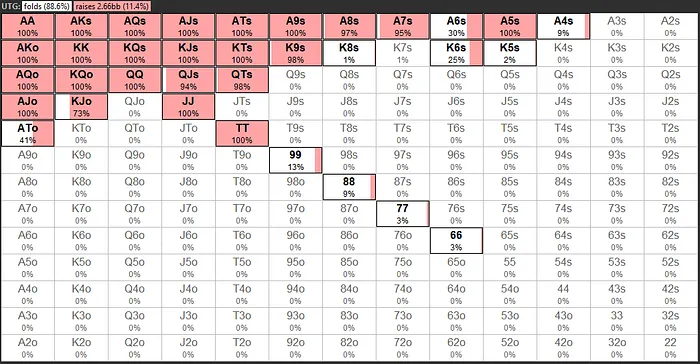
A5s is a pure open from UTG in this spot.
Tony Gregg goes all-in holding A♠Q♦. GTO Disapproved.
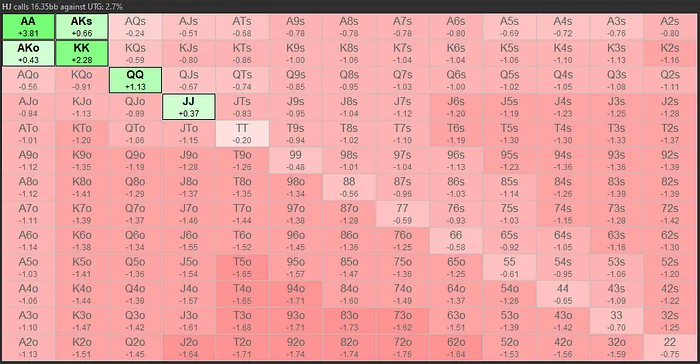
HJ Range vs UTG Open (HRC):
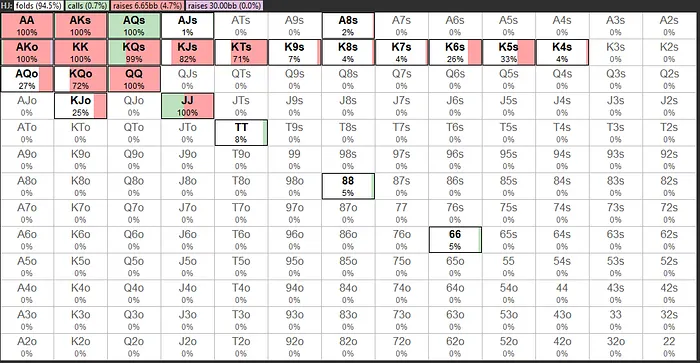
In this sim, the solver mostly folds AQo, mixing in a 27% frequency raise to 6.65bb, with no all-ins recommended in this spot.
HJ Range vs UTG Open (GTO Wizard):
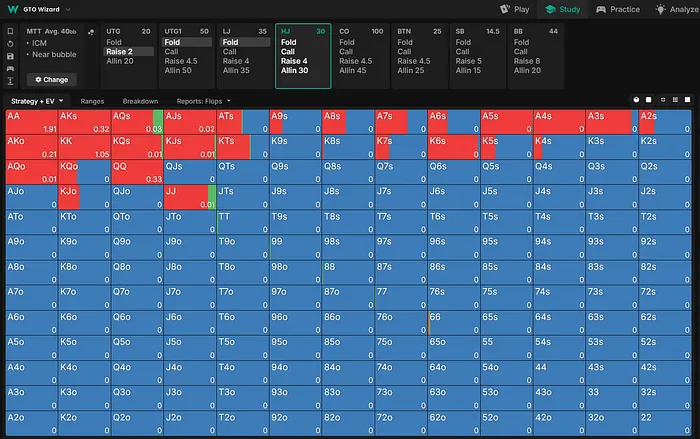
Comparing this to a similar sim in GTO Wizard, we again see no all-ins being recommended, with AQo preferring a small 3-bet to 4bb. The intention behind showing two different solver outputs is to demonstrate that across two similar, yet slightly different ICM bubble scenarios, neither solver ever prefers a 3-bet all-in in this type of spot, regardless of hand strength.
It is also important to note that UTG used a larger 2.66bb open sizing in-game, which helps explain why AQo is folded more frequently in the first sim compared to the second, where a smaller 2bb open sizing is used.
Let’s delve a bit deeper into why the all-in size is never being used.
HJ 3-bet all-in EV’s vs UTG:
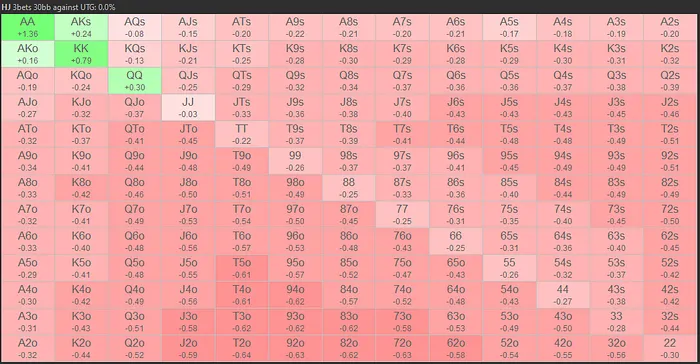
If we filter to compare the EVs of every hand in the HJ’s range vs an UTG open, we can see that only five hands show a profitable all-in: AKo, AKs, QQ, KK, and AA. However, even with these hands, the solver achieves significantly higher EVs by selecting alternative actions, most notably calling or raising to 6.55bb. But why is this the case?
Bubble Factors
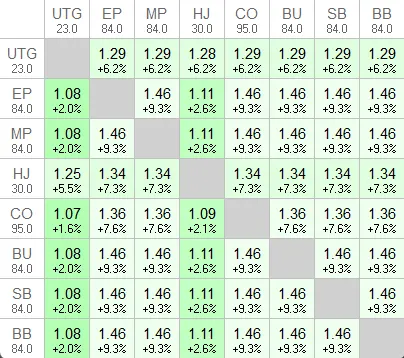
The above shows that the HJ vs UTG carries a bubble factor of 1.25 and a risk premium of +5.5%.
What is a Bubble Factor and Risk Premium in Poker?
Bubble Factor:
- Measures how much a player’s strategy should tighten when they are close to a payout (the “bubble”).
- A higher bubble factor means losing chips is very costly, so you need stronger hands to play big pots.
Risk Premium:
- The extra equity a hand needs to continue in a spot because losing chips is more expensive than usual.
- In other words, it’s the penalty for risking chips under ICM, the higher the risk premium, the stronger your hand must be to play aggressively.
So what does this mean specifically for the HJ in this spot?
With the tournament approaching the money, ICM plays a significant role in this decision. The bubble factor of 1.25 means that for the HJ, losing chips is 25% more costly than gaining the same amount, while the +5.5% risk premium shows that Gregg needs more equity than usual to justify putting his tournament life at risk. With several players behind covering his stack, busting at this stage carries a heavy penalty, making high-variance decisions far less attractive, even with strong hands.
Why the solver never jams from the HJ
Given this ICM pressure, the solver therefore never recommends any all-ins from the HJ at 30bb. Shoving removes flexibility, risks immediate elimination, and generates very little additional fold equity against an UTG opening range that is already strong.
On top of that, players behind are able to call with very tight, high-equity ranges while fully covering Gregg, making the downside far greater than the potential reward. As a result, the solver prefers standard 3-bet sizes that apply pressure while preserving tournament life, rather than committing the entire stack in a low-reward, high-risk spot.
Details for AQo:
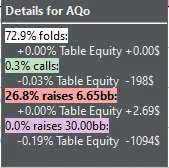
This is why shoving AQo in this spot loses the most $EV compared to the other available options. Let’s analyse the rest of the hand, shall we?
Dzivielevski calls from the CO with K♠K♦. GTO Approved.
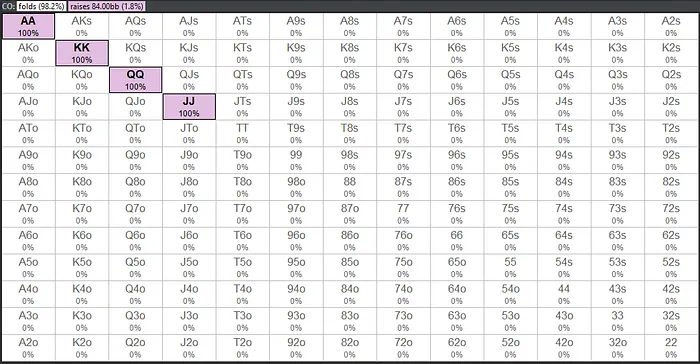
KK is an obvious call here, further highlighting how players behind are only going to call with extremely tight, high-equity ranges. Okelola folds A♣5♣. GTO Approved.
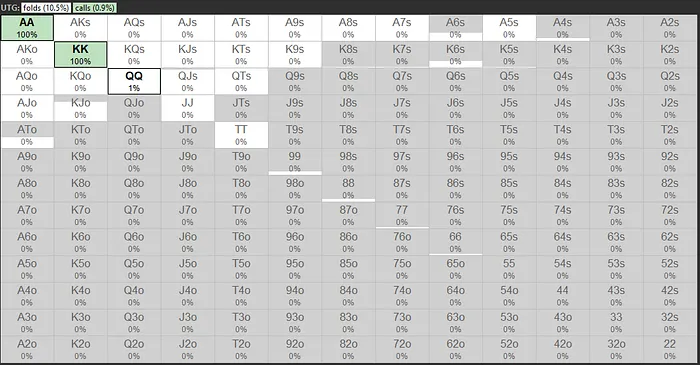
This is a very easy fold with A5s, with only KK and AA showing as profitable calls. To round out the hand, Phil Hellmuth also mentioned that AQo should be played as a 3-bet, but folded to any 4-bet in this spot, so let’s see if the solver agrees with him here as well.
Of course, he is correct... as always.
Conclusion
The key takeaway from this hand is that with around 30 big blinds, close to the money in a large-field tournament, and with multiple stacks behind that cover you, open-shoving is simply too high risk. ICM, bubble factor, and risk premium all combine to heavily penalise all-ins in this spot, with the solver consistently preferring smaller 3-bet sizes that apply pressure while preserving tournament life. Even strong hands like AQo do not benefit from committing the entire stack, as the extra fold equity gained is minimal compared to the downside of busting. And perhaps the most amusing part of this hand is that Phil Hellmuth, often known for his “White Magic” explanations, ends up landing firmly on the solver-approved side here.
His recommendation to 3-bet small and comfortably fold to a 4-bet lines up closely with modern GTO principles in an ICM-heavy spot like this. So maybe Phil really has been playing GTO all along... just cleverly disguising it as White Magic on his way to becoming the greatest bracelet winner the game has ever seen.
If you want to pick up some White Magic ICM poker of your own, click the link below and try GTO Wizard for free today.






![[REVIEW] Alex Fitzgerald - How to Think Like a Poker Player](https://s.pnimg.net/X9UE8P0nPWCGPMbT4I4bHk7aWOTk8TGpsDo9wmLHn2s/pr:template-4-in-row/aHR0cHM6Ly9wbmlt/Zy5uZXQvdy9hcnRp/Y2xlcy8wLzVkNi85/NGNlZThhOGU2Lmpw/Zw.webp)