Kalshi is adopting Nasdaq’s market-surveillance technology in a move designed to help the prediction market exchange detect insider trading, manipulation and other forms of market abuse as its trading volume and product offerings continue to grow.
The companies announced a multi-year partnership Monday that will bring Nasdaq Market Surveillance into Kalshi’s existing monitoring system. The rollout will take place in phases and cover both event contracts and perpetual-style derivatives, giving Kalshi access to cross-market and cross-asset monitoring tools used across traditional financial markets.
At the most immediate level, the announcement concerns an upgrade to Kalshi’s compliance technology. Its broader significance, however, lies in what it suggests about the institutional development of prediction markets.
It Doesn't Just Add Credibility
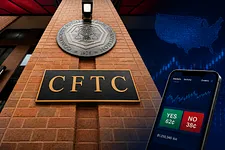
Nasdaq’s involvement extends beyond providing institutional credibility. Its technology is used by more than 50 exchanges and 20 international regulators, and the Commodity Futures Trading Commission began adopting the same surveillance platform last year. Kalshi is therefore integrating infrastructure designed for major financial marketplaces and already familiar to its primary federal regulator.
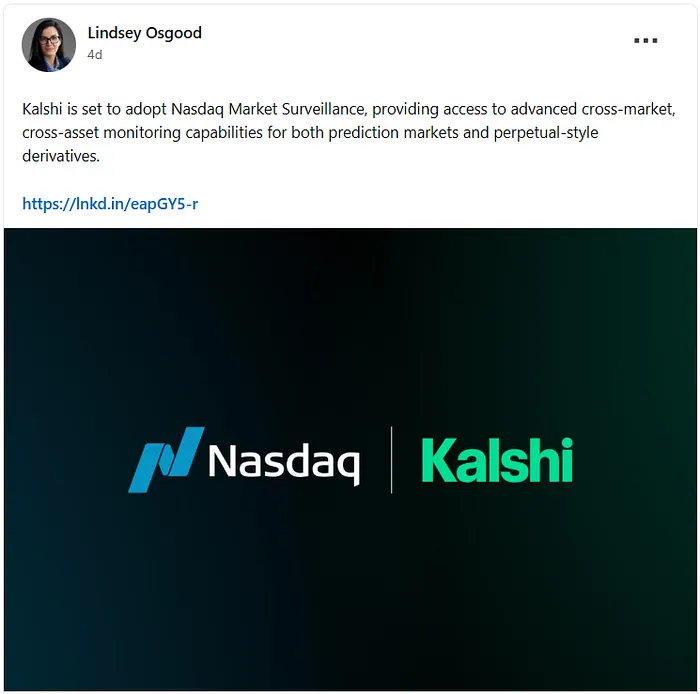
Lindsey Osgood, a senior sales executive at Nasdaq Financial Technology, highlighted the partnership on LinkedIn, pointing specifically to the advanced cross-market and cross-asset monitoring that will cover Kalshi’s prediction markets and perpetual-style products.
Those capabilities matter because suspicious trading is not always visible within a single contract. A trader could build related positions across several markets, use multiple products to obscure a strategy or attempt to manipulate one market in order to profit in another. Nasdaq’s system is designed to reconstruct order-book activity and identify patterns across venues, products and asset classes, rather than evaluating every trade in isolation.
The technology will also help Kalshi deliver trading data to the CFTC in the agency’s required format, according to the exchange’s announcement. Tony Sio, Nasdaq’s head of regulatory strategy and innovation, said the growth of prediction markets now requires surveillance infrastructure capable of keeping pace with the industry.
A Response to Real Scrutiny
The timing is not accidental. Prediction markets have faced increased attention from lawmakers and regulators following several alleged cases of traders using privileged information or manipulating markets tied to events they could influence.
In July, the CFTC ordered former Rep. George Santos to pay $35,000 over manipulative trading in a Kalshi contract tied to his attendance at the State of the Union. Reuters has also reported that a White House teleprompter operator is under investigation for potentially trading with advance knowledge of President Donald Trump’s remarks.
Kalshi identified the suspicious activity in both matters and referred it to regulators. The Nasdaq agreement is therefore better understood as an effort to strengthen an existing surveillance framework than as an emergency response to a system that had failed to detect misconduct.
Kalshi has spent years developing its own surveillance system, known internally as “Poirot,” and previously added technology from Solidus Labs. The exchange has said its systems use pattern recognition to flag unusual trades, after which its market-regulation team can review customer identity information, funding sources and trading history. In February, Kalshi disclosed that it had opened more than 200 investigations during the previous year and had frozen accounts connected to suspicious activity.
The Nasdaq platform will sit on top of those existing efforts. It adds scale, institutional experience and stronger cross-market analysis at a time when Kalshi is listing more products and serving a much larger group of traders.
The partnership also carries clear reputational significance for Kalshi. Working with Nasdaq strengthens the company’s argument that prediction markets should be evaluated as regulated exchanges rather than characterized as lightly supervised betting platforms.
Treating the agreement primarily as a branding exercise, however, would understate its practical importance. As an exchange expands, the number of relationships among its contracts can increase more rapidly than the number of contracts themselves. Surveillance systems that are sufficient for a smaller marketplace may become strained when trading occurs continuously across politics, economics, sports, cryptocurrency and company-specific events.
No surveillance platform can prevent every insider from trading, and detecting suspicious activity is only the beginning. Investigations still require people, judgment and a willingness to impose penalties or refer cases to regulators. The technology also cannot resolve the larger legal debate over which event contracts should be permitted in the first place.
Nevertheless, the agreement represents an important upgrade.
Prediction markets are unlikely to develop into durable financial institutions if ordinary traders believe that unusual price movements routinely result from privileged access to nonpublic information. Perceptions of fairness are not separate from liquidity. They are one of the conditions necessary for liquidity to persist.
Kalshi’s adoption of Nasdaq surveillance illustrates the direction in which the industry is developing. Prediction markets are no longer merely borrowing the terminology of traditional exchanges. They are increasingly adopting comparable infrastructure, working with the same regulators and accepting the expectation that market-integrity systems must expand alongside trading volume.
Prediction markets involve risk and are not suitable for everyone. While many of the best prediction platforms offer tools to make informed trades, outcomes are never guaranteed, and users should never risk more than they can afford to lose. Always trade responsibly. Additionally, platform availability and legal status vary by region. It is your responsibility to check local laws and verify that you are legally allowed to use a given platform before participating.

 button in Safari