button in Safari
Was This Huge River Bluff with 9-High Actually GTO Approved?


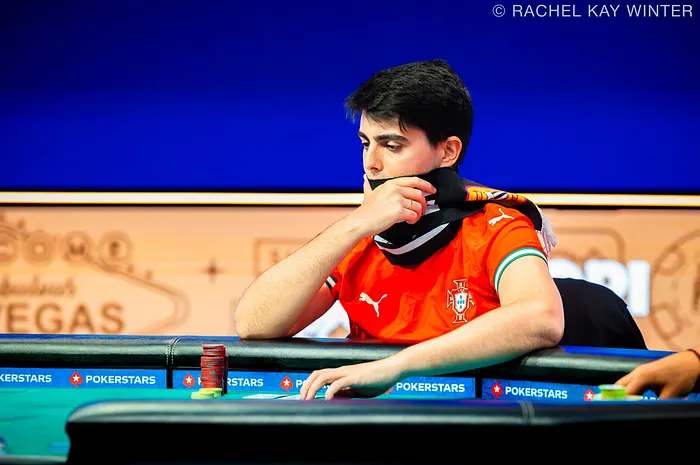
Poker pro Lukas Robinson uses GTO Wizard to analyze one of the sickest attempted river bluffs of the year at the 2026 $10,300 GGMillion$ Final Table.
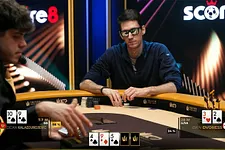
With the pair heads-up and $481,199 up top, Y Schneider in the small blind held 9,984,832, good for 40 big blinds, while Pedro Neves defended his big blind with 17,204,168 (or 69bb) behind.
Pre-flop Action
Schneider raises to 575,000 with 9♠7♣. Pedro Neves defends his BB with Q♣6♥.
Post-Flop
Flop (1,210,000 Pot): K♥Q♥2♥
Action: Neves checks. Schneider bets 302,500. Neves calls.
Turn (1,815,000 Pot): J♥
Action: Neves checks. Schneider bets 875,000. Neves calls.
River (3,565,000 Pot): 8♦
Action: Neves checks. Schneider bets 3,875,000. Neves calls.
Pedro Neves wins a 11,315,000 pot with a flush.
An incredible battle between two elite players, featuring a fearless bluff and a huge hero call under immense pressure. Let’s now use the GTO Wizard solver to see how closely their decisions aligned with GTO strategy.
Preflop Analysis
Schneider raises to 575,000 with 9♠7♣. GTO approved ✅.
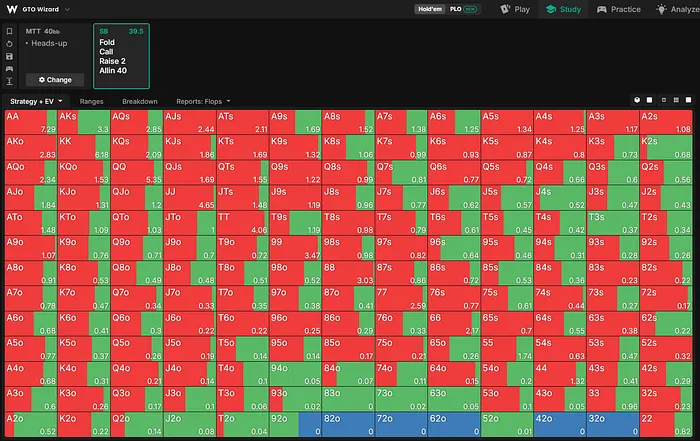
There is a 60% overall open-raising frequency here, with 97o mixing between raising and calling.
Neves defends his BB with Q♣6♥. GTO Approved ✅.
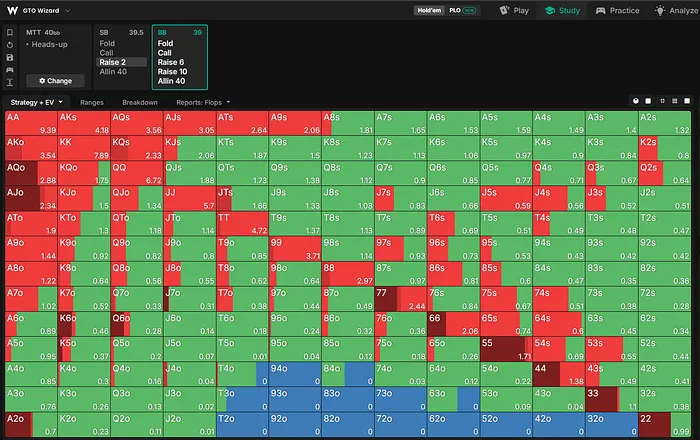
Recommended Strategy and EV for Q6o pre-flop:
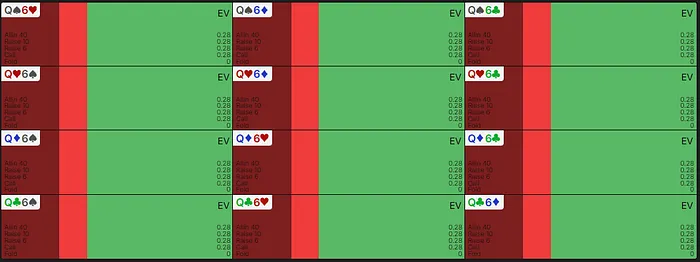
Although Q6o mostly prefers calling, you can see that calling, non-all-in raising, and jamming all generate almost identical EV.
Postflop Analysis
Flop (1,210,000 Pot): K♥Q♥2♥
Neves checks with Q♣6♥. GTO Approved ✅.
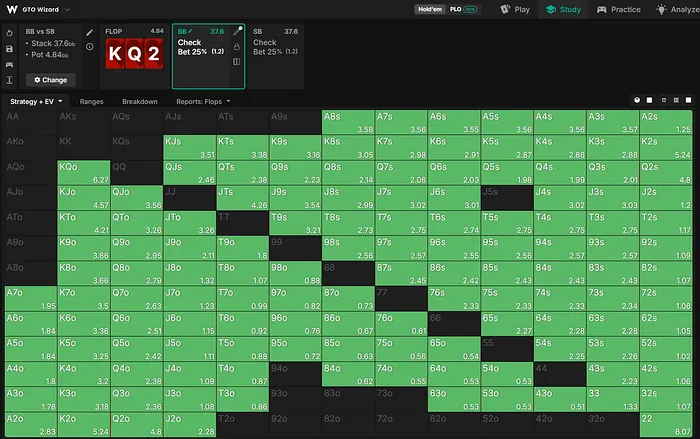
The solver recommends a pure check from the BB on this flop, as the SB holds both the EV and equity advantage on this specific board.
Flop Range Comparison (BB vs SB):
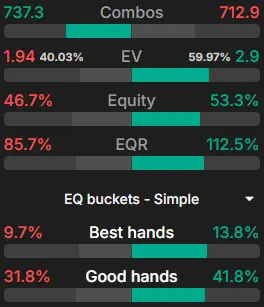
As you can see, the SB holds all of the strongest value hands on this board, while also benefiting from a significant EQR (equity realisation) advantage due to playing in position.
Schneider bets 302,500 with 9♠7♣. GTO Approved ✅.
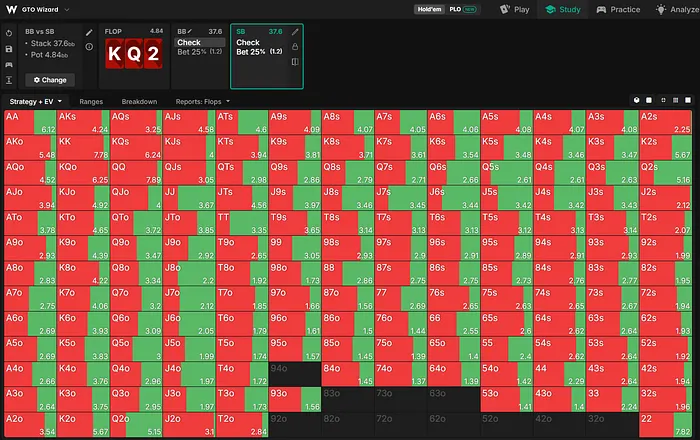
The solver recommends a high-frequency c-bet strategy due to the SB holding the equity, EV, and EQR advantages in this spot.
Recommended Strategy and EV for 97o:
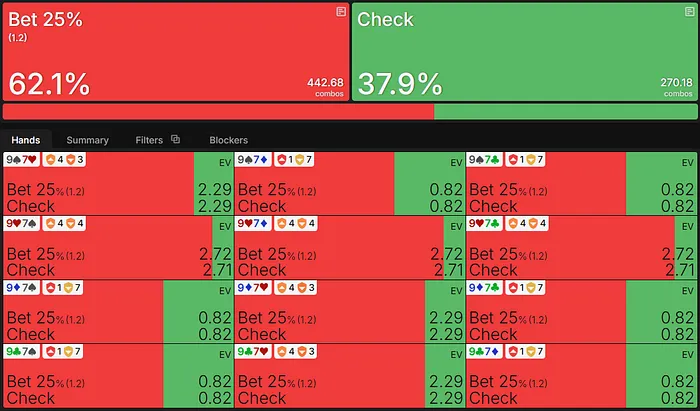
All 97o combos mostly prefer c-betting, although checking back generates virtually the same EV overall.
Neves calls the 302,500 bet with Q♣6♥. GTO Approved ✅.
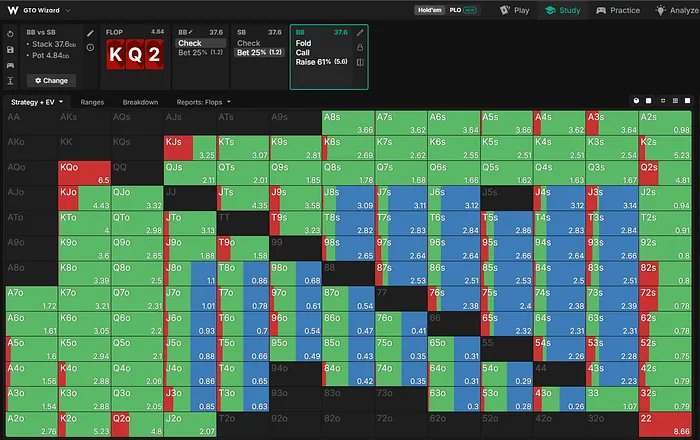
Recommended Strategy and EV for Q6o:
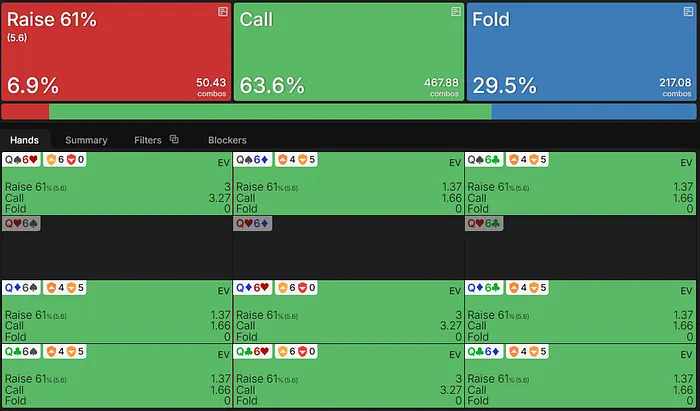
All Q6o combos, even those containing a heart, are pure calls vs this flop c-bet.
Turn (1,815,000 Pot): J♥
Neves checks turn. GTO Approved ✅.
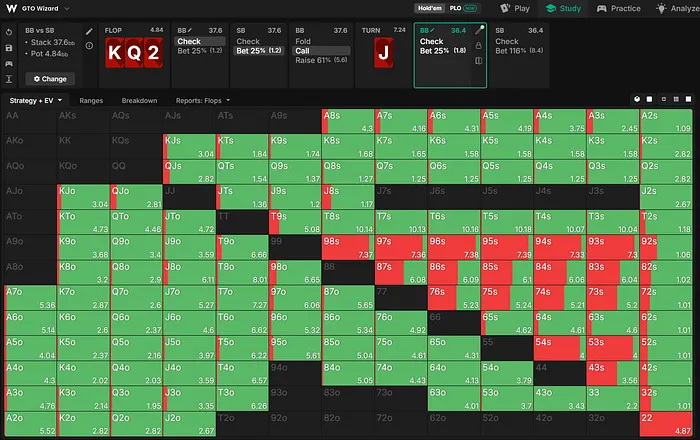
As you can see, the solver does recommend some 25% donk leads in this spot. Let’s compare the ranges to understand why.
Turn Range Comparison (BB vs SB):
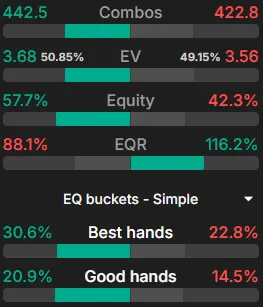
The EV and equity have now shifted in favour of the BB, as their range contains far more strong hands, such as flushes and straights, compared with the SB. This is why the solver now starts to implement donk leads.
EV for Q6o:
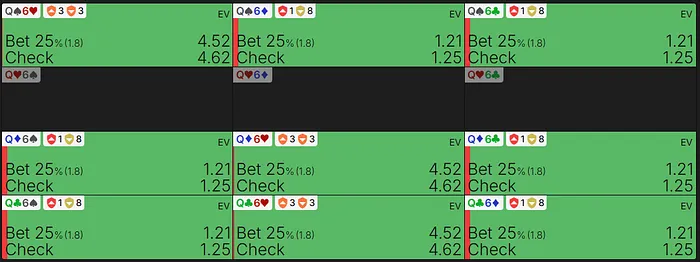
Q6o, even the combos that have made a flush, are still mostly recommended to check in this spot.
Schneider bets 875,000 on the turn with 9♠7♣. GTO Approved ✅.
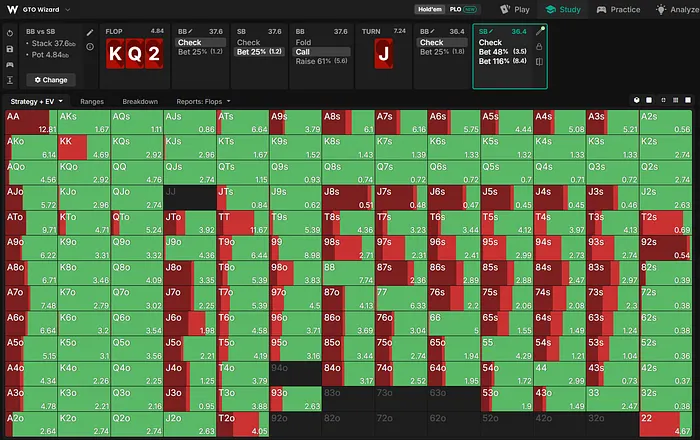
Due to this shift in equity, the SB should now adopt a polarised betting strategy, betting both the top and bottom of range while mostly using a 116% geometric sizing.
What is a geometric bet size?
A geometric bet size is one where you bet a consistent percentage of the pot on each street so that stacks end up effectively going all-in on the river. This approach is optimal when your range is perfectly polarized, as it maximizes minimum defense frequency (MDF) while ensuring that the full stacks are committed by the river.
Recommended Strategy and EV for 97o:
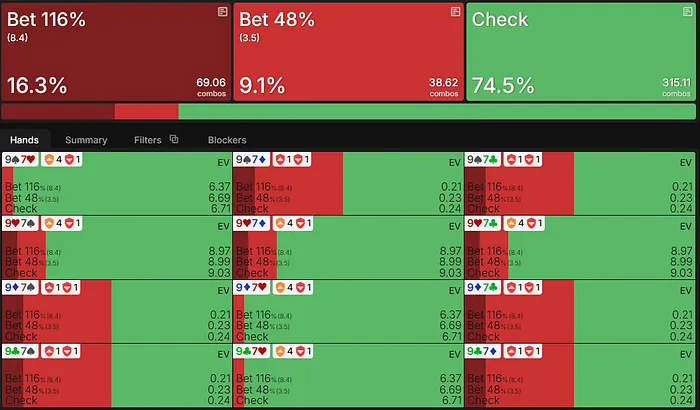
Some 97o combos do mix in low-frequency bets, including 9♠7♣. However, you can see that checking still generates the highest EV overall with these hands.
If we highlight the ‘No Made Hands’ section of the SB’s range, we can clearly see which hands prefer bluffing over 97o.
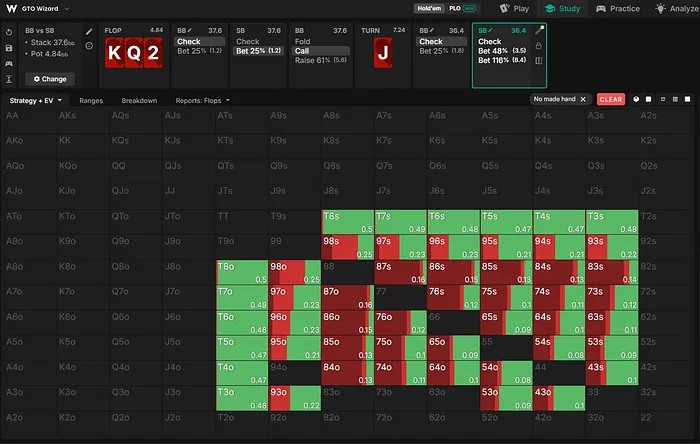
There are enough 5-high, 6-high, 7-high, and 8-high hands in the SB’s range that prefer bluffing ahead of 97o. This means that if Schneider is bluffing 97o at full frequency here, he would be overbluffing, resulting in too many bluffs relative to value hands and therefore making his range easier to play against overall.
Neves calls the 875,000 bet with Q♣6♥. GTO Approved ✅.
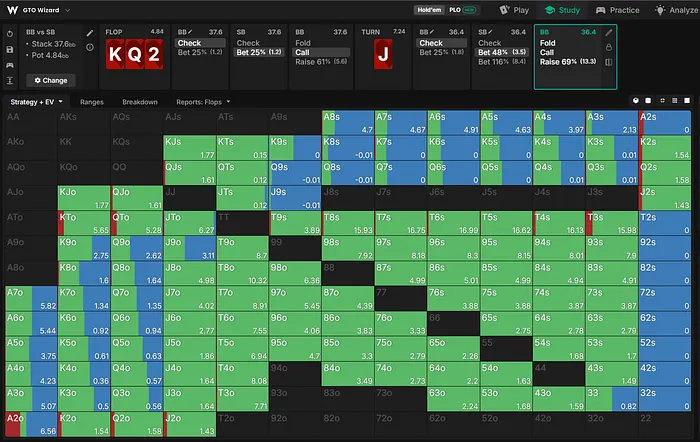
Recommended Strategy and EV for Q6o:
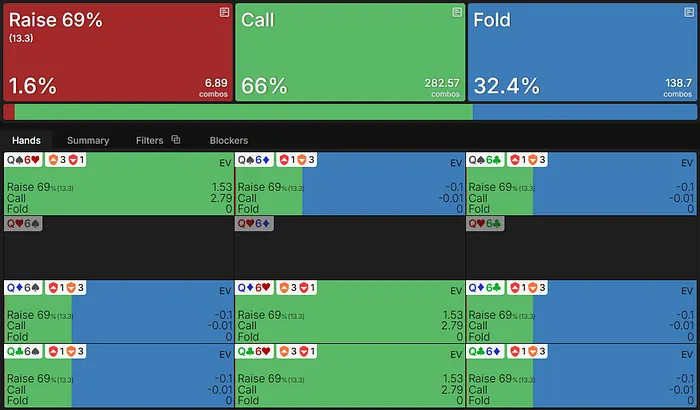
All Q6o combos containing a heart are pure calls vs this turn bet.
River (3,565,000 Pot): 8♦
Neves checks the river. GTO Approved ✅.
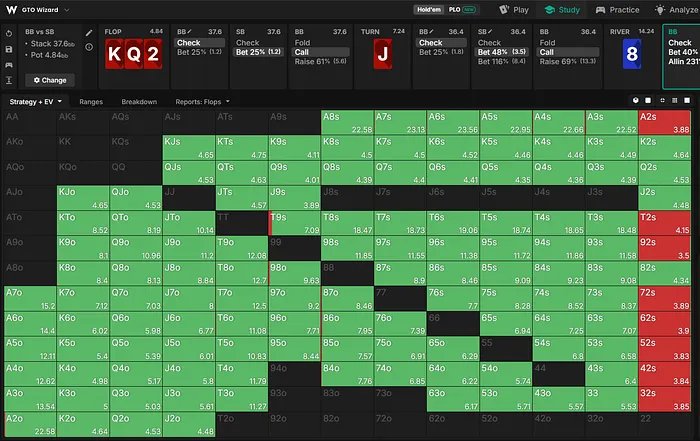
The solver recommends a pure check on this river card, with donk-betting occurring at less than a 1% frequency overall.
Schneider bets 3,875,000 on the river with 9♠7♣. GTO Approved ✅.
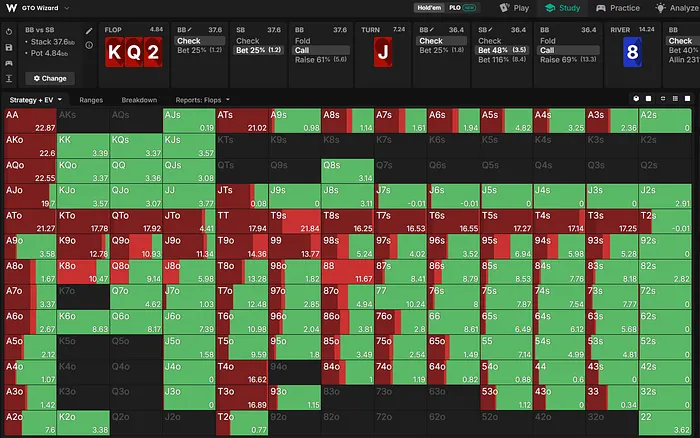
Recommended Strategy and EV for 97o:
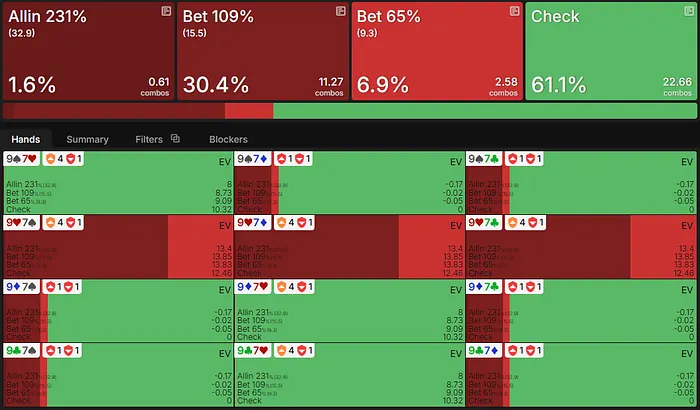
Schneider does a great job of selecting the near-optimal river sizing here with the 109% bet. 9♠7♣ is also mixed into this sizing at low frequency, although checking back still loses less EV overall with this combo.
‘No Made Hands’ in the SB Range:
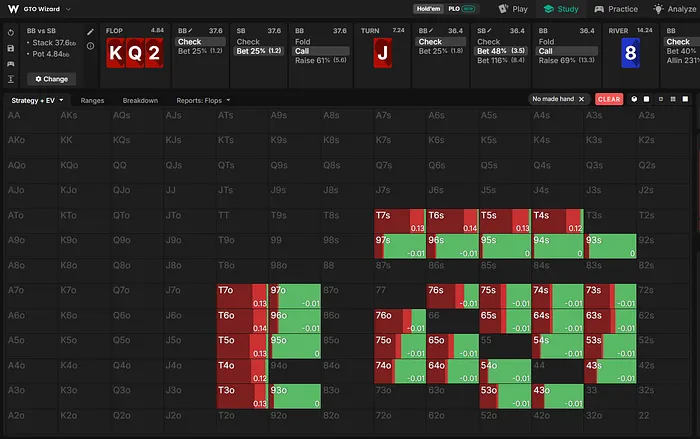
Once we highlight the hands the solver chooses to bluff in this spot, you can see why 97o is still used as a bluff at low frequency. Many of the weaker hands are already bluffing on the turn, meaning some 97o combos are needed as river bluffs to properly balance the value range.
So although there are technically better bluff candidates available on this river, the solver still likes bluffing 97o at some low frequency.
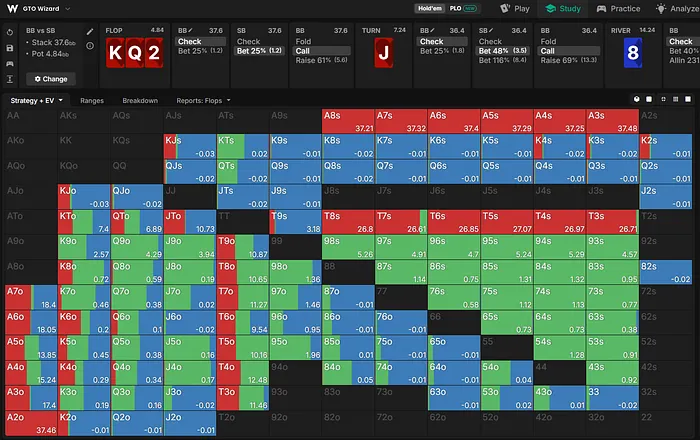
Neves calls the 3,875,000 river bet with Q♣6♥. GTO Approved ✅.
Recommended Strategy and EV for Q6o:
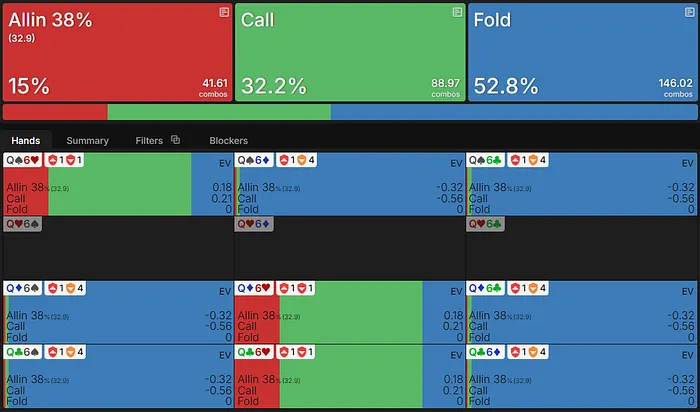
Neves makes the GTO-approved call on the river with Q♣6♥. Let’s now take a look at whether there are any flushes in the BB’s range that the solver actually recommends folding vs this sizing.
Flushes in the BB’s Range on the river:
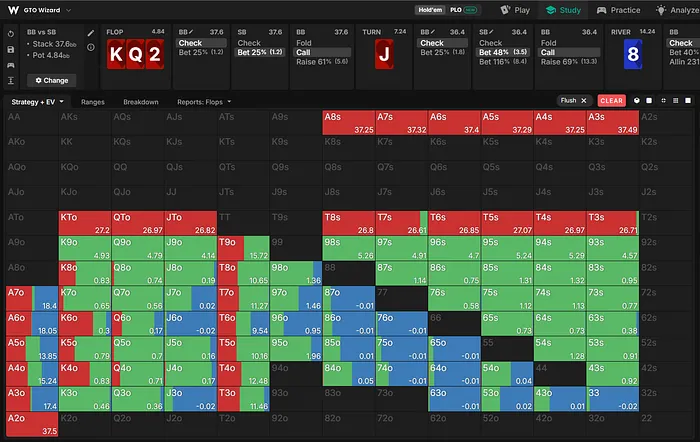
You can see that the hands highlighted in blue are folds. This means that vs this bet size, the solver starts folding the weaker flush combos from the bottom of range.
Key Takeaway:
- The SB holds a major EV, equity, and EQR advantage on the flop, allowing for a very high-frequency c-bet strategy.
- Once the turn completes more straights and flushes, the EV and equity shift heavily towards the BB, allowing donk leads to be introduced.
- The SB should then adopt a polarised betting strategy on the turn, mostly using large geometric sizings.
- Although 97o can bluff at low frequency, there are many better bluff candidates available, meaning overbluffing this hand would make the range easier to exploit.
- Q♣6♥ is a GTO-approved bluff-catcher on the river, although the solver does begin folding the weakest flushes vs the large river sizing.