
 button in Safari
PokerNews is excited ahead of the World Series of Poker. As the primary source of information and news for the WSOP, PokerNews strives to provide the audience with a constant flow of up-to-date content including live reporting, interviews, videos, photos, podcasts, and so much more.

World Series of Poker - WSOP
| Finished Events | Winner | Winning Hand | Prize | Runner-up | Losing Hand |
|---|---|---|---|---|---|

|
q♥10♥
|
$50,000 | MinhxDynasty | a♣8♠ | |

|
k♠6♦
|
$10,000,000 | Lauri Saaskilahti | a♠7♦ |
What is the World Series of Poker (WSOP)?
The World Series of Poker (WSOP) is a live poker festival held every year in Las Vegas. The first WSOP took place in 1970, and it continues to attract some of the best poker players in the world.
It remains one of the largest and most popular poker events in the world, attracting recreational players and poker pros alike.

When is the World Series of Poker (WSOP) 2026?
The 2026 World Series of Poker will run from Tuesday, May 26, through Wednesday, July 15, 2026. The full schedule released in February, showing 100 bracelet events with buy-ins ranging from $300 to $250,000.
PokerNews and the World Series of Poker
PokerNews has attended every World Series of Poker since 2007, and is proud to serve as the official live coverage partner of the WSOP, including Main Event coverage.
Each year, a dedicated team of live reporters, editors, presenters, videographers and photographers help make PokerNews the place to be when it comes to staying up-to-date on the World Series.
Chad Holloway, Mike Holtz and Ben Ludlow broke down the 2026 WSOP schedule in a special episode of the PokerNews Podcast.
History of the World Series of Poker Main Event
The first World Series took place in 1970 and featured no tournaments at all. A group of players gathered to play a selection of cash games including draw and seven card stud at Binion’s Horseshoe Casino, and after a week-and-a-half they voted Johnny Moss the “Best All Around Player” and awarded him a silver cup.
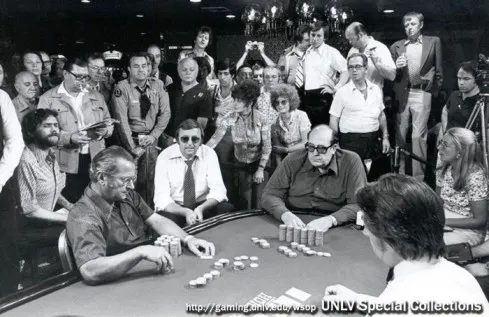
The following year, the tournament saw its first buy-in of $5,000 and this was increased to $10,000 in 1972. The 70s featured some of the most iconic names in World Series of Poker history, with Moss and Doyle Brunson winning five Main Events between them.
The start of the 1980s was heralded by back-to-back wins for Stu Ungar and the following year, the field surpassed 100 for the first time. The end of the decade saw another back-to-back winner, with Johnny Chan winning in both 1987 and 1988.
Outside of the Main Event, the WSOP schedule would also continue to grow, with 15 events scheduled in 1990. That year saw the first non-American win the Main Event as Mansour Matloubi triumphed, and 1991 saw the first prize reach $1,000,000 for the first time.
More famous players added their names to WSOP history, as Dan Harrington, Huck Seed and Scotty Nguyen all won Main Events. Barbara Enright became the only woman to make the Main Event final table with her fifth-place finish in 1995, until Leo Margets achieved the same feat in 2025 where she finished seventh.
There was also still time for another legend to write himself into the record books. Stu Ungar was 44 in 1997, but won a record-equalling World Series Main Event only one year before his death.
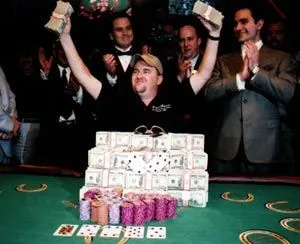
No decade shook up the WSOP like the 2000s. Chris Moneymaker’s fairytale triumph in 2003 over a field of 839 was the catalyst that saw the field balloon to 8,773 just three years later as Jamie Gold won $12,000,000.
In 2008, the WSOP introduced the November Nine where the Main Event plays down to a final table of nine in July, before resuming in November.
In 2015, the WSOP awarded their first online poker gold bracelet, with Anthony ‘casedismised’ Spinella winning the inaugural event. This was the first time poker players were able to win a WSOP bracelet online, with the final six playing down at the Rio to crown the winner.
The November Nine concept continued until 2016, by which point the Main Event was continuing to attract over 6,000 entries. However, from 2017 entries in the Main Event increased year-on-year, with the 8,569 players in the 2019 WSOP Main Event the second-highest ever, just short of the record of 8,773 set in 2006.
Following the cancellation of the 2020 WSOP in Las Vegas, the WSOP Main Event went online for the first time, crowning Damian Salas the winner of a hybrid online-live 2020 WSOP Main Event, with the heads-up taking place in Las Vegas.
When the World Series of Poker returned in 2021, it was Germany's Koray Aldemir who won the 2021 World Series of Poker Main Event taking home $8,000,000. He topped a field of 6,550 players to win after battling it out at the final table at the Rio All Suite Hotel & Casino.
The 2022 WSOP was the first to be held on the Las Vegas Strip at Bally’s and Paris Las Vegas Hotel & Casino, and coincided with a period of immense growth in fields — especially in the Main Event.
The 2022 Main Event was the second-largest in history, won by Norway's Espen Jorstad.
The record was eventually broken the following year as Daniel Weinman topped a field of 10,043 players to win the 2023 WSOP Main Event, however that record lasted just a year as Jonathan Tamayo defeated 10,112 players in 2024 to set the new mark.
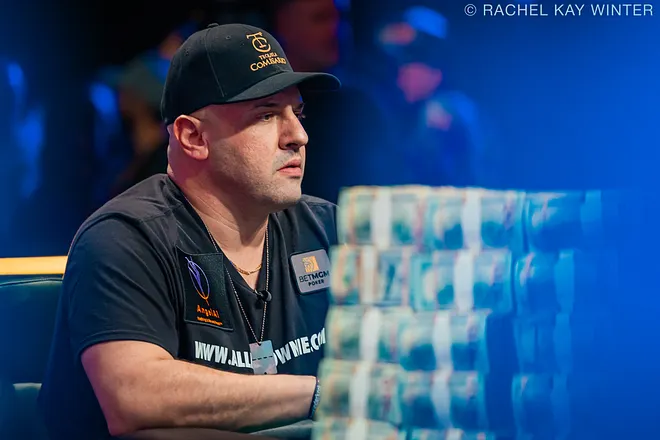
In 2025, the streak of record fields didn't continue. However, the story lay elsewhere as Michael Mizrachi steamrolled his way to the Main Event title, the same year he won the Poker Players Championship, earning instant induction into the Poker Hall of Fame.
FAQs
Where is the WSOP held?
The World Series of Poker is held ever summer at the Horseshoe and Paris Las Vegas Hotel & Casino. From 2004-2021, the WSOP was held at the Rio All-Suite Hotel & Casino. Before that, from 1970-2004, the WSOP took place at Binion’s Horseshoe.
Where is the WSOP Schedule 2026?
Click here for the 2026 WSOP schedule.
How much does it cost to enter the World Series of Poker?
Buy-ins at the World Series of Poker range from hundreds to hundreds of thousands of dollars. In 2026, the lowest buy-in event was $300 (The Gladiators of Poker) and the biggest buy-in event was $250,000 (Super High Roller).
The biggest buy-in event in WSOP history is the $1,000,000 Big One for One Drop, held in 2012, 2014 and 2018.
How many players are there at the WSOP?
The WSOP regularly attracts more than 200,000 entries over the course of the festival. In 2024, the festival saw 229,559 entrants from more than 100 countries with a record-breaking $437.4 million total prize pool. The Main Event itself usually sees over 9,000 entries. In 2024, the WSOP Main Event saw a record 10,112 players.
What is a WSOP bracelet?
Each winner of a WSOP event is awarded a gold bracelet, considered the highest achievement any poker player can achieve.
Phil Hellmuth has the most bracelets of all-time, having won 17 between 1989 and 2024. Phil Ivey has 11 bracelet wins, with Doyle Brunson, Johnny Chan, and Erik Seidel (10) the only players with double-digit WSOP bracelet wins.
WSOP Main Event Champions 1970-2025
Here is a list of the past WSOP Main Event champions:
| YEAR | ENTRIES | CHAMPION | COUNTRY | PRIZE |
|---|---|---|---|---|
| 2026 | 9,208 | TBD | $10,000,000 | |
| 2025 | 9,735 | Michael Mizrachi | United States | $10,000,000 |
| 2024 | 10,112 | Jonathan Tamayo | United States | $10,000,000 |
| 2023 | 10,043 | Daniel Weinman | United States | $12,100,000 |
| 2022 | 8,663 | Espen Jorstad | Norway | $10,000,000 |
| 2021 | 6,550 | Koray Aldemir | Germany | $8,000,000 |
| 2020 | 1,379 | Damian Salas | Argentina | $2,550,969 |
| 2019 | 8,569 | Hossein Ensan | Germany | $10,000,000 |
| 2018 | 7,874 | John Cynn | United States | $8,800,000 |
| 2017 | 7,221 | Scott Blumstein | United States | $8,150,000 |
| 2016 | 6,737 | Qui Nguyen | United States | $8,005,310 |
| 2015 | 6,420 | Joe McKeehen | United States | $7,683,346 |
| 2014 | 6,683 | Martin Jacobson | Sweden | $10,000,000 |
| 2013 | 6,352 | Ryan Riess | United States | $8,361,570 |
| 2012 | 6,598 | Greg Merson | United States | $8,531,853 |
| 2011 | 6,865 | Pius Heinz | Germany | $8,715,638 |
| 2010 | 7,319 | Jonathan Duhamel | Canada | $8,944,310 |
| 2009 | 6,494 | Joe Cada | United States | $8,547,042 |
| 2008 | 6,844 | Peter Eastgate | Denmark | $9,119,517 |
| 2007 | 6,358 | Jerry Yang | United States | $8,250,000 |
| 2006 | 8,773 | Jamie Gold | United States | $12,000,000 |
| 2005 | 5,619 | Joe Hachem | Australia | $7,500,000 |
| 2004 | 2,576 | Greg Raymer | United States | $5,000,000 |
| 2003 | 839 | Chris Moneymaker | United States | $2,500,000 |
| 2002 | 631 | Robert Varkonyi | United States | $2,000,000 |
| 2001 | 613 | Carlos Mortensen | Spain | $1,500,000 |
| 2000 | 512 | Chris Ferguson | United States | $1,500,000 |
| 1999 | 393 | Noel Furlong | Ireland | $1,000,000 |
| 1998 | 350 | Scotty Nguyen | Vietnam | $1,000,000 |
| 1997 | 312 | Stu Ungar | United States | $1,000,000 |
| 1996 | 295 | Huck Seed | United States | $1,000,000 |
| 1995 | 273 | Dan Harrington | United States | $1,000,000 |
| 1994 | 268 | Russ Hamilton | United States | $1,000,000 |
| 1993 | 220 | Jim Bechtel | United States | $1,000,000 |
| 1992 | 201 | Hamid Dastmalchi | Iran | $1,000,000 |
| 1991 | 215 | Brad Daugherty | United States | $1,000,000 |
| 1990 | 194 | Mansour Matloubi | Iran | $895,000 |
| 1989 | 178 | Phil Hellmuth | United States | $755,000 |
| 1988 | 167 | Johnny Chan | United States | $700,000 |
| 1987 | 152 | Johnny Chan | United States | $625,000 |
| 1986 | 141 | Berry Johnston | United States | $570,000 |
| 1985 | 140 | Bill Smith | United States | $700,000 |
| 1984 | 132 | Jack Keller | United States | $660,000 |
| 1983 | 108 | Tom McEvoy | United States | $540,000 |
| 1982 | 104 | Jack Straus | United States | $520,000 |
| 1981 | 75 | Stu Ungar | United States | $375,000 |
| 1980 | 73 | Stu Ungar | United States | $385,000 |
| 1979 | 54 | Hal Fowler | United States | $270,000 |
| 1978 | 42 | Bobby Baldwin | United States | $210,000 |
| 1977 | 34 | Doyle Brunson | United States | $340,000 |
| 1976 | 22 | Doyle Brunson | United States | $220,000 |
| 1975 | 21 | Brian Roberts | United States | $210,000 |
| 1974 | 16 | Johnny Moss | United States | $160,000 |
| 1973 | 13 | Walter Pearson | United States | $130,000 |
| 1972 | 8 | Thomas Preston | United States | $80,000 |
| 1971 | 6 | Johnny Moss | United States | $30,000 |
| 1970 | 7 | Johnny Moss | United States | N/A |
WSOP Asia-Pacific
In 2012, the World Series of Poker (WSOP) announced a second expansion effort with the creation of the World Series of Poker Asia-Pacific (APAC).
To date, there have only ever been two WSOP APAC festivals, in 2013 and 2014, both taking place at the Crown Casino in Melbourne, Australia.
| Year | Location | Entries | Champion | Country | Prize |
|---|---|---|---|---|---|
| 2013 | Melbourne, Australia | 405 | Daniel Negreanu | Canada | A$1,038,825 |
| 2014 | Melbourne, Australia | 329 | Scott Davies | United States | A$850,136 |
WSOP Circuit
The World Series of Poker Circuit (WSOPC) debuted in 2005. Instead of bracelets, the WSOP Circuit awards rings. Maurice Hawkins holds the record for most circuit rings with 25.
In 2015, the WSOP International Circuit was launched.
The WSOP Circuit began its 17th season in 2022 with stops in North Carolina, Los Angeles, Florida, Louisiana and Canada, culminating in the WSOP Tournament of Champions. This replaced the Global Casino Championship.
WSOP Europe
The WSOP Europe was the first expansion of the World Series of Poker, making its debut in 2007. The WSOP Europe is currently held every year at the Hilton in Prague, Czech Republic, having been held at King's Resort Rozvadov from 2017 to 2025.
WSOP Online
The very first WSOP online bracelet tournament was in 2015, with the $1,000 WSOP.com Online No-Limit Hold 'Em won by Anthony Spinella over a field of 905 for $197,743.
In 2020, the COVID-19 pandemic forced the postponement of the World Series of Poker for the first time in its history. In its place, a summer schedule of online bracelet events were establish, with separate schedules for WSOP.com and GGPoker bracelets.
2020 $5,000 WSOP Online Main Event Results
| Year | Entries | Champion | Country | Prize |
|---|---|---|---|---|
| 2020 | 5,802 | Stoyan Madanzhiev | Bulgaria | $3,904,686 |
WSOP Player of the Year 2004-2025
| Year | Name | Bracelet | Final Tables | Cashes | Tournament Earnings |
|---|---|---|---|---|---|
| 2025 | Shaun Deeb | 1 | 4 | 22 | $3,827,607 |
| 2024 | Scott Seiver | 3 | 5 | 17 | $1,449,736 |
| 2023 | Ian Matakis | 1 | 3 | 22 | $869,791 |
| 2022 | Dan Zack | 2 | 4 | 18 | $1,461,625 |
| 2021 | Josh Arieh | 2 | 4 | 11 | $802,377 |
| 2019 | Robert Campbell | 2 | 6 | 13 | $750,843 |
| 2018 | Shaun Deeb | 2 | 5 | 20 | $2,534,511 |
| 2017 | Chris Ferguson | 1 | 4 | 23 | $428,423 |
| 2016 | Jason Mercier | 2 | 4 | 11 | $960,424 |
| 2015 | Mike Gorodinsky | 1 | 3 | 8 | $1,766,796 |
| 2014 | George Danzer | 3 | 5 | 10 | $878,993 |
| 2013 | Daniel Negreanu | 2 | 4 | 10 | $2,214,304 |
| 2012 | Greg Merson | 2 | 2 | 4 | $9,755,180 |
| 2011 | Ben Lamb | 1 | 4 | 5 | $5,352,970 |
| 2010 | Frank Kassela | 2 | 3 | 6 | $1,255,314 |
| 2009 | Jeff Lisandro | 3 | 4 | 6 | $807,521 |
| 2008 | Erick Lindgren | 1 | 3 | 5 | $1,348,528 |
| 2007 | Tom Schneider | 2 | 3 | 3 | $416,829 |
| 2006 | Jeff Madsen | 2 | 4 | 4 | $1,467,852 |
| 2005 | Allen Cunningham | 1 | 4 | 5 | $1,006,935 |
| 2004 | Daniel Negreanu | 1 | 5 | 6 | $346,280 |
WSOP Free Online Game
The World Series of Poker free online poker game is available for players around the world. Find out the best way to get free chips by clicking here!